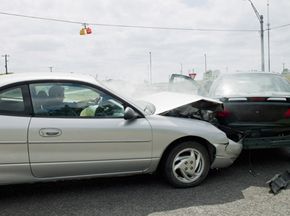
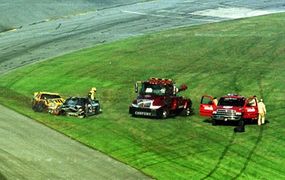
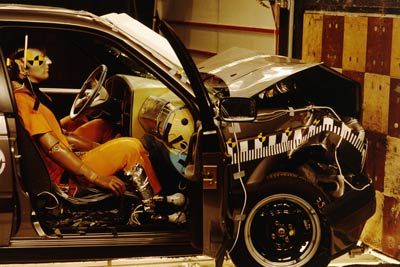
Crumple zones are designed to absorb and redistribute the force of a collision. See more car safety pictures.
Yellow Dog Productions/Getty Images
Auto safety has come a long way in the last few decades, and one of the most effective innovations is the crumple zone. Also known as a crush zone, crumple zones are areas of a vehicle that are designed to deform and crumple in a collision. This absorbs some of the energy of the impact, preventing it from being transmitted to the occupants.
Of course, keeping people safe in auto accidents isn't as simple as making the whole vehicle crumple. Engineers have to consider many factors in designing safer cars, including vehicle size and weight, frame stiffness and the stresses the car is likely to be subjected to in a crash. For example, race cars experience far more severe impacts than street cars, and SUVs often crash with more force than small cars.
Advertisement
We're going to find out how crumple zones redistribute the forces involved in a crash, what crumple zones are made out of and learn about a few other advanced safety systems that are being tested right now. We'll also find out how crumple zones have been incorporated into race cars, and why a number of racing fatalities could have been prevented if the sport had adopted these safety features sooner. We'll even take a look at crumple zones designed to absorb the massive impact of a train collision.
To find out the forces involved in a collision, and to learn how a well designed crumple zone can minimize occupant injury, read the next page.
What's In a Crumple Zone?
The specifics of crumple zone designs are usually proprietary information that auto makers are reluctant to divulge. They can vary widely, depending on the size and weight of the vehicle. Designers have to strike a balance between too much impact resistance and too little impact resistance. Simple designs can include frame segments built to bend in certain areas or collapse onto themselves. More advanced designs can utilize a variety of metals and other materials carefully engineered to absorb as much kinetic energy as possible. High-performance cars often use a honeycomb design, which offers stiffness under normal conditions, but can collapse and crumple in a crash.
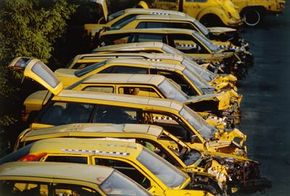
These cars have been put to the collision test at an automobile safety research facility in Wolfsburg, Germany. Notice how the crumple zones appear to have absorbed most of the impact.
Peter Ginter/Getty Images
Whenever a car is involved in a crash, intense kinetic forces are at work. A given amount of force is present during any crash. The actual numbers vary based on the speed and mass of the car and the speed and mass of whatever it hits. Physicists measure this force as acceleration -- even when moving from a high speed to a lower speed, any change in speed over time is scientifically referred to as acceleration. To avoid confusion, we will refer to crash acceleration as deceleration.
Crumple zones accomplish two safety goals. They reduce the initial force of the crash, and they redistribute the force before it reaches the vehicle's occupants.
Advertisement
The best way to reduce the initial force in a crash with a given amount of mass and speed is to slow down the deceleration. You've seen this effect for yourself if you've had to slam on your brakes for any reason. The forces you experience in an emergency stop are much greater than when you gradually slow down for a stoplight. In a collision, slowing down the deceleration by even a few tenths of a second can create a drastic reduction in the force involved. Force is a simple equation:
Force = mass * acceleration
Cutting the deceleration in half also cuts the force in half. Therefore, changing the deceleration time from .2 seconds to .8 seconds will result in a 75 percent reduction in total force.
Crumple zones accomplish this by creating a buffer zone around the perimeter of the car. Certain parts of a car are inherently rigid and resistant to deforming, such as the passenger compartment and the engine. If those rigid parts hit something, they will decelerate very quickly, resulting in a lot of force. Surrounding those parts with crumple zones allows the less rigid materials to take the initial impact. The car begins decelerating as soon as the crumple zone starts crumpling, extending the deceleration over a few extra tenths of a second.
Crumple zones also help redistribute the force of impact. All of the force has to go somewhere -- the goal is to send it away from the occupants. Think of the force involved in a crash as a force budget. Everything that happens to the car during an impact and every person inside of the car at the time of the impact spends some of the force. If the car hits a non-stationary object, like a parked car, then some force is transferred to that object. If the car hits something with a glancing blow and spins or rolls, much of the force is spent on the spinning and rolling. If parts of the car fly off, even more force is spent. Most importantly, damage to the car itself spends force. Bending parts of the frame, smashing body panels, shattering glass -- all of these actions require energy. Think of how much force is needed to bend the steel frame of a car. That amount of force is spent on bending the frame, so it is never transmitted to the occupants.
Crumple zones are based on that concept. Parts of the car are built with special structures inside them that are designed to be damaged, crumpled, crushed and broken. We'll explain the structures themselves shortly, but the fundamental idea is that it takes force to damage them. Crumple zones spend as much force as possible so that other parts of the car as well as the occupants don't suffer the effects.
So why not make the entire car one giant crumple zone? And if you need space for a crumple zone to absorb impact, how do you build a compact car with crumple zones? We'll explain in the next section.
The Inventor of the Crumple Zone
Béla Barényi was an engineer and inventor who spent most of his career working for Daimler-Benz. His name appears on more than 2,500 patents. One of those patents, issued in 1952, explains how a car could be designed with areas at the front and rear built to deform and absorb kinetic energy in an impact. He put the concept to use in 1959 on the Mercedes-Benz W111 Fintail, the first car to use crumple zones [source: German Patent and Trade Mark Office].
Advertisement
Design Compromises
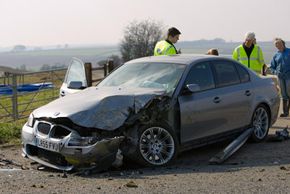
This BMW has obviously suffered a severe impact and appears extensively damaged. However, none of the damage was to the passenger compartment -- the front crumple zone did its job.
Tim Graham/Getty Images
Absorbing and redirecting impact is great, but it isn't the only safety issue auto designers have to worry about. The passenger compartment of the car has to resist being penetrated by outside objects or other parts of the car, and it has to hold together so the occupants aren't thrown out. You can't make an entire car a crumple zone because you don't want the people inside it to crumple also. That's why cars are designed with a rigid, strong frame enclosing the occupants, with crumple zones in the front and rear. Force reduction and redistribution is accomplished inside the passenger compartment through the
There are some parts of cars that simply can't crumple. The engine is the main offender -- in most vehicles, the engine is a large, heavy block of steel. No crumpling there. The same holds true for vehicles with aluminum engine blocks. Sometimes, cars have to be redesigned to move the engine farther back in the frame to accommodate a larger crumple zone. However, this can cause problems as well - if the engine is pushed back into the passenger compartment as a result of impact, it can cause injuries.
Fuel tanks and battery packs, in electric or hybrid vehicles, also need to be protected from impact to prevent fires or exposure to toxic chemicals. They can be designed so that a section of frame protects the tank, but that part of the frame can bend away from the impact. For example, if a car is rear-ended, the frame bends up, lifting the gas tank out of the way and absorbing some impact. Newer cars have systems that cut off fuel supply to the engine during a crash, and the Tesla Roadster, a high performance electric car, has a safety system that shuts off the battery packs and drains all electrical energy from the cables running throughout the car when it senses an emergency [source: Tesla Motors].
Of course, it's easy to build crumple zones into a large vehicle with plenty of room to crumple before the passenger compartment is impacted. Designing crumple zones into small vehicles takes some creativity. A good example is the smart fortwo, an extremely small
and efficient vehicle. The driver and passenger are enclosed in the tridion safety cell, a steel framework with excellent rigidity for its size. The geometry is designed to distribute impacts across the entire frame. At the front and rear of the smart fortwo are what smart calls crash boxes. These are small steel frameworks that collapse and crumple to absorb impacts. Because the crash boxes are so small, other impact-absorbing features have been used to supplement them. For example, the transmission can act as a shock absorber in the event of a front-end collision. The short wheelbase of the fortwo means almost any impact will involve the tires, wheels and suspension. These components have been designed to deform, break away or rebound, helping absorb even more kinetic energy during an impact [source: smart USA].
Next, we'll see how crumple zones are helping to keep your favorite race car driver alive.
Crumple Zones on Trains
We've talked about the incredible kinetic force at work when a car crashes, but imagine the force involved when two trains collide. Because of the immense weight of a train, a collision can create forces dozens or even hundreds of times greater than those in a car crash. Yet crumple zones can be used even under these extreme circumstances. Using 3D computer simulations, engineers can build a crumple zone that will deform steadily and evenly during impact, absorbing the maximum force possible. The crumple zones are then placed on both ends of every car in a passenger train. In the event of a collision, the chain reaction of cars slamming into each other distributes force through all of the crumple zones in the train. That could absorb enough of the impact forces to prevent injuries to passengers [source: Machine Design].
Advertisement
Preventing Fatalities in Auto Racing
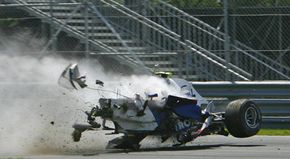
Some crashes, such as this one involving Formula One driver Robert Kubica, look spectacular and horrifying. In fact, the destruction of the car likely saved Kubica's life.
DAVID BOILY/AFP/Getty Images
Even if you're not a fan of auto racing, you've probably seen images of spectacular crashes in which cars tumble down the track, flinging parts in every direction as the car is literally destroyed. Yet miraculously, the driver climbs out of the twisted wreckage and walks away uninjured. While these crashes look horrifying, all that spectacular destruction is spending kinetic energy. It's probably not a fun ride for the driver, but the car is doing exactly what it was designed to do in this situation -- protect the person in the driver's seat.
There have also been rare occasions when a race car has struck a solid object at high speed, such as NASCAR driver Michael Waltrip's crash at Bristol in 1990. He hit the blunt end of a concrete wall at racing speeds, and the car stopped very suddenly. The impact generated enormous forces, yet Waltrip was unhurt. The reason is evident in looking at the remains of his car on that day. It was completely and utterly destroyed. All that force was spent on the destruction of the car. Clearly, the incident went well beyond the abilities of any crumple zone, and in fact it was simply a matter of luck that nothing intruded into the driver's compartment to injure Waltrip. Force redistribution saved his life.
Advertisement
The aftermath of the crash that killed Dale Earnhardt, Sr. His car, the black #3, does not appear to be heavily damaged.
Robert Laberge/Allsport/Getty Images
There is an unfortunate counterpoint to the concept, however. From the 1980s to the early 2000s, there were numerous racing fatalities due to overly stiff chassis. Probably the most widely known incident is the death of Dale Earnhardt Sr. in the 2001 Daytona 500. The crash didn't initially appear to be severe, and the car didn't seem to suffer extensive damage; however, that was exactly the problem. A great deal of the force of impact was transferred directly to the driver, causing immediate and severe injuries. The fatal injury was a basilar skull fracture, an injury to the area where the skull and spinal cord connect. This injury is the cause of death in many auto racing accidents, and it occurs when the head snaps forward on impact while the body remains restrained by safety belts. While head and neck restraint devices have lowered the incidence of basilar skull fractures, reducing impact forces on the driver have played a major role as well.
Several other well-known drivers were killed during this period, as well as lesser-known drivers in NASCAR modified and late models classes racing at tracks throughout the United States. The reason behind the increase in fatal crashes was simply the pursuit of higher performance. Car designers and crews sought better handling by creating a more rigid chassis. This included adding components to the frame, using straight frame rails, and switching to steel tubes with thicker walls. Sure, they made the chassis more rigid, but when these inflexible cars hit a wall, there was no give. None of the force was absorbed by the car -- the driver took most of the impact.
Even before Earnhardt's death in 2001, race tracks were trying to find solutions to this problem. Tracks in the northeastern United States experimented with giant blocks of industrial Styrofoam lining the walls, a similar concept to the soft wall technology used on many superspeedways today. More importantly, the cars were changed. Thinner-gauge steel tubing is now used on certain portions of the chassis, and frame rails are given a bend or notch so they deform somewhat predictably on impact.
NASCAR's Car of Tomorrow, used in Sprint Cup racing, has foam and other impact absorbing material inserted into critical areas of the frame. Although auto racing will always be a dangerous sport, the use of less rigid chassis construction, soft wall technology and head and neck restraint systems have greatly reduced crash impact forces on drivers.
For more information about automotive safety devices, racing and other related topics, follow the links on the next page.
Safety Ride Down
Volvo has been developing another impact absorbing technology for use in small cars. The driver's seat is mounted to what is basically a sled on a rail, with shock absorbers in front of it. In an impact, the whole "sled" (seat and driver included) slides forward up to 8 inches, and the shock absorbers literally do their job, absorbing the shock of the impact. At the same time, the steering wheel and a section of the dash board slide forward to make room for the driver. Combined with a front crumple zone and possibly an airbag, this system could greatly reduce the forces acting on the driver in a front-end collision [source: Ford Motor Company].
Advertisement
Crumple Zone FAQ
How do crumple zones work?
Crumples zones aim to create a buffer around the area containing the driver and passengers in a vehicle, called the “safety cell.†The most basic designs include segments that bend, deform or collapse, absorbing energy during impact.
Why do vehicles need crumple zones?
Crumple zones help accomplish two vehicle safety goals. Firstly, they reduce the overall initial kinetic force caused by the crash. Secondly, they help redistribute the kinetic force before it harms the occupants inside the cabin.
Do old cars have crumple zones?
Unfortunately, most cars manufactured before the 60s do not. In fact, the first car to be designed with crumple zones was the Mercedes Benz 220 sedan in 1959. As a result, older cars tend to be quite dangerous in a crash.
Do crumple zones save lives?
Crumple zones, coupled with other car safety features, are responsible for saving hundreds of thousands of lives each year.
How are car safety features tested?
Most vehicles’ safety features are tested with the help of speed sensors, dummy passengers, vehicle sensors and interior video footage. Using all of the above, car companies evaluate their vehicle safety systems by running them through multiple tests in a controlled environment.
Akins, Ellen. "Safety in Small Cars: Volvo's Safety Ride Down Concept." Ford Motor Company. Jan. 12, 2005. (Aug. 1, 2008) http://media.ford.com/newsroom/feature_display.cfm?release=19713
Bolles, Bob. "Stock Car Safety - A Refresher Course." Circle Track. (Aug. 1, 2008) http://www.circletrack.com/safety/ctrp_0805_stock_car_safety/index.html
Machine Design. "Will the crash zone crumple? FEA tells." Nov. 6, 2003. (July 31, 2008) http://machinedesign.com/ContentItem/62566/WillthecrashzonecrumpleFEAtells.aspx
Material Worlds. "The effects of crumple zones: crashes into wall." (Aug. 1, 2008) http://www.materialworlds.com/sims/Crash/
Smart USA. "A hard shell with a soft interior." (Aug. 1, 2008) http://www.smartusa.com/smart-fortwo-safety-design.aspx
Tesla Motors. "Safety." (July 31, 2008) http://www.teslamotors.com/design/safety.php
The German Patent and Trade Mark Office. "Béla Barényi." (July 31, 2008) http://www.dpma.de/ponline/erfindergalerie/e_bio_barenyi.html
Cite This!
Please copy/paste the following text to properly cite this HowStuffWorks.com article: