Introduction to How the BMW H2R Works
|
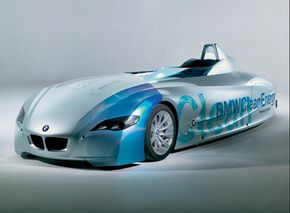
It's sleek. It's aerodynamic. It's environmentally friendly. BMW's H2R (Hydrogen Record Car) is powered entirely by the clean-burning process of liquid-hydrogen combustion, and this next-generation racecar has already set speed records in its class.
So why is BMW expending copious amounts of time, money and energy to spearhead the production of hydrogen-powered vehicles? According to the BMW Web site, the company's long-term goal is to eventually replace the cars that run on atmosphere-polluting fossil fuels with vehicles that use clean-burning, liquid-hydrogen fuel. In this article, you'll learn about the H2R and its unique, hydrogen combustion engine.
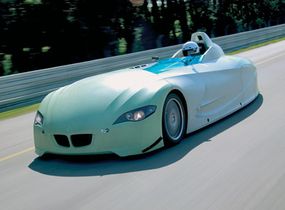
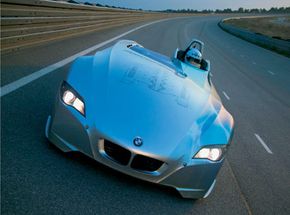
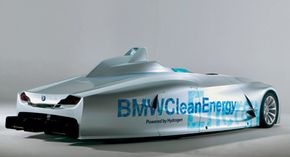
With its smooth lines, aerodynamic design and gleaming silver body, the H2R appears to have sprung from the pages of a science fiction novel: It looks like a cross between a thoroughbred sports car, a sleek zeppelin and a futuristic rocket ship.
With a lightweight aluminum chassis, a monocoque aluminum space frame and an outer skin composed of carbon-fiber-reinforced plastic, the H2R is designed for high speed and maximum stability under extreme driving conditions. Tires measuring 245/40/19 ensure maximum road contact.
Alternative Fuel Vehicle Image Gallery

Photo courtesy BMW AG, Munich, Germany
Hydrogen Record Car. See more alternative fuel vehicle pictures.
![]() Photo courtesy BMW AG, Munich, Germany |
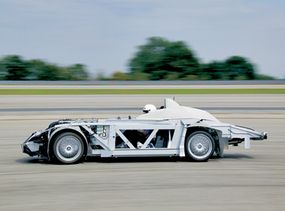
The H2R's suspension system comprises a double-wishbone, spring-strut front axle, rack-and-pinion steering, forged-aluminum track control arms (with two ball joints for superior wheel guidance and directional stability), a tie bar and an anti-roll bar. The result is a stable skeleton that results in a smooth and vibrationless driving experience.
![]() Photo courtesy BMW AG, Munich, Germany H2R skeleton on the race track |
The H2R's race-car-like appearance and high-speed performance belie its extreme environmental friendliness. Conceived and developed in only 10 months, the H2R features a 6.0-liter, V-12 hydrogen-powered engine. Whereas other carmakers have gone the route of hydrogen fuel cells, BMW has opted for a more traditional-style engine that utilizes a nontraditional fuel. The hydrogen combustion engine operates on the same principle as other internal combustion engines except that liquid hydrogen is used as the fuel source rather than gasoline or diesel oil.
|
A Hydrogen-Fueled Car
The use of hydrogen as a fuel in motor vehicles offers several advantages over traditional fossil fuels:
- There exists an unlimited supply of hydrogen -- hydrogen is the most abundant element in the universe and the tenth most abundant element on Earth.
- Hydrogen is renewable -- When hydrogen reacts with oxygen, the by-product is water (H2O), which can then be hydrolyzed (broken up into its component parts) to yield more hydrogen.
- Hydrogen is clean-burning -- Unlike the burning of fossil fuels, hydrogen combustion does not produce any destructive environmental pollutants.
- Hydrogen weighs less and generates more power than hydrocarbon-based fuels.
- Hydrogen burns faster (and at a lower temperature) than conventional gasoline.
![]() Photo courtesy BMW AG, Munich, Germany The H2R's hydrogen combustion engine produces record speeds on clean-burning fuel. |
But carmakers and the general public have yet to declare hydrogen power safe for consumer use. To learn more about the use of hydrogen as a fuel source and why you still can't buy a hydrogen car, see How the Hydrogen Economy Works.
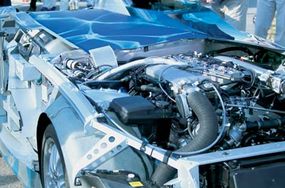
In addition to running on hydrogen instead of fossil fuels, the internal components of the H2R's engine are unique in two significant ways: the hydrogen-injection valve and the materials used for the combustion chambers. In the H2R, the injection valves have been integrated into the intake manifolds, as opposed to injecting fuel directly into the combustion chambers.
![]() Photo courtesy BMW AG, Munich, Germany |
![]() Photo courtesy BMW AG, Munich, Germany Hydrogen combustion engine in the H2R |
Liquid hydrogen does not lubricate the way gasoline does, so the H2R uses altered valve seat rings that compensate for this. To maximize power and efficiency, hydrogen is injected into the intake manifold as late as possible, so the injection valves have been redesigned, as well.
In the next section, we'll look at the H2R fuel tank and how it gets refilled.
The H2R Fuel Tank
Pure hydrogen is highly flammable and produces a great deal of energy when it reacts with oxygen, so safety is of primary importance in the design of any hydrogen-powered vehicle. The H2R's fuel tank is vacuum-insulated and double-walled, and it's equipped with three active safety valves.
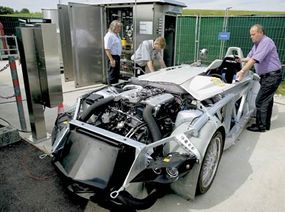
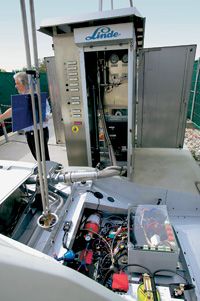
![]() Photo courtesy BMW AG, Munich, Germany Refueling the H2R |
To prevent possible leaks in the jacket around the fuel tank, which helps maintain the liquid hydrogen at a sufficiently low temperature (hydrogen takes its liquid form at -423F/-253C), the H2R features a double-redundant safety system: If the pressure within the tank ever exceeds 5 bar, two additional safety valves open up immediately. As an additional safety precaution, the combustion chambers are cooled by air before the hydrogen/air mixture flows into the cylinders to ensure that it won't ignite in an uncontrolled manner.
Refueling the H2R
Aside from the notable scarcity of hydrogen filling stations, refueling a hydrogen-powered vehicle requires no more effort than refueling a gasoline-powered one.
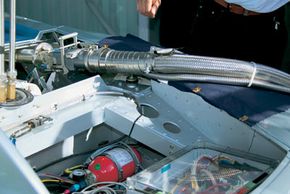
Hydrogen is added to the H2R's tank at a mobile hydrogen filling station through a manual tank coupling. Because of an interesting safety setup, it is impossible for hydrogen gas to leak into the air during the refueling process. In a liquid-hydrogen-powered BMW, the hydrogen left in the tank has returned to a gaseous state by the time the driver needs more fuel. This gaseous hydrogen exerts a higher pressure inside the tank. At the refueling station, when super-cold liquid hydrogen is pumped into the tank, the gaseous hydrogen already there condenses. The condensation of the gaseous hydrogen reduces the partial pressure inside the tank, so no hydrogen escapes while the tank is being filled.
In the next section, we'll see how the H2R engine turns hydrogen into energy.
|
In 1979, BMW developed the 520, a prototype vehicle featuring an engine that ran on either hydrogen or gasoline. Building on the potential of the 520, BMW produced and road tested three generations of hydrogen-powered cars from 1984 to 1996 and in 2000 introduced the 5.0-liter V-12 750hL, the company's fifth-generation hydrogen car. In 2001, BMW produced its sixth-generation hydrogen concept car, the 4.4-liter V-8 745h. It had two fuel tanks -- one for hydrogen and one for gasoline. When running on hydrogen, the 745h generated 182 horsepower, reached 62 miles per hour (100 kph) in 9.9 seconds and had a top speed of 134 mph (216 kph).
In 2004, BMW unveiled the H2R hydrogen-powered concept racecar, which went on to set nine speed records for hydrogen-combustion vehicles at the Miramas Proving Grounds in France. |
Hydrogen Energy in the H2R Engine
![]() Photo courtesy BMW AG, Munich, Germany |
As you can see, the only by-product of this reaction is water, which makes the combustion of liquid hydrogen a clean-burning alternative to the combustion of fossil fuels. Unfortunately, as hydrogen does not occur naturally in its pure state, an initial input of energy is required to separate pure hydrogen from other naturally occurring compounds. Essentially, we need to use "dirty" energy to produce "clean" energy. The BMW Group is researching ways to generate the initial energy input in environmentally friendly ways, such as through wind, solar or hydroelectric power.
The use of liquid hydrogen as a fuel source is not a new concept. The aerospace industry already uses liquid hydrogen in rockets and spacecraft, and liquid hydrogen is being considered for use in airplanes because of its low density. Hydrocarbon-based fuels are very heavy; an equal volume of liquid hydrogen weighs less and produces nearly three times more power than gasoline.
To learn more about the science of hydrogen as a fuel source, see How the Hydrogen Economy Works. For more information on the H2R and other concept cars, check out the links on the next page.
|
Because of the present scarcity of hydrogen refueling stations, the H7 will feature a combustion engine that can run on either liquid hydrogen or gasoline. BMW's Double-VANOS and Valvetronic engine technologies will allow the engine to adjust to burning hydrogen/air or gasoline/air fuel mixtures. These sophisticated systems also help prevent nitrogen oxide (NOx) emissions in the combustion process. NOx emissions contribute to the formation of ozone and acid rain. |
Lots More Information
Related HowStuffWorks Articles
- Quiz Corner: Fuel Cell Quiz
- How the Hydrogen Economy Works
- How Fuel Cells Work
- How Fuel Processors Work
- How NASCAR Race Cars Work
- How GM's Hy-wire Works
- How the Volvo 'Your Concept Car' Works
- How the Toyota MTRC Works
- How the Toyota PM Works
- EPA Fuel Economy Explained
- How Gasoline Works
- How a Hydrogen-Boosted Gasoline Engine Works
- How Air-Powered Cars Will Work
- How Hybrid Cars Work
- How Electric Cars Work
- How Biodiesel Works
- Why doesn't gasoline burn cleanly?
More Great Links
- BMW World: BMW Hydrogen Racer H2R
- Car Design Online: BMW H2R Hydrogen Car
- Hydrogen Forecast: BMW Hydrogen Powered H2R Debuts in Los Angeles
- RSportsCars.com: Record Run for BMW's Hydrogen Combustion Engine - 9/22/2004
Sources
- BMW Clean Energy
http://www.bmwtransact.com/hydrogen/
- BMW Hydrogen Racer H2R, BMW World.
http://www.bmwworld.com/hydrogen/h2r_racer.htm
- BMW H2R Hydrogen Car, Car Design Online.
http://www.cardesignonline.com/technology/bmw-h2r/index.php
- Hydrogen, Microsoft® Encarta® Online Encyclopedia, 2005.
http://encarta.msn.com/encyclopedia_761552913/Hydrogen.html