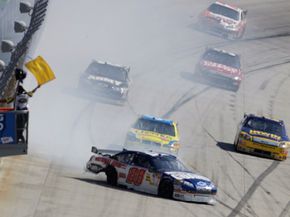
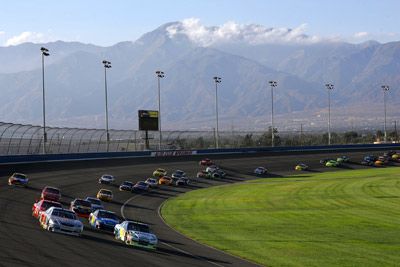
NASCAR's gentleman's agreement came about due to some complexities in racing rules, and some technological limitations that couldn't be overcome in the 1970s. For most of racing's history, a car's position on the track relative to the other cars was noted by human scorers, who watched for the car each time it crossed the start/finish line. Whenever a caution flag was thrown due to a crash or some other problem on the track, scoring was noted the next time the cars crossed the line following the throwing of the caution. That meant that it was in a driver's best interest to continue racing to the line, even though there may have been damaged cars on the track. This obviously created a safety concern, not only because of the chance of further collisions, but because safety crews had to wait for everyone to reach the line before they could approach an on-track accident scene. If a driver was injured in a crash, the delay could literally be a matter of life or death.
Racing to the line was vitally important for a car that was a lap down -- that is, the leader had passed him, so he had completed one fewer lap than the lead cars. Getting a lost lap back is crucial if a driver is to have any chance at a decent finish, so a lapped car near the front of the field would race hard to beat the leader to the line in order to get back on the lead lap.
Despite the inherent danger, NASCAR never changed the "race back to the line" rule. Several of the top drivers in the 1970s discussed the problem and came up with their own solution -- the gentleman's agreement. Richard Petty, Buddy Baker, Cale Yarbrough and David Pearson decided that everyone on the track would slow down and hold their positions whenever a caution was thrown [source: Cross]. Even though it was perfectly legal under NASCAR rules to pass other cars before they got to the start/finish line when a caution flag waved, they simply agreed not to. To accommodate lapped cars that were desperate to get back on the lead lap, the leaders would often slow down a little more to let one lapped car pass. Because these drivers were the most successful and respected NASCAR competitors of the era, this idea worked. "They all went off on their own and made an agreement: When the caution comes out, let's throw up our hand, and everybody should whoa up at the same time," said NASCAR President Mike Helton in a 2003 interview. "That's the gentleman's agreement. It's been working pretty well up until recent years."
Even though it was never written down in NASCAR's bylaws, the agreement remained in place for decades. Many years after the original gentlemen had retired from racing, drivers still didn't race to the line. But in 2003, something changed.
It started at the road course in Sonoma, Calif., when Robby Gordon passed Kevin Harvick during a full-course caution and went on to win the race. Gordon was lambasted by the other drivers in the press and in person, too, but he didn't break any official rules -- the win counted. Jimmy Johnson did it at Chicago when he passed Michael Waltrip, and at that point, the flood gates were opened. NASCAR realized they needed to step in. First, Helton issued warnings, asking the drivers to police themselves. That didn't happen. The reason is anyone's guess, though racing fans have plenty of theories. A popular idea is that the influx of corporate sponsorship money into NASCAR raised the stakes too high. The chance to gain a position or win a race was worth far too much money for drivers to pass up. Others claim that today's drivers lack the sense of racing tradition held by the previous generation. One thing is for sure -- if you want to stir up a heated debate among race fans, just mention the gentleman's agreement.
We may not be able to explain the cause, but we can tell you plenty about the effect of the agreement dissolving. NASCAR changed the rule, and they did it with the help of some new technology.