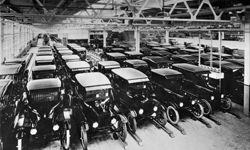
Most people know that the Ford Model T was the first truly affordable automobile. But do you know what kind of engine it had? The original Model T, released in 1908, packed a 2.9-liter four-cylinder engine with just 22 horsepower.
That's a tiny output for its size compared to the engines of today, but it sure beat the engine in what's considered to be the first automobile -- the 1885 Benz Patent Motorwagen. That car had a single-piston engine and generated just two-thirds of a single horsepower.
Advertisement
As you can see, automobile engines have been in constant evolution since the very beginning of motoring. Today they are more powerful, quieter, more durable, less polluting and more fuel-efficient than they have ever been before, thanks to constant advancements in engine design and technology.
Automotive engineers are constantly working on ways to improve the internal combustion engine and carry it into the future. How many other inventions do you know that have been continuously refined for more 150 years?
In this article, we'll take a look at 10 of the biggest and most significant engine improvements of all time. From fuel injection to hybrid motors, we'll take a look at where engines have been, and hopefully get some insight on where they're headed.