Hybrid cars are powered by combined fuel technologies. Learn how the Tesla Roadster or the Ford Escape hybrid technologies work and see what tax credits hybrid owners receive.
Please copy/paste the following text to properly cite this How Stuff Works article:
Appel, Tom. "How Plug-In Hybrid Cars Work." 29 January 2007. HowStuffWorks.com. <http://auto.howstuffworks.com/plug-in-hybrid-car.htm> 17 May 2008.
How Plug-In Hybrid Cars Work
by
Tom Appel
Inside This Article
1.
How Plug-In Hybrid Cars Work
2.
Because of their promise of improved fuel economy and reduced tailpipe emissions, vehicles employing hybrid drivetrain technology have drawn the attention of both the media and automotive consumers. There is no question that the technology works, typically providing fuel economy gains of 25-40 percent when compared to similar vehicles with conventional drivetrains.
Looking for ways to further improve fuel-economy, manufacturers are exploring enhancements to the basic hybrid concept. One promising avenue is the plug-in hybrid car. In simplest terms, plug-in hybrid cars incorporate traditional hybrid technology but benefit additionally from plug-in charging.
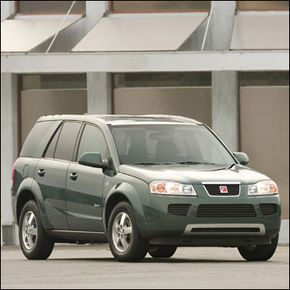
While several manufacturers claim to be working on the technology, General Motors' Saturn division has promised to introduce a plug-in hybrid version of its Vue SUV by 2009.
 In the next few years, Saturn plans on selling a plug-in version of its hybrid Vue Green Line midsize SUV. See more pictures of hybrid cars.
|
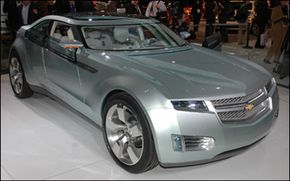
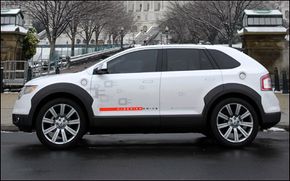
Expanding further on plug-in hybrid technology are two vehicles still in the concept stage. The Chevrolet Volt, which was introduced at the 2007 Detroit Auto Show, and the Ford Edge with HySeries Drive, also introduced in 2007, combine elements of plug-in charging with other potentially fuel-conserving technologies.
The following article will explain exactly how plug-in hybrid cars work. It also will examine some of the benefits of plug-in hybrid cars.
Plug-in Hybrid Cars Explained
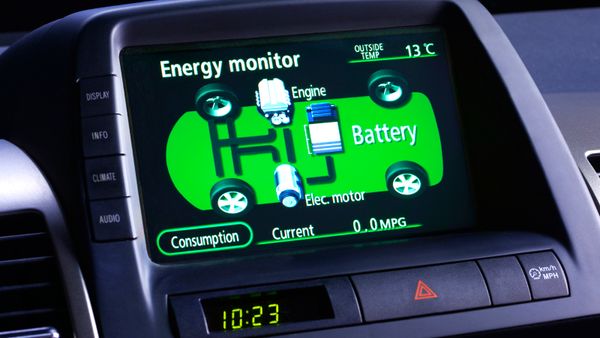
In summary, current hybrid vehicles have a gasoline engine that is assisted by an electric motor, which helps it save gas. A typical hybrid vehicle conserves fuel a few different ways. It recaptures energy lost through braking and decelerating. This recaptured energy is stored in a battery pack as electricity. As demand warrants, the stored electricity is used to power an electric motor that assists the vehicle's gasoline engine--usually during acceleration.
Many hybrid vehicles conserve additional fuel by incorporating a shut-off system that shuts down the engine during stops. In these cars and trucks the electric motor alone may propel the vehicle for short distances.
Hybrid vehicles available today are closed systems, and do not require plug-in charging. A plug-in hybrid vehicle expands on the hybrid concept by allowing for the battery pack to be even further recharged through plug-in charging. According to Saturn, the Vue plug-in hybrid will use a conventional electric cord that can be plugged into any 110-volt household wall outlet.
While a conventional hybrid vehicle may travel short distances in pure-electric mode, plug-in hybrids are designed to travel extended distances with little or no assistance from the gasoline engine. Even before the charge is depleted, the gasoline engine may be called on to provide additional power for recharging the battery, accelerating, passing, and merging.
While operating on the additional plug-in charge, a plug-in hybrid more-or-less works the opposite of a conventional hybrid, with the electric motor acting as the primary power source, and the gasoline engine providing supplemental motivation. In the case of the Vue, once the initial charge is depleted, it would operate just as conventional hybrid does, using the gas engine. The Chevrolet Volt Concept is designed to use only its electric motor, using gasoline only to aid in battery recharging, not driving.
To keep vehicle weight inline with a conventional hybrid, plug-in hybrids would have little or no additional battery capacity. As such, the distance a plug-in hybrid will travel in pure-electric mode will be relatively modest. Saturn has suggested distances as great 40 miles, and as low as 20; GM estimates that the Volt Concept could travel an average of 40 miles per charge.
In the next section, we'll detail the benefits of plug-in hybrid cars and take a sneak peak at pure plug-in concepts from Chevrolet and Ford.
For more information about hybrid cars, go to:
- Hybrids come in many shapes and sizes. Read Consumer Guide's new-car reviews of all the latest Ford, Honda, Lexus, Saturn, and Toyota hybrid cars and trucks.
- The Chevrolet Volt Concept was unveiled at the 2007 Detroit Auto Show. Click here for more Volt pictures and information.
- Volt wasn't the only alternative fuel-powered concept car unveiled at the 2007 Detroit Auto Show. Read about other fuel-cell, biofuel, and electric-powered vehicles on the stage.
Inside This Article
1.
How Plug-In Hybrid Cars Work
2.
-
VIDEO SELECTIONS
Fuel Economy Concerns for Motorists
Cars Can Take Pills for Better Gas Mileage
Iceland Pledges to Cut Emissions by Half
How the Chevy Tahoe Hybrid SUV Works
How Biofuels and Ethanol Works
Chevy Volt Engineer
Meet the Chevy Volt with E-Flex
Geneva Goes Green for Car Show
Energy Policy: The Need for Diversity
Ford, 2008, 5 Seats, 2.3L - 4 Cylinders
Honda, 2007, 5 Seats, 1.3L - 4 Cylinders
FREE CARFAX Record Check
Check for costly hidden problems before you buy.