In addition to a range of new, commercial vehicles, regular visitors to motor shows have come to expect something a little more exciting. There's an increasing demand for car manufacturers to unveil innovative, extravagant and sometimes way-out concept cars -- vehicles that are not quite ready for mass production but offer a thrilling insight into what might be rolling off the production line in the future. The unveiling of a new concept car allows manufacturers the opportunity to test out radical designs, body shapes, alternative power sources or new control systems, all without needing to worry about the costs or feasibility of mass production.
In this article, HowStuffWorks takes a look at Toyota's MTRC concept car, which the carmaker revealed at the 74th Geneva International Motor Show in March 2004. As well as examining its ultra-modern curves, we'll see how it really pushes the limits of current technology.
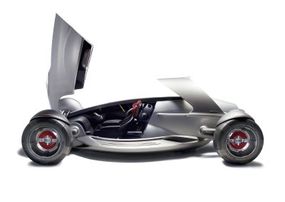
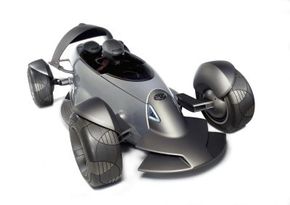
The MTRC features in-line seating. Rear view of the MTRC
Photo courtesy Toyota Photo courtesy Toyota Photo courtesy Toyota
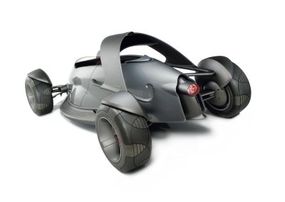
The MTRC features in-line seating. Rear view of the MTRC
Photo courtesy Toyota Photo courtesy Toyota Photo courtesy Toyota
The MTRC features in-line seating. Rear view of the MTRC
Photo courtesy Toyota Photo courtesy Toyota Photo courtesy Toyota
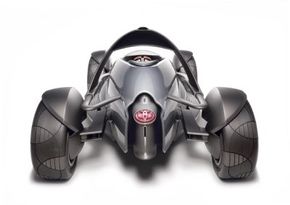
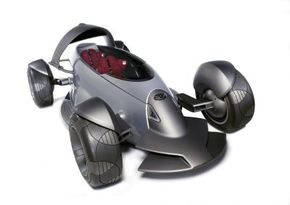
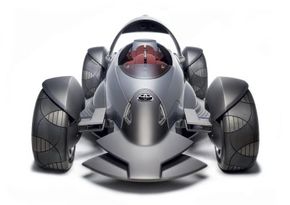
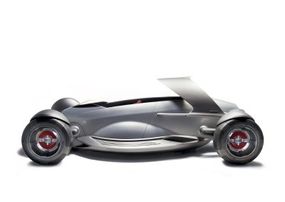
Over the years, Toyota has become renowned for producing futuristic and dramatic concept cars, and the designers at Toyota's European Design Studio, ED2, worked to ensure that the Motor Triathlon Race Car (MTRC) continues this trend. Its sleek, pod-like body conjures up images of a 1950s rocket ship -- even the seats have been mounted one behind the other to make the vehicle as slim as possible.
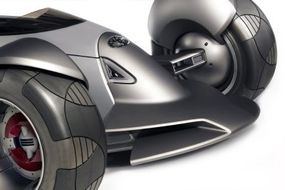
Four wheels and a semi-circular nose cone protrude from the central pod, with headlamps and other accessories mounted on or flush to the surface of the shiny, metal body. In the picture below, you can see that the door opens flush to the side of the car, in keeping with the streamlined theme of the MTRC.
Advertisement
The cockpit itself is completely open, with only a minimal windscreen to protect the occupants from the elements. At the rear of the car is a large, curved spoiler, providing aerodynamic stability as well as a counterpoint to the front nose cone. Of course, the spoiler also adds a touch of style to the design, as does the central, mounted tail light in the shape of the Toyota logo.
Not everyone's wild about the MTRC's ultra-modern curves -- various journalists have described it as an overblown toy car, while Top Gear magazine complains that it's still not sure which end's the front. But then, the MTRC was designed to make an impression, and that's exactly what it has done.
It would be easy to imagine that the MTRC's looks are the most innovative thing about it, but there's far more to the MTRC than meets the eye. Even for a concept car, the MTRC is technologically advanced.
Advertisement
A Closer Look Inside
Photo courtesy Toyota
Toyota describes the MTRC as a futuristic race car concept, and it has been designed specifically to showcase Toyota's three main strengths:
an extensive involvement in motor sports, including Formula 1, Le Mans and the Japan GT Championship
considerable experience in the development of four-wheel-drive vehicles
introduction of eco-friendly and information technologies
Let's take a closer look at how Toyota has focused on each of these strengths.
Advertisement
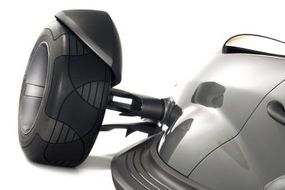
Each tire is equipped with its own sensor.
Photos courtesy Toyota
Each tire is equipped with its own sensor.
Photos courtesy Toyota
The MTRC features not one but four separate electric motors, one in each wheel, all powered by hydrogen fuel cells to ensure zero emissions. The MTRC is certainly environmentally friendly -- no gasoline means no exhaust fumes. The only thing coming out of the MTRC exhaust is water.
The ability to control four separate, wheel-based motors gives the MTRC an unprecedented level of control, and the vehicle has a whole range of features aimed squarely at making maximum use of those motors. An electronically controlled suspension system constantly monitors road conditions, adjusting the performance of the car to match the external environment. The vehicle's futuristic-looking tires are also more than just show -- built-in sensors adapt the tires to the road surface, ensuring maximum grip.
The open-wheeled look of the MTRC is nothing new for Toyota. It clearly draws on the carmaker's experience with the Formula Toyota series of racing vehicles.
The whole body of the MTRC works to control airflow, and better aerodynamic efficiency means higher speeds and enhanced stability.
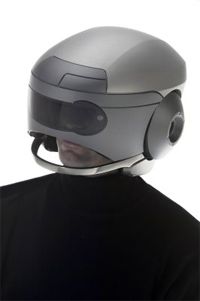
Mixed Reality helmet
Photo courtesy Toyota
Mixed Reality
While the technology built into the MTRC already sounds stunning, there's more. Working with motor parts supplier Denso and electronics giant Canon, Toyota has developed what it calls "Mixed Reality" technology. What is it?
We all know that there are times you could use a co-pilot -- someone to give you a heads-up and make sure you get where you're going. Driving's a complicated business: You not only have to keep on top of what's happening right now, but you also have to anticipate what could be coming up.
The Mixed Reality technology is designed specifically to help with this situation. Both the driver and the passenger wear a special helmet, the goal of which is to help process information and present it to the occupants in an understandable, organized manner. Besides the usual, factual information we're all familiar with -- speed or temperature, for example -- the Mixed Reality system tries to predict future road conditions. Meshing electronically with the car's systems, it provides a constant flow of information between car and driver: road temperature, tire status or the presence of ice or snow, for example. The ultimate goal is to help the driver navigate the road and control the car more safely and with greater accuracy than ever before.
If it sounds like something out of a video game, then you won't be surprised to find out where Toyota drew some of its inspiration for this remarkable vehicle...
Advertisement
A Virtual Driving Experience
The MTRC is likely to remain just a concept.
Photo courtesy Toyota Photo courtesy Toyota
The MTRC is likely to remain just a concept.
Photo courtesy Toyota Photo courtesy Toyota
Concept cars may be fun, but there's something a little frustrating about them. Your first reaction might well be amazement, but in reality, you're unable to do the one thing that would make the concept car experience perfect: hop in behind the wheel and give it a go.
One of the most popular racing games available at the moment is the latest in the Gran Turismo series. The games are famous for their realistic depictions of the handling and looks of a huge range of vehicles. Gran Turismo 4 includes an unprecedented level of detail -- and the Toyota MTRC.
Advertisement
Kazunori Yamauchi, the creator of Gran Turismo, describes the process of extracting the technology from a futuristic car as an "exciting experience." It's clear that another important influence for Toyota in designing the MTRC is the younger generation, in which mobile phones, video games and other pieces of cutting-edge technology are an important part of everyday life. Using youth-based technology as an inspiration has provided Toyota with a boost to its already dynamic image: Toyota has gained valuable advertising with a younger generation of gamers -- a generation that will become the next great mass of car buyers.
So we know the MTRC has made its debut on PS2 screens everywhere. The next question is: When will it make it onto the road in real life. Just how viable are the technologies Toyota showcases in this concept car?
The truth of the matter is that the MTRC is unlikely to be produced. The vehicle itself is more of an opportunity to show creative engineering, cutting-edge design and a sense of fun than a realistic attempt to design a mass-producible vehicle. Its virtual appearance on Gran Turismo 4 is the closest this concept will come to reality.
However, in the same way that the first-ever concept car provided GM with a wealth of new ideas, the technology embodied in the MTRC's sleek shell will undoubtedly influence Toyota's designs for the future.
For more information on the Toyota MTRC and other concept cars, check out the links on the next page.
The Start of the Concept
The idea of the concept car began with General Motors in 1938, when it unveiled the first-ever concept car. The Buick Y-Job, whimsically named so by its designer because most carmakers called their experimental vehicles 'X', gave Buick the chance to showcase features that it would come to use in Buick and Cadillac products through the 1940s. As well as providing an opportunity for General Motors to show off a little, it generated a sudden interest in GM's existing vehicles. The success of General Motors' first concept car led other car manufacturers to put time and effort into their own concept car unveilings.
Advertisement
MTRC Technical Specifications
When it comes to technical specifications, the MTRC is tricky to pin down. Its basic physical attributes are merely a matter of measuring. Other specifications, however, are more complex. Toyota have not yet released details of the car's performance on the road. Top speeds, acceleration and fuel efficiency remain a mystery and, in all likelihood, will stay that way. A vehicle like the MTRC utilizes technologies that are still experimental and unlikely to provide the perfect performance Toyota would like us to see.
Drive system: Four-wheel drive (Each tire has its own in-wheel motor.)
Check out the next page for more articles about concept cars and future auto technology.
Why Triathlon?
The Motor Triathlon Race Car is designed to be equally at home in three different racing environments: a smooth, high-grip racing surface; zipping through the narrow streets of a city circuit; or taking the bumps of an off-road course.