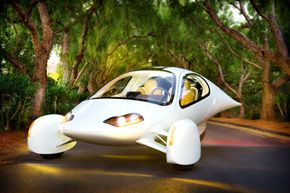
What if you could drive across the entire United States -- from East coast to West coast -- on just one tank of gas? Sounds like a crazy idea, right? Ever since Nicholas August Otto developed the gasoline engine in the 1870s and Rudolph Diesel invented the diesel engine in the 1890s, people have improved upon vehicle efficiency in fits and starts.
As concerns continue to grow over the possible consequences of global warming, nations and governments are beginning to react. The European Union continues to revise its strict emission standards, and ultracompact cars like the Smart Car, the MINI Cooper and the iQ Car catch lots of attention for their space- and energy-saving qualities. In the U.S., meanwhile, President George W. Bush signed an energy bill on Dec. 19, 2007, that encourages automakers to produce more fuel-efficient vehicles and increase the industry average to at least 35 miles per gallon by 2020.
Advertisement
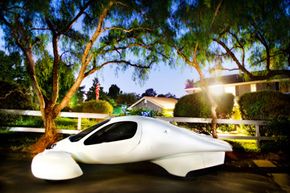
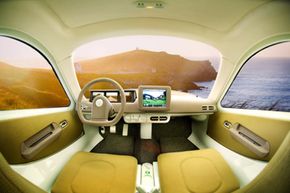
While these are small steps toward a respectable goal, Aptera Motors, Inc., a private company based in San Diego, Calif., may be taking a big leap with the Aptera, a three-wheel, two-passenger prototype that aims for an astounding 300 miles per gallon. The company was founded in 2006 by Steve Fambro and Chris Anthony, two independent entrepreneurs with experience in everything from composites and biotechnology to aerodynamics and finance.
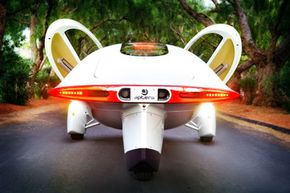
This combination of expertise led to the Aptera, a truly unique vehicle that looks like a cross between a dolphin and a helicopter. Technically classified as a motorcycle, the vehicle will only be available to residents of California when it's initially produced. If the Aptera sells well, AC hopes to offer its vehicle to national and international markets.
The initial prototype of the Aptera achieved 230 mpg, a number that is 195 mpg over the projected standard outlined in President Bush's recent energy bill. As of now, the developers still have more time to work out the kinks and improve its efficiency -- AC expects the Aptera to be ready for Californians in late 2008.
How fast will the Aptera go? Since it's technically a motorcycle, what are its safety features? Read on to learn more about the Aptera.
Advertisement