With the unveiling of the Personal Mobility (PM) concept car at the Toyota Motor Show in October 2003, Toyota's designers shared a new vision of personalized travel. Rather than simply rolling out a futuristic vehicle, Toyota unveiled a plan for changing how we travel in our individual vehicles.
Since the advent of the automobile, the car model someone chooses has reflected something about his or her personality. The average American driver spends one hour and 41 minutes in their cars each day, almost more than any other daily activity, according to research from the University of California at Berkeley. Toyota recognizes that fact and has designed the PM to create an entirely new vehicular modality in which people are not isolated by their vehicles, but rather are joined together in a mobile community.
Advertisement
In this article, we'll profile the PM's design, power, and unique features. We'll also take a peek at some other Toyota concept cars.
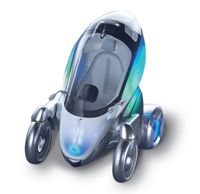
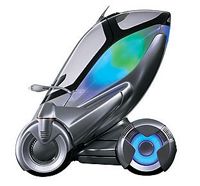
This single-passenger cockpit design resembles a flightless helicopter. Hydraulic door and seat in entry position
Photo courtesy Toyota Photo courtesy Toyota
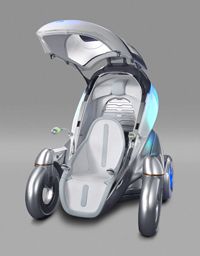
This single-passenger cockpit design resembles a flightless helicopter. Hydraulic door and seat in entry position
Photo courtesy Toyota Photo courtesy Toyota
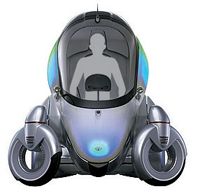
The Toyota PM doesn't resemble the traditional definition of a car. It lacks side doors and accommodates just a single passenger. This single-passenger cockpit design more resembles a flightless helicopter on wheels than a car.
Rather than stepping into a side door, passengers enter through a front hatch, which raises and lowers using hydraulic-lift bars. This front hatch also doubles as the vehicle's windshield.
Advertisement
As the vehicle moves, the wheelbase lengthens to allow the cabin encapsulating the cockpit to recline. The driver shifts from an upright position to a tilted position.
When exiting or entering the vehicle, the hydraulic door lifts and the vehicle's seat slides forward to ease the driver's entry or exit. Once you're seated, or when the door shuts, the seat slides back into the body of the vehicle and is positioned for travel.
Other innovations in the PM design include hollow-center wheels and see-through shaftless construction. Each wheel is independent of the other three, which gives the vehicle unique steering ability.
PM Dimensions
Length: 5.74-8.69 feet (1.75-2.650 m), depending on position of cabin
Width: 4.81 feet (1.47 m)
Height: 3.99-6.09 feet (1.22-1.86 m)
Wheelbase: 3.61-6.56 feet (1.10-2.00 m), depending on position
Minimum turning radius: 3.94 feet (1.2 m), in entry/exit mode
In the next section, we'll look at the PM's handling ability.
Advertisement
Power and Handling
Back view of the Toyota PM concept car
Photo courtesy Toyota
There is no hood on the PM that you can open to get a look at the engine. For one reason, there's no engine. A rear-mounted DC brushless electric motor powers the PM. Toyota hasn't disclosed details about the vehicle's top speed or battery life. The PM is keyless, and a push-button similar to that on a PC starts the motor.
The body arrangement of the PM is not static. The wheelbase can lengthen to allow the cabin to recline depending on the vehicle's mode of operation. The cabin is isolated from the wheels, allowing the PM to vary its posture according to speed or for easy entry/exit. There are three modes of operation, including:
Advertisement
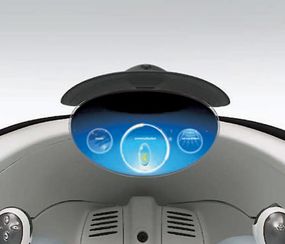
View from the driver's seat
Photo courtesy Toyota
Entry/Exit mode - At rest, the cabin is upright and its length is minimized. Because the wheels are independent of one another, the PM can turn in place by turning the left and right rear wheels in opposite directions.
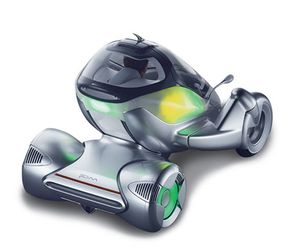
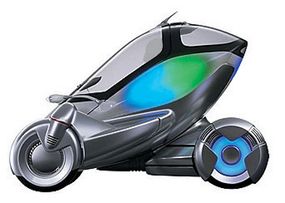
City - In stop-and-go travel, the cabin tilts back, which allows it to maneuver through the tight corners of an urban environment.
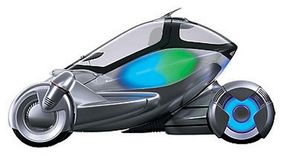
High-speed - On the open road, the wheelbase extends to allow the cabin to recline to its lowest posture to increase stability in high-speed travel.
Navigation is also unique in the PM. Toyota designers took out the steering wheel and replaced it with two joystick controllers to control acceleration, deceleration and steering. The PM is equipped with additional computer equipment that allows it to communicate with other PMs. In the next section, we'll take a closer look at this technology.
Advertisement
Mobile Networking
At rest, the cabin is upright and its length is minimized.
Photo courtesy Toyota
The PM is more than just a mode of transportation; it's also a communications device. It melds the functionality of transport and wireless communication into one machine. Using a yet-to-be-named wireless technology, PMs are able to locate other nearby PMs. Multiple PMs can then communicate with each other. Additionally, PM drivers can surrender control of their vehicle to another PM driver.
The instrumentation panel displays vehicle data, location, and position based on information, attributes, and the paths of nearby PMs, and even entertainment guidance. On most vehicles, knobs or push buttons are used to input preferences. The PM uses a virtual interface that appears to float in midair and uses infrared sensors to detect fingertip position.
Advertisement
In stop-and-go travel, the PM's cabin tilts back - allowing it to maneuver through the tight corners of an urban environment. T
Photo courtesy Toyota Photo courtesy Toyota
In stop-and-go travel, the PM's cabin tilts back - allowing it to maneuver through the tight corners of an urban environment. T
Photo courtesy Toyota Photo courtesy Toyota
When PMs are communicating with other PMs, LED technology is employed to change the color of the vehicle to indicate "emotions" and situations. Different colors display on the door tips, antennas, headlamps, side and rear panels, and rear wheels to indicate what activities are taking place in the PM.
To share the burden of driving, multiple PMs can team up in a lead-follow arrangement. One PM can become the lead vehicle, while others follow on autopilot. The following-position vehicle's on-board computer controls handling, throttle and braking, and maintains a safe distance from other PMs in front or behind. However, the following-position PM surrenders direction and steering to the lead PM. The lead PM driver is in charge of direction and speed. This autopilot feature is convenient for guiding a group of PMs (e.g., car pooling), or if someone is more familiar with a particular area and might know a shortcut.
The PM is just one of several concept cars that Toyota has unveiled over the years. Among each new pack of concept vehicles, some make it to the production line, while others inspire enhancements for new or existing models. Let's take a quick peek at some of the other future-minded vehicles that Toyota has created.
Advertisement
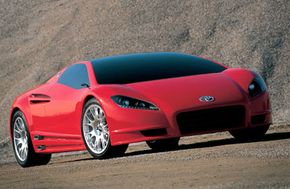
Alessandro Volta
Toyota is honoring Alessandro Volta by naming the first high-performance hybrid vehicle for the famous inventor.
Photo courtesy Toyota
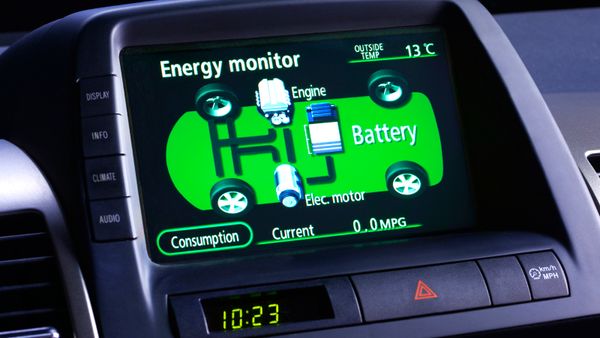
Alessandro Volta invented the electric battery in 1800. Toyota is honoring Volta by naming the first high-performance hybrid vehicle in his name. The Volta is powered by a V6 with an electric motor on each axle. The engine provides 408 horsepower and allows the car to travel 435 miles (700 km) on a 13.7-gallon (51.86 liter) tank.
To prove that hybrid technology can be used in a high-performance vehicle, the Volta can go from 0-60 mph (95.56 km/hour) in 4 seconds and reach a top speed of 155 mph (249 km/hour). It won't compete with Lamborghini or Ferrari with that top speed, but it uses a lot less gas.
Advertisement
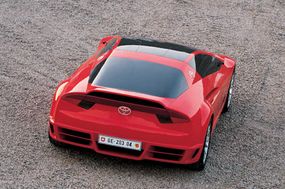
The first high-performance hybrid means business; the Volta can go from 0-60 mph in a mere 4 seconds.
Photo courtesy Toyota
The body of the Volta is made of carbon fiber and can seat three people abreast. The car also features drive by wire technology -- a computer actually operates the components that move the wheels, activate the brakes and so on, based on input from an electronic controller. This is the same control system employed in modern fighter jets as well as many commercial planes. The drive-by-wire system allows the passengers to reposition the steering wheel and pedals in front of any one of them.
Advertisement
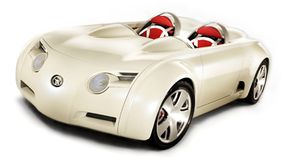
Compact Sports & Speciality (CS&S)
Toyota rolls out another hybrid concept car -- the CS&S.
Photo courtesy Toyota
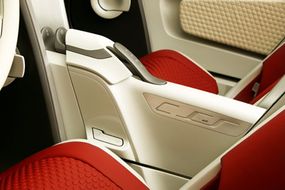
A Toyota hybrid first showcased in 2003, the CS&S is a future vehicle with a retro roadster look. This two-seat, open-topped car combines a 1.5-liter gasoline engine and a 50kW high-output motor for acceleration. A canopy on the rear of the car can slide back to provide another row of seats, albeit a tight-fitting space.
Toyota included a space-touch control interface in which a driver touches a spherical holographic interface to control climate and audio functions. The design is very rounded, from the headlights to the horseshoe-style seating.
Advertisement
Inside the CS&S cabin
Photo courtesy Toyota
FTX
The future of the Toyota full-size truck -- the FTX.
Photo courtesy Toyota
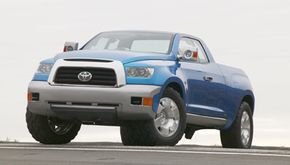
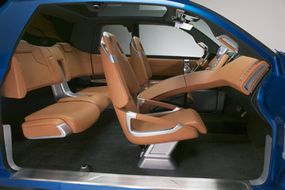
Unveiled at the 2004 North American International Auto Show in Detroit, the FTX provides a preview of what Toyota is planning for its future full-size truck models. This extended cab truck sports suicide doors (a front-hinge door and a back-hinge door that open from the same originating spot) that open at 90 degrees. The FTX is nearly 19 feet (5.79 m) in length, 7 feet (2.13 m) wide and 6.5 feet (1.98 m) tall. The FTX is powered by a large-displacement V8 hybrid, gas-electric engine that delivers V6 fuel efficiency.
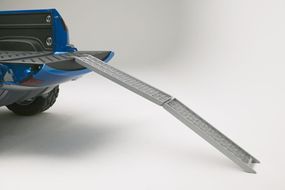
On the exterior, the bumpers have integrated tow hooks and special hideaway universal carabiner-type tie-down hooks in the truck bed. An electric generator, air compressor and other outlets are contained in a multi-functional unit under the rear skid plate. It also has a hideaway ramp that extends to the ground when the gate is open. This ramp is ideal for unloading heavy items.
Advertisement
The FTX sports suicide doors that open at 90 degrees.
Photo courtesy Toyota
The FTX includes a hideaway ramp that extends to the ground when the tailgate is open.
Photo courtesy Toyota
For more information on the Toyota PM concept car and related topics, check out the links on the next page.