
Chopper Frames
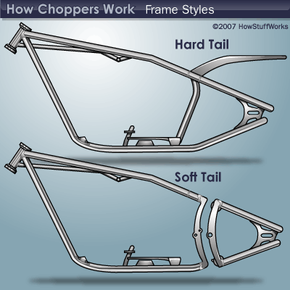
Choppers tend to be based off of traditional motorcycles or cruisers, which have a different style from other bikes. Unlike sport bikes, where the rider leans forward, choppers are usually designed so that the rider sits low in the seat, leaning back, arms outstretched. This provides a relaxed riding experience.
Advertisement
To get this look, a chopper has to have the right frame. There are two main kinds of frames used in choppers: hard-tail frames and soft-tail frames. A hard-tail frame is a solid frame with no rear wheel suspension system. Hard-tails have the classic lines that chopper enthusiasts love, but they tend to give very bumpy rides.
Soft-tail frames have rear-wheel suspension, meaning the frame comes in two major pieces. The front part of the frame is where you'd mount the engine, transmission, fork and handlebars. The rear section is where you'd mount the rear wheel. You connect the two sections together using bolts, brackets, spacers and other equipment, depending on the frame's manufacturer.
At the front end of the frame, whether it's a soft-tail or hard-tail, is where you mount the fork assembly. The fork assembly is the part of the bike that connects the front tire and handlebars to the frame. The fork assembly also includes the front wheel suspension system, which usually either uses springs or hydraulics.
In the next section, we'll learn about a chopper's rake and trail.