Introduction to How the Cadillac Provoq Works

Just a few years ago, the concept cars the major automakers created to showcase their design and engineering teams were all about horsepower, speed and luxury; however, massive increases in fuel prices are causing an industry-wide change. The unveiling of the Cadillac Provoq concept at the Consumer Electronics Show in Las Vegas -- not one of the large auto shows, where such designs are usually debuted -- is just one sign of the times. The Provoq's listed top speed of 100 mph is another. The concept car of 2008 isn't an ultrapowerful sports car or high-torque off-roader -- instead, it sports alternative fuels, environmentally friendly materials and high fuel efficiency.

Concept Car Image Gallery

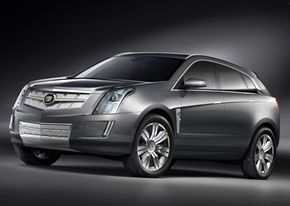
The Cadillac Provoq.
© GM Corp.

The Cadillac Provoq is an eco-friendly concept. See more concept car pictures.

Of course, cars that achieve amazing miles-per-gallon numbers using fuel cells, rechargeable batteries and lightweight materials are nothing new, especially when it comes to concept cars. The real challenge faced by Cadillac's designers was to make efficiency sexy. More importantly, could they create an alternative fuel "crossover" small Sport Utility Vehicle (SUV) that still had cargo room once the battery packs and fuel cell stacks were in place?

E-Flex
E-Flex is General Motors' platform for new automotive technologies. The basic frame can be mated to an electric motor with plug-in batteries, as with the Chevy Volt, and can even include a separate engine to help charge the batteries. It's also adaptable to different fuel sources, such as bio-diesel or ethanol. It can even use an entirely different technology, such as the fuel cell used in the Provoq. It's all part of GM's plan to deal with worldwide energy problems by creating a flexible, regionally adaptable platform to build cars on.

From its louvered grill to the fin-like taillights, the Cadillac Provoq looks as stylish as it is eco-friendly. Interested in what's under the hood of the Provoq? Want to know how much power the Provoq can deliver? Read the next page to find out.
Hydrogen Power

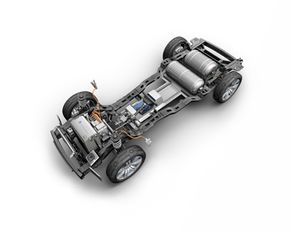
The Cadillac Provoq is powered by a hydrogen fuel cell that sits under the hood, right where you'd find the engine in a typical car. Inside the fuel cell is the stack -- a sandwich of anodes, cathodes and other high-tech materials -- that enables a chemical reaction to give the Provoq its power. At the back end of the vehicle, below the cargo floor, two storage tanks hold 13.2 pounds (5.99 Kg) of hydrogen gas at 10,000 psi. The hydrogen is fed to the fuel cell and mixed with oxygen, which is drawn from the air, pressurized and humidified. The fuel cell can constantly crank out 88 kW of power, which is equal to about
118 horsepower.

The E-flex chassis.
© GM Corp.
The Cadillac Provoq's E-Flex chassis

Running along the center of the chassis, beneath the floor of the vehicle, is a series of lithium-ion batteries. These batteries can be charged by plugging the Provoq into an electrical outlet through either of the front fender ports. The battery power can be used to extend the Provoq's range, or it can give the motors a little extra juice if they need to accelerate quickly. The batteries store a maximum of 9 kWh of energy and can generate a peak of 60 kW (80.5 horsepower) for a power boost.

The Provoq is an all-wheel-drive vehicle, giving it stability and traction in a wide range of conditions; however, it doesn't work like most other all-wheel drive vehicles. Instead of a transmission that sends the engine's power to each wheel, the Provoq makes use of three separate drive motors. One motor provides drive for both front wheels at 70 kW (93.9 horsepower). Each rear wheel has its own hub motor, providing 40 kW (53.6 horsepower) of driving force. With that power, the Provoq posts a 0 to 60 mph time of 8.5 seconds and has a top speed of 100 mph. At first, that may seem unimpressive compared to the muscle-bound concept cars of recent years, but they're good numbers for a fuel cell vehicle. Also, electric motors are able to deliver strong, instant torque to the wheels, which makes for very responsive acceleration.

Making Fuel Cells Happen
Hydrogen fuel cell technology has been touted for years as a major automotive breakthrough, but we still don't have fuel cell-driven cars available at the local dealer. A fuel cell mixes hydrogen and oxygen in a chemical reaction that creates an electric current, which drives an electric motor. The exhaust given off by a fuel cell vehicle is water. They're much cleaner than internal combustion engines and they don't rely on gasoline for fuel. What's not to love? For one thing, the total lack of an infrastructure to support a hydrogen economy. A fuel cell is great, unless you have nowhere to fill up your hydrogen tanks. GM is playing wait-and-see when it comes to production cars using fuel cells -- they have tentative plans to sell limited numbers of the fuel cell equipped Equinox in 2010, but only in U.S. cities that build enough hydrogen refueling stations to support it [source: Popular Science].

Just how environmentally responsible is the Cadillac Provoq? Does the eco-friendly part of this concept start and stop with the fuel cell? What other green features does the Provoq offer potential owners? Find out on the next page.

A Green Cadillac

General Motors claims the Provoq can drive 300 miles before the hydrogen tanks must be refilled. The last 20 miles of the trip come from the range-extending ability of the batteries, so aggressive drivers might not get as far. While the logistics of making, transporting and storing hydrogen mean that fuel cells are not totally without an environmental footprint, a car that doesn't release a single whiff of carbon dioxide is certainly a breath of fresh air. Currently, hydrogen is produced using natural gas (methane). There is low demand for hydrogen, and the price is tied to the cost of natural gas. If fuel cell vehicles become common, demand, along with prices, will rise. There are ways to make hydrogen without using methane, but they obviously require energy. The actual "greenness" of the Provoq and other fuel cell vehicles will depend on the power sources used to make the hydrogen.

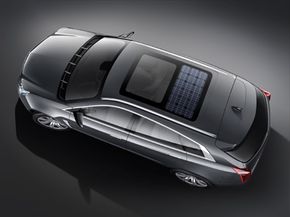
A solar panel for accessory power.
© GM Corp.
An integrated solar panel provides power for
Provoq's accessories.

The Provoq's environmentally friendly credentials aren't just about clean emissions and alternative fuels. GM has built several other green features into the concept. Part of the roof is taken up by a solar panel that draws in the Sun's energy to power accessories like the stereo, interior lights and the integrated hard drive. The tires were custom made by Michelin and use that company's Green-X technology. Although the tires maintain performance and grip, they also offer low rolling resistance. That means the motors don't need to use as much energy to turn the wheels, improving the overall efficiency of the Provoq.

GM touted several other eco-friendly features in their press release for the Provoq:

  • The headliner is wrapped in a fully recyclable soy-based material.
  • The carpet is made of recycled polyester and jute.
  • The leather used to cover the seats and the instrumental panel is free of harmful chemicals.
  • The chrome trim is made with less-harmful materials.

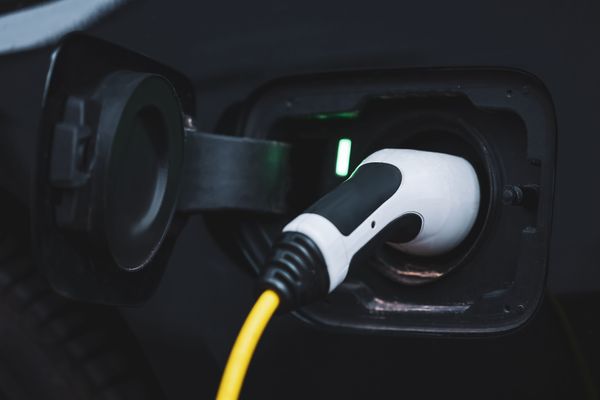
You can charge up the Provoq's batteries overnight by plugging either of the front fender charging ports into an outlet. No external charging device is necessary. The charging ports are part of the Provoq's sleek design -- instead of hiding them away behind a panel, GM's design team integrated them into the sweeping shape of the side panels. An amber light shows that the batteries are charging, and a green light indicates a full charge.

Provoq-ative Aerodynamics
To further increase efficiency, the Provoq has a sleek, aerodynamic shape. The door handles are flush with the doors, and the side-view mirrors were designed in a wind tunnel. Turn signals are integrated right into the mirror body. The glass in the side windows is flush with the pillars, keeping the exterior as smooth as possible. The signature Cadillac spoke wheels even have transparent material between the spokes. They look like classic caddy wheels, but have a better aero profile. Even the roof rack is designed with the aim of minimizing wind resistance. The most unique aero feature is the front grille, which has louvers that close at high speed for better aerodynamics and open at slower speeds for better air flow into the fuel cell compartment. Fuel cells are notorious for running very hot.

You're probably guessing that the new technology and eco-friendly design compromises the comfort and luxury that you've come to expect from Cadillac, right? Don't be so sure. Continue reading to find out how the Provoq is still very much a Cadillac.

A Stylish Crossover

The four-door Provoq is either a small SUV or a sporty wagon, a class of car currently known as a crossover. One of the original design parameters of the Provoq was that the alternative fuel system couldn't intrude on the interior space. With the low, center mounted batteries -- which also give the Provoq a low center of gravity -- and the fuel cell stack mounted in the engine compartment, that mission is mostly accomplished. Even when compressed, hydrogen is not as dense as gasoline, so the hydrogen tanks take up a certain amount of space. Even so, there's still room for a decent-sized rear cargo area and 60/40 split folding rear seat.

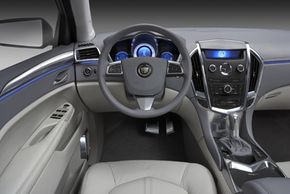
The luxurious interior of the Cadillac Provoq.
© GM Corp.

The interior of the Cadillac Provoq includes an abundance of luxury features for the occupants.

Being environmentally conscious about your vehicle choice can sometimes mean that you're willing to sacrifice some of the interior refinements that you would typically find in a luxury car. Not so in the Cadillac Provoq. In fact, it offers superfluous touches like "hand-wrapped leather with French seams" on the seats; ambient lighting on the door panels, footwells, sills and even beneath the seats; and USB ports for all your electronic devices. You can also put your cell phone into the cell phone holder, which is Bluetooth-ready and capable of inductive charging. No need to bring your iPod along -- the hard drive can store thousands of songs and maps for the navigation system. The instrument cluster has configurable LCD displays, while the center stack has the controls for the air conditioning and heat plus the
audio system.

To keep the ride comfortable, the Provoq sits on a four-wheel independent suspension, with Macpherson struts in the front and a four-link system in the rear. Neither is an especially revolutionary suspension, but the Provoq isn't meant for high-speed cornering at Laguna Seca. There are no hydraulic brake lines -- the Provoq uses a brake-by-wire system. This means the brakes are electronic. Each stop the vehicle makes will extend the Provoq's range slightly, as the regenerative brakes recharge the batteries.

It may take a while to get your hands on a new Cadillac Provoq. General Motors has no immediate plans to make a production model, and no pricing estimates have been given.

To find out more about fuel cells, hydrogen and concept cars, follow the links on the next page. They'll provide you with a lot more information.

Lots More Information

Related HowStuffWorks Articles

More Great Links

Sources

  • General Motors. "Cadillac Provoq Fuel Cell Concept Delivers Clean, Petroleum-free Performance and Signature Design." Feb. 15, 2008.
    http://www.cadillac.com/_res/pdf/08NAIAS_Cadillac-Provoq-Concept.pdf
  • Popular Science. "Hot Hydrogen-Powered Cadillac." Jan. 8, 2008. http://popsci.typepad.com/popsci/2008/01/hot-hydrogen-po.html