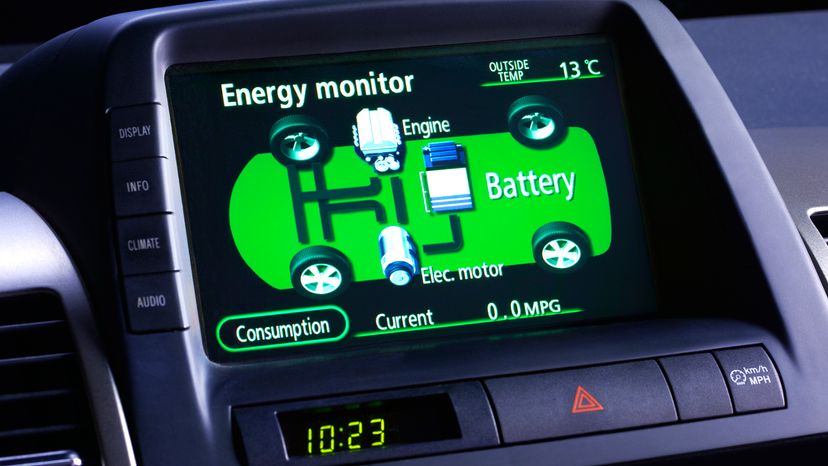
You have questions about how a hybrid electric vehicle works. We have answers. Peter Dazeley / Getty Images
Have you pulled your car up to the gas pump lately and been shocked by the high price of gasoline? Maybe you've thought about trading in your car for something that gets better mileage — or maybe you're worried that your car is contributing to the greenhouse effect, but you're not ready to go fully electric.
Enter the hybrid car. But how do hybrid electric vehicles work?
Advertisement
What goes on under the hood to give you 20 or 30 more miles per gallon than the standard gas-powered automobile? And does it pollute less just because it gets better gas mileage? Also, where does the plug-in hybrid come in?
In this article, we'll help you understand how this technology works, and we'll even give you some tips on how to drive a hybrid car for maximum efficiency.
The gasoline-electric hybrid car is just what it sounds like — a cross between a gasoline-powered car and an electric car. Let's start with a few differences between a gasoline-powered car and a typical electric car.
A gas-powered car has a fuel tank supplies gasoline to the internal combustion engine. The engine then turns a transmission, which turns the wheels.
Advertisement
An electric car, on the other hand, has a set of batteries that provides electricity to an electric motor. The motor turns a transmission, and the transmission turns the wheels.
The hybrid is a compromise. It attempts to significantly increase the mileage and reduce the emissions of a gas-powered car while providing the convenience of refueling at the gas station.
Advertisement
Gasoline-electric Hybrid Structure
Gasoline-electric hybrid cars contain the following parts:
Gasoline engine: The hybrid car has a gasoline engine much like the one you will find on most cars. However, the engine on a hybrid is smaller and uses advanced technologies to reduce emissions and increase efficiency.
Fuel tank: The fuel tank in a hybrid is the energy storage device for the gasoline engine. Gasoline has a much higher energy density than batteries do. For example, it takes about 1,000 pounds (454 kg) of batteries to store as much energy as 1 gallon (3.8 liters) of gasoline.
Electric motor: The electric motors on hybrid cars are very sophisticated. Advanced electronics allow it to act as a motor as well as a generator. For example, when it needs to, it can draw energy from the batteries to accelerate the car. But acting as a generator, it can slow the car down and return energy to the batteries.
Generator: The generator is similar to an electric motor, but it acts only to produce electrical power. It is used mostly on series hybrids.
Batteries: The batteries in a hybrid car are the energy-storage device for the electric motor. Unlike the gasoline in the fuel tank, which can only power the gasoline engine, the electric motor on a hybrid car can put energy into the batteries as well as draw energy from them.
Transmission: The transmission on a hybrid car performs the same basic function as the transmission on a conventional car. Some hybrids, like the Honda Insight, have conventional transmissions. Others, like the Toyota Prius, have radically different ones.
Parallel Hybrids
You can combine the two power sources found in a hybrid car in different ways. One way, known as a parallel hybrid, has a fuel tank that supplies gasoline to the engine and a set of batteries that supplies power to the electric motor.
Advertisement
Both the engine and the electric motor can turn the transmission at the same time, and the transmission then turns the wheels.
Series Hybrids
In a series hybrid, the gasoline engine turns a generator, and the generator can either charge the batteries or power an electric motor that drives the transmission. Thus, the gasoline engine never directly powers the vehicle.
Advertisement
Hybrid Car Performance
The key to a hybrid car is that the gasoline engine can be much smaller than the one in a conventional car and therefore more efficient. Most cars require a relatively big engine to produce enough power to accelerate the car quickly.
In a small engine, however, the efficiency can be improved by using smaller, lighter parts, by reducing the number of cylinders and by operating the engine closer to its maximum load.
Advertisement
Why Are Smaller Engines More Efficient?
There are several reasons why smaller engines are more efficient than bigger ones.
The big engine is heavier than the small engine, so the car uses extra energy every time it accelerates or drives up a hill.
The pistons and other internal components are heavier, requiring more energy each time they go up and down in the cylinder.
The displacement of the cylinders is larger, so more fuel is required by each cylinder.
Bigger engines usually have more cylinders, and each cylinder uses fuel every time the engine fires, even if the car isn't moving.
This explains why two of the same model cars with different engines can get different mileage. If both cars are driving along the freeway at the same speed, the one with the smaller engine uses less energy.
Both engines have to output the same amount of power to drive the car, but the small engine uses less power to drive itself.
Getting Enough Power
How can this smaller engine provide the power your car needs to keep up with the more powerful cars on the road?
Let's compare a car like the Chevy Camaro, with its big V-8 engine, to our hybrid car with its small gas engine and electric motor. The engine in the Camaro has more than enough power to handle any driving situation.
The engine in the hybrid car is powerful enough to move the car along on the freeway, but when it needs to get the car moving in a hurry, or go up a steep hill, it needs help. That "help" comes from the electric motor and battery — and this system steps in to provide the necessary extra power.
The gas engine on a conventional car is sized for the peak power requirement (those few times when you floor the accelerator pedal). In fact, most drivers use the peak power of their engines less than 1 percent of the time.
The hybrid car uses a much smaller engine, one that is sized closer to the average power requirement than to the peak power.
Advertisement
Improving Fuel Economy in 5 Different Ways
Besides a smaller, more efficient engine, today's hybrids use many other tricks to increase fuel efficiency. Some of those tricks will help any type of car get improved fuel economy, and some only apply to a hybrid.
1. Recovering Energy and Storing It in the Battery
Whenever you step on the brake pedal in your car, you are removing energy from the car. The faster a car is going, the more kinetic energy it has.
Advertisement
The brakes of a car remove this energy and dissipate it in the form of heat. A hybrid car can capture some of this energy and store it in the battery to use later.
It does this by using a "regenerative braking" system. That is, instead of just using the brakes to stop the car, the electric motor that drives the hybrid can also slow the car. In this mode, the electric motor acts as a generator and charges the batteries while the car is slowing down.
2. Sometimes Shutting Off the Engine
A hybrid car does not need to rely on the gasoline engine all of the time because it has an alternate power source: the electric motor and batteries. So the hybrid car can sometimes turn off the gasoline engine — for example when the vehicle is stopped at a red light.
3. Using Advanced Aerodynamics to Reduce Drag
When you are driving on the freeway, most of the work your engine does goes into pushing the car through the air. This force is known as aerodynamic drag.
This drag force can be reduced in a variety of ways. One sure way is to reduce the frontal area of the car. Think of how a big SUV has to push a much greater area through the air than a tiny sports car.
Reducing disturbances around objects that stick out from the car or eliminating them altogether can also help to improve the aerodynamics. For example, covers over the wheel housings smooth the airflow and reduce drag.
4. Using Low-rolling Resistance Tires
The tires on most cars are optimized to give a smooth ride, minimize noise, and provide good traction in a variety of weather conditions. But they are rarely optimized for efficiency.
In fact, the tires cause a surprising amount of drag while you are driving. Hybrid cars use special tires that are both stiffer and inflated to a higher pressure than conventional tires. The result is that they cause less drag than regular tires.
5. Using Lightweight Materials
Reducing the overall weight of a car is one easy way to increase the mileage. A lighter vehicle uses less energy each time you accelerate or drive up a hill.
Composite materials like carbon fiber or lightweight metals like aluminum and magnesium can be used to reduce weight.
Advertisement
The Power Split Device
The power split device is the heart of the Toyota Prius, the most famous hybrid vehicle. This is a clever gearbox that hooks the gasoline engine, generator and electric motor together.
It allows the car to operate like a parallel hybrid: The electric motor can power the car by itself, the gas engine can power the car by itself or they can power the car together.
Advertisement
The power split device also allows the car to operate like a series hybrid; the gasoline engine can operate independently of the vehicle speed, charging the batteries or providing power to the wheels as needed.
It also acts as a continuously variable transmission (CVT), eliminating the need for a manual or automatic transmission. Finally, because the power split device allows the generator to start the engine, the car does not need a starter.
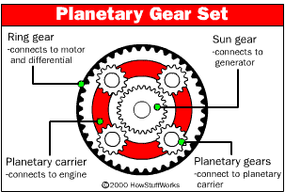
The power split device is a planetary gear set. The electric motor is connected to the ring gear of the gear set. It is also directly connected to the differential, which drives the wheels. So, whatever speed the electric motor and ring gear spin at determines the speed of the car.
The Prius planetary gear set.
The generator is connected to the sun gear of the gear set, and the engine is connected to the planet carrier. The speed of the ring gear depends on all three components, so they all have to work together at all times to control the output speed.
When you accelerate, initially the electric motor and batteries provide all of the power. The ring gear of the power split device is connected to the electric motor, so it starts to spin with the motor.
The planet carrier, which is connected to the engine, is stationary because the engine is not running. Since the ring gear is spinning, the planets have to spin, which causes the sun gear and generator to spin. As the car accelerates, the generator spins at whatever speed it needs to in order for the engine to remain off.
Once you reach about 40 mph (64 km/h), the gasoline engine will turn on. The generator suddenly changes speed, causing the planet carrier to turn and start the engine.
Once the engine is running, it settles into a constant speed while the generator varies its speed to match the output speed with the electric motor.
If you are really accelerating hard, the motor will draw extra power from the batteries. Once you are up to freeway speed, the car will move under a combination of gas and electric power, with all of the electricity coming from the generator.
Advertisement
How Much Horsepower Do You Need?
The amazing thing is that most of what we require a car to do uses only a small percentage of its horsepower. When you are driving along the freeway at 60 mph (96.6 km/h), your car engine has to provide the power to do three things:
Overcome the aerodynamic drag caused by pushing the car through the air
Overcome all of the friction in the car's components such as the tires, transmission, axles and brakes
For most cars, doing all this requires less than 20 horsepower. So, why do you need a car with 200 horsepower? So you can "floor it," which is the only time you use all that power. The rest of the time, you use considerably less power than you have available.
Advertisement
Hybrid Mileage Tips
A driver's desire for quick acceleration causes our cars to be much less efficient than they could be. You may have noticed that a car with a less powerful engine gets better gas mileage than an identical car with a more powerful engine. (Just look at the window stickers on new cars at a dealership for a city and highway mpg comparison.)
How to Get the Best Mileage
You can get the best mileage from a hybrid car by using the same kind of driving habits that give you better mileage in your gasoline-engine car.
Advertisement
Drive slower. The aerodynamic drag on the car increases dramatically the faster you drive. For example, the drag force at 70 mph (113 km/h) is about double that at 50 mph (81 km/h). So, keeping your speed down can increase your mileage significantly.
Maintain a constant speed. Each time you speed up the car, you use energy, some of which is wasted when you slow the car down again. By maintaining a constant speed, you will make the most efficient use of your fuel.
Avoid abrupt stops. When you stop your car, the electric motor in the hybrid acts like a generator and takes some of the energy out of the car while slowing it down. If you give the electric motor more time to slow the vehicle, it can recover more of the energy. If you stop quickly, the brakes on the car will do most of the work of slowing the car down, and that energy will be wasted. The same reasoning applies to gasoline-powered cars: Abrupt stops waste a lot of energy.
Advertisement
Lots More Information
Sources
"Diesel-based hybrid cars." The Daily Times. http://www.dailytimes.com.pk/default.asp?page=2006%5C01%5C09%5Cstory_9-1-2006_pg6_13