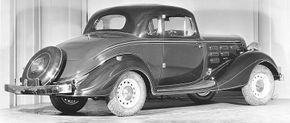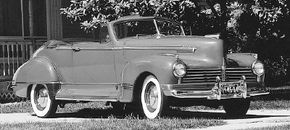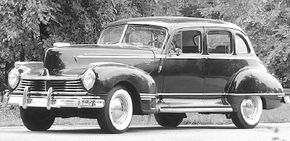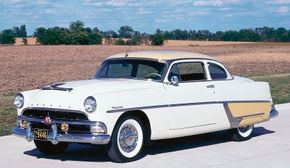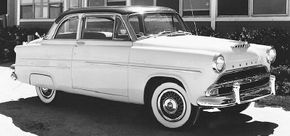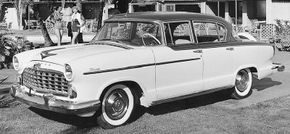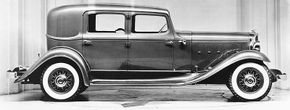
Eight Detroit businessmen pooled resources to found the Hudson Motor Car Company in February 1909. Among them was retailing magnate Joseph L. Hudson. Another was Roy D. Chapin, Sr., who led the new firm to high prosperity as its president from 1910 to 1923.
Hudson built some of America's fleetest and finest cars during its 48-year history and was often among the industry's sales leaders through 1950. A key early success was the low-priced four-cylinder Essex introduced in 1919.
Advertisement
By 1925, it had boosted Hudson to third place behind Ford and Chevrolet. Hudson then ran third, fourth, or fifth on volume that reached 300,000 cars by 1929. Unfortunately, total sales fell sharply in the devastated Depression market. Had it not been for the speedy, inexpensive Essex Terraplane, Hudson might have folded by 1940.
The firm forged an enviable reputation in the 1920s largely with its Super and Special Sixes: big, smooth, solid cars offering good performance for the money and fine reliability. But with the advent of an Essex Six in 1924, Hudson decided to move upmarket.
The result was a single 1930 line called Great Eight. Great it wasn't. At 213.5 cubic inches, its engine was actually smaller than previous Hudson sixes, had just 80 horsepower to move a heavy chassis, and wasn't as sturdy. It did boast an integrally cast block and crankcase, and was the first straight eight with a counterweighted crankshaft, but its splash lubrication system was outmoded.
Hudson stayed with this engine for the optimistically named Greater Eights of 1931-32 -- in retrospect it was a mistake for a depressed market where sixes would surely have sold better. Displacement was increased each year: first to 233.7 cid and 87 bhp, then to 254 cid and 101 bhp.
Another 1930 setback was the Depression-related closure of Biddle and Smart, Hudson's longtime supplier of magnificent open bodies. The company thus turned to Murray and Briggs for phaeton and speedster bodies. A few eight-cylinder Hudsons of this period also sported dashing coachwork by the renowned firm LeBaron.
Through 1933, Hudson Eights offered numerous body styles on wheelbases of 119-132 inches: roadsters, Victorias, convertibles, sedans, town sedans, coupes, and Broughams (two-door sedans). It was an attractive line that would have done justice to far-costlier brands, but it wasn't successful. The Greater Eight managed only 22,250 sales for 1931. The '32 total was below 8000, despite unchanged prices and lush new Sterling and Major series.
Seeing the error of its ways, Hudson launched a new Super Six for its 1933 "Pacemaker" line -- the car was essentially the 73-bhp 193-cid Essex Terraplane engine in the 113-inch Hudson chassis. That year's Eights comprised four 119-inch-wheelbase standard models and five luxurious Majors on a 132-inch platform. But production bottomed out at under 3000. Interesingly, Eights outsold Sixes nearly 2-to-1. For 1934, Hudson again abandoned sixes, reserving them for the new Terraplane line that replaced Essex as the firm's "companion" marque.
For more on defunct American cars, see:
- AMC
- Duesenberg
- Oldsmobile
- Plymouth
- Studebaker
- Tucker
Advertisement