Why is it still necessary to crash test vehicles?

Not long after the first car rumbled down the road, there was also the first car accident. As car technology and ownership has evolved, so too has the number and severity of car accidents. Despite public service campaigns, police enforcement and common sense, drivers still take unnecessary risks, make bad decisions in emergencies and drive distracted. Automakers also have to take some of them blame: unsafe or malfunctioning cars have contributed to many deaths over the decades, too.

Car Safety Image Gallery

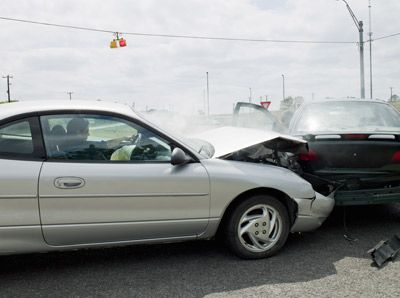
A serious car crash scene.
John Cowpland/Getty Images
An investigator examines a car that crashed into a wall in Hastings, New Zealand, following a short police chase. The driver of the car died at the scene. See more car safety pictures.
Up Next

But, as automotive power and performance have increased, a number of safety features have helped to lower the number of deaths from car accidents each year. Airbags, antilock brakes and wider seatbelt usage have all helped to protect the vehicle's passengers. Despite these features, car accident deaths and injury rates are still very high. It seems that as soon as car designers come up with new systems to protect passengers, people find new ways to injure themselves on the road.

How do car makers stay ahead of this deadly curve? By consistently staging crashes, gathering data and looking at driver response to various situations. In short, they perform auto crash tests. But, given the availability of computer modeling, why do car makers, private groups and the federal government still crash test cars? Keep reading to find out why it's still necessary to destroy actual vehicles.
Uncommon Metal
Plenty of teenagers have been in the doghouse for wrecking the cheap old jalopy their parents bought them. How bad would they feel if they wrecked several hundred thousand dollars worth of car? Crash testing of expensive cars is actually pretty rare. The government doesn't crash test cars that cost over $60,000 and neither do most private groups. However, many exotic super cars have extensive crashing in their DNA, as they tend to be based on race cars.

A Smashing Success

Different crash testing groups have different goals. Some, like the government, want to set safety standards and make sure automakers adhere to them. Others want to learn more about accidents themselves, mainly so that accident investigators can reconstruct real-life accidents. Others want to warn consumers of safety risks that might not be covered in government tests. Car makers want to engineer safety systems that will keep their customers safe and help sell more cars. All of these goals lead to one thing: reducing deaths from automotive accidents.

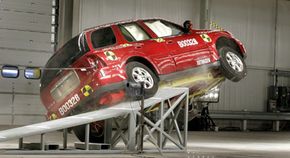
A rollover crash test at GM's new crash testing center.
Bill Pugliano/Getty Images
A rollover crash test at General Motors' new $10 million crash testing center in Milford, Mich. GM announced that rollover airbags will be standard equipment in all its vehicles by 2012.

A real-world example of these objectives coming together happened in the early part of the 21st century. SUVs were extremely popular, but they had a high risk for rolling over. Controlled crash tests and accident investigations determined that improperly inflated tires and driver error had contributed to many of the accidents. As a result, the government began assigning roll-over ratings to SUVs and educating drivers about how to change their driving habits when behind the wheel of a larger vehicle. Many automakers engineered and began offering tire pressure monitoring systems to alert drivers when their tires were unsafe. All of this came together because of crash testing.

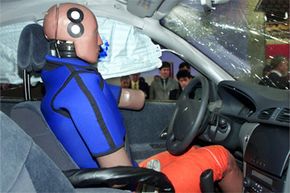
From that example you can see how crash testing can identify and respond to a problem that puts millions of drivers at risk. Crash testing can also anticipate safety problems and serve as an early warning to consumers. When airbags were first introduced, they were seen as an incredible safety device. Crash testing, however, showed that they had the power to injure and even kill some passengers, especially children. As a result, drivers were warned to sit children in the rear seat or turn their passenger-side airbags off.

Safety Ratings
Crash testing has helped inform drivers about safety risks like airbags and kids, but its most wide-reaching effect has been to help consumers decide which cars to purchase. The Insurance Institute of Highway Safety (IIHS) and the federal government's National Highway Transportation Safety Administration (NHTSA) are two of the best known crash testing organizations and both rate cars based on crash tests. IIHS uses a scale of Poor, Marginal, Acceptable and Good to rate overall safety, while NHTSA uses a five-star scale to rate front- and side-impact protection as well as rollover protection.

What's been the effect of crash testing, and what's in store for crash testing in the future? Read on to find out.

­

Buckle Up, Dummy

It's impossible to put a number on the lives that have been saved a because of crash testing. What we do know is that when new safety technology, like airbags, has been introduced, there is almost always a corresponding dip in vehicular deaths. Think of the simple things you do when you drive, like buckling your seatbelt. Odds are that you buckle up because you know the seatbelt keeps you safe -- and you know the seatbelt keeps you safe because of crash testing.

Crash testing continues to advance and respond to automotive buying trends. As more people bought SUVs, crash testing focused on finding ways to lessen the risk of rollover and methods of strengthening the roof in case a rollover did occur. Crash testing also focused on exactly what causes an SUV to roll over, so buyers could be educated on preventing those types of crashes. As more Americans have chosen smaller cars, crash testing has begun to focus on improving safety cages and crumple zones in this group of vehicles. Some car companies even have crash testing that focuses on pedestrian safety.

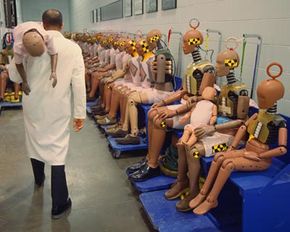
Crash test dummies
Louie Psihoyos/Getty Images
Crash test dummies replicate passengers ranging from pregnant women to infants.

Crash testing is also beginning to focus on keeping more types of people safe. Initially, all crash test dummies were the same size, shape and weight, but scientists have realized that people of different sizes -- men, women and children -- are susceptible to different injuries in crashes. As a result, dummy technology is dramatically improving. Dummies now come in all shapes and sizes, too. Researchers have even developed a pregnant crash test dummy. Dummies are also becoming more lifelike and more capable of effectively mimicking human physiology, which will give researchers more data to develop systems that protect actual humans.

Too Perfect?
With computer simulators and modeling available, why do we still perform actual crash tests? A computer "driver" will always have the perfect response. That means computer data is too perfect to use in the real world. Computers rely on input from people to complete the model, and human input can be incorrect, or it can just fail to anticipate something that might happen in an actual crash test. For example, in government crash tests the Smart fortwo's driver-side door opened. That's something that wasn't anticipated, and easily something that a computer model may have missed.

There will always be some risk in car travel. Crash testing helps develop safety systems and inform consumers, which takes some of that risk away. While smashing cars into walls or each other may seem wasteful, the data these tests yield is invaluable. In the 1980s the slogan was, "You could learn a lot from a dummy." As it turns out, that's very true.

For more information about crash testing, automotive safety devices and other related topics, follow the links on the next page.

­

Lots More Information

Related HowStuffWorks Articles

More Great Links

Sources

  • BBC News. "How The Dead Have Helped the Living." September 23, 1998. http://news.bbc.co.uk/1/hi/special_report/1998/car_crash/48062.stm
  • Drury, Bob. "Meet the Human Crash Test Dummy." Men's Health.
    http://www.menshealth.com/cda/article.do?site=MensHealth&channel=guy.wisdom&category
    =howto.guides&conitem=ce5a99edbbbd201099edbbbd2010cfe793cd____
  • Harley, Michael. "Ghastly! Saab may have used human cadavers for safety research." Autoblog. May 8, 2008.
    http://www.autoblog.com/2008/05/08/ghastly-saab-may-have-used-human-
    cadavers-for-safety-research/
  • Left Lane News. "Report: GM/Saab used human cadavers for crash tests." May 8, 2008.
    http://www.leftlanenews.com/report-gm-saab-used-human-cadavers-for-crash-tests.html
  • Roach, Mary. "I was a human crash test dummy." Salon.com. November 19, 1999.
    http://www.salon.com/health/col/roac/1999/11/19/crash_test/
  • Rupp, Jonathan. "Development of the MAMA-2B Pregnant Crash Test Dummy." University of Michigan Transportation Research Institute. March 31, 2000.
    http://www.umtri.umich.edu/project.php?wipID=81
  • U.S. News. "2008 Smart fortwo Safety Review." August 4, 2008.
    http://usnews.rankingsandreviews.com/cars-trucks/2008-Smart-ForTwo/Safety/