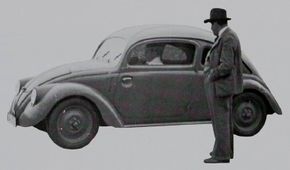
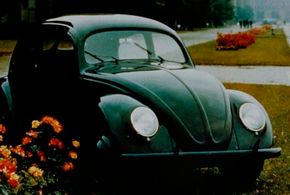
The Volkswagen Beetle was born from a desire to put the Third Reich on wheels. Here, Ferdinand Porsche observes a 1930s Beetle prototype. See more Volkswagen Beetle pictures.
2007 Publications International, Ltd
The 1931-1945 Volkswagen Beetle represented the first generation of the enduring little car whose history is rife with irony, intrigue, and surprise.
Interrupted by World War II, the 1931-1945 Volkswagen Beetle designs never saw high-volume commercial production. But they did lead directly to the reliable, low-cost cars that one day would ply roads the world over. This article tells the story of the 1931-1945 Volkswagen Beetle.
Advertisement
The Model T Ford was the first "people's car," but a brilliant engineer named Ferdinand Porsche dreamed of one for the German people. So did Adolf Hitler, who saw a Volkswagen as a way to secure himself as Germany's absolute ruler.
With Der Fuhrer's patronage, Porsche designed a simple yet sophisticated machine with a distinctive beetle-like shape. Porsche's design was heavily influenced by other European designs of small cars. But just as production got rolling, Hitler began World War II and the little car's future was very much in doubt.
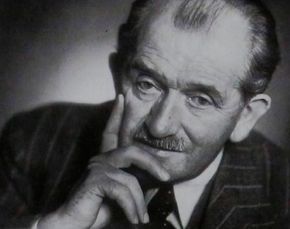
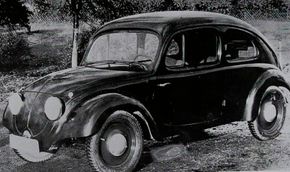
Engineer Ferdinand Porsche, later of sports-car fame, designed the NSU Type 32. Its basic lines carried over to early Volkswagen Beetles.
2007 Publications International, Ltd
Of the many ironies surrounding the Volkswagen Beetle, perhaps the greatest is that such a friendly little car of near universal appeal should be born during Germany's hideous Third Reich. The embryonic version of the car, the 1931-1933 Volkswagen Beetle, sprang as much from the fearsome will of a nationalistic dictator as the fertile mind of a respected engineer.
The dictator, of course, was Adolf Hitler, the failed artist and former army corporal who got himself elected German chancellor in 1933. With the vast majority of his countrymen still demoralized by World War I and suffering anew in the Great Depression, Hitler and his National Socialist Party viewed a revived economy and increased consumerism as ways to win support for the military adventurism and rank genocide they had long sought. So it was that Hitler began to champion a small, affordable "people's car" -- a Volkswagen.
Advertisement
Just two years before, the headstrong but eminently talented Ferdinand Porsche began pursuing this very thing with colleague Karl Rabe. Since 1898, Porsche had worked -- and chafed -- in the employ of automakers like Steyr and Austro-Daimler, so in 1930, at age 55, he established a Konstruktionsburo, an independent design consultancy, in Stuttgart.
Besides Rabe as chief designer, his employees included air-cooled-engine whiz Josef Kales, body designer and aerodynamicist Erwin Komenda, and attorney Dr. Anton Piech. All would prove integral to creating and managing Porsche projects through the years.
The Volkswagen that Porsche would eventually create was ever characterized by a rear-mounted, air-cooled four-cylinder engine in "boxer" format (horizontally opposed cylinders); fully independent suspension with rear swing axles and front transverse torsion bars; a sturdy platform chassis with reinforcing central "backbone"; and an aerodynamic beetle-shaped two-door sedan body in contemporary "streamlined" style.
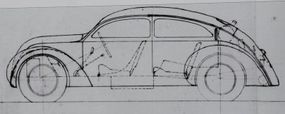
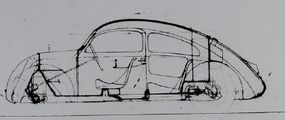
Here's a blueprint drawing for the Porsche-designed 1933 NSU Type 32. A step toward the eventual Beetle, the Type 32 never went into production.
2007 Publications International, Ltd
While none of these ideas were new even in the early 1930s, Porsche's great achievement was to put so much sophistication into one relatively simple car.
Earlier experience had shown the way. For instance, German automaker Wanderer had engaged the Porsche Bureau to design a small sedan that entered production in 1932. Shortly afterwards, Wanderer merged with Audi, DKW, and Horch to form Auto-Union, which led to a swing-axle rear-suspension layout.
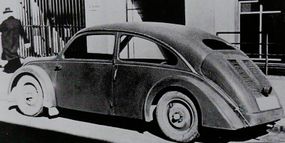
The prototype of the 1933 NSU Type 32 shows a striking resemblance to the later Volkswagen Beetle.
2007 Publications International, Ltd
In addition, the Porsche firm developed and patented a novel independent front suspension with transverse torsion-bar springs. More advances came when Porsche was commissioned to design prototypes of small, inexpensive cars for motorcycle makers Zündapp and NSU, who were then thinking of entering the auto market.
Both projects provided valuable lessons with engineering elements that would later define the Beetle, especially the NSU Type 32 and its air-cooled four-cylinder "boxer" engine. Even so, neither car came to fruition.
Advertisement
1934-1936 Volkswagen Beetle
After being courted by Adolf Hitler to design a small affordable car for the masses, Porsche produced the Volkswagen V3 concept in 1935.
2007 Publications International, Ltd
Development of the 1934-1936 Volkswagen Beetle prototypes centered on Adolf Hitler's specific requirements for the "people's car."
In the early 1930s, Germany's new Führer was touting a national superhighway system -- the Autobahnen -- and the need for affordable cars to traverse them. A politically connected Mercedes-Benz executive, Jakob Werlin, arranged for Porsche to meet with Adolf Hitler in 1934.
Advertisement
First, though, Porsche sent a memo (dated January 17) detailing points with which Hitler was likely to agree. The Volkswagen would be durable and space-efficient; it would cruise at its maximum speed of 100 kilometers per hour (62 mph) and average about 40 miles per gallon of gas; it would easily climb hills; it should have an easily repairable air-cooled engine (service stations were sparse, and German winters can be harsh); it must be large enough for two adults and three children (the ideal Nazi family) plus their luggage; and its platform must be adaptable to a variety of uses. Chillingly, the last included military applications.
Hitler was no less a "car nut" than Porsche, and he was all smiles when the two met in May. Then he dropped a bombshell: Any Volkswagen must sell for no more than 1000 Reichsmarks -- only about $360.
Yet even Hitler realized that was faintly absurd, so he ordered the Reichsverband der Deutsche Automobilindustrie (RDA, German Automobile Manufacturers Association) to assist with developing the Type 60, an evolution of the Type 32 recently begun at Porsche Konstruktionsburo.
With a grudgingly small RDA grant, the Porsche team went to work on the 98.5-inch-wheelbase design. This produced two, largely hand-built prototypes by 1935: a sedan called V1 ("V" for Versuch, or "experimental") and a V2 convertible (party planning called for both body styles).
Further refinement produced a trio of V3 models later in the year. Hitler liked these so much that at the 1935 Berlin Motor Show he ordered the V3 be prepared for production. But when RDA members complained loudly about the sub-RM1000 price -- a genuine threat to their business -- a piqued Hitler made the project a wholly state-run enterprise of the Deutsche Arbeitsfront (DAF), the national labor union.
The motto of one DAF department was Kraft durch Freude, or "Strength through Joy," and it prompted the official name KdF-Wagen, though the car was still widely referred to as the Volkswagen and even Beetle.
The lack of a rear window is evident in this drawing for the 1935 Volkswagen V3 concept.
2007 Publications International, Ltd
For more great articles and pictures on new and classic Volkswagens, see:
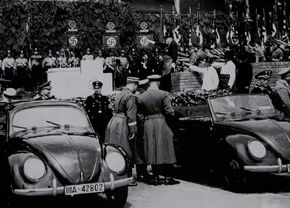
With much fanfare, Adolf Hitler on May 26, 1938, presided over the cornerstone ceremony for the new Volkswagen factory in what would later be called Wolfsburg.
2007 Publications International, Ltd
The development phase covered by the 1937-1940 Volkswagen Beetle included a series of protoypes, a new VW factory, and a prepayment plan designed to help prospective buyers.
After the Volkswagen V3, or KdF-Wagen, was prepared for production, a series of prototypes tagged V30 was next. Though closer still to the eventual Beetle, they lacked a rear window, as had the V3s.
Advertisement
By 1937, Hitler had decided the KdF would be built at a new plant, which would not only remove it from any Reichsverband der Deutsche Automobilindustrie (RDA) influence but create needed local employment.
Land was duly confiscated near Castle Wolfsburg in northern Germany, about 40 miles east of Hanover, and Hitler himself laid the cornerstone on May 26, 1938.
Envisioned as a typical Third Reich monument of heroic proportions, the plant rose quickly on the north side of the vital Mitteland Canal. However, final prototypes, dubbed VW39 and all but identical with the future Volkswagen Beetle, didn't begin testing until July 1939.
Not that it mattered much. With average monthly wages of only RM300, most Germans couldn't hope to buy a KdF outright. The Reich's answer? Pre-pay installments. Prospective buyers received booklets for the pasting in of stamps costing RM5 each (about $1.75). A full booklet, Berlin promised, could be redeemed for one KdF-Wagen.
"The wish of the Führer . . . fulfilled!" shouted propaganda of the time. And shouting there was, Nazi minions boasting of up to a half-million cars a year spewing from the new town of KdF-Stadt (south of the canal), a number as unbelievable as the final DM990 price.
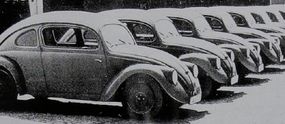
A fleet of Volkswagen V30 Beetle prototypes underwent testing by SS officers stationed near Stuttgart, Germany.
2007 Publications International, Ltd
But the first civilian cars weren't built until August 1940, and then only in a trickle. By that time, the Hitler War had been raging almost a year, and KDF-Stadt was ducking British bombs after turning to airplane assemblies, engine parts, stoves, V1 rockets -- and Beetle-based military vehicles.
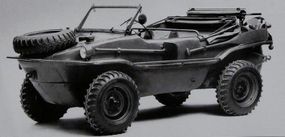
The last comprised the Type 62 Kubelwagen ("bucket car"), the Wehrmacht's Jeep; the improved Type 82 with engine enlarged from 985 to 1131 ccs; the Type 82E, a KdF sedan body on the high-riding Kubel chassis; the Type 86 Kubel with four-wheel drive instead of rear drive; the Type 87, a 434 82E; and most successful of all, the amphibious Type 166 Schwimmwagen.
Porsche Bureau was heavily involved in engineering all of these (starting as early as 1937), and the 166 pleased Hitler so much that he made Ferdinand an honorary SS officer, thus allowing the postwar French to charge the apolitical Porsche as a collaborator, which he wasn't.
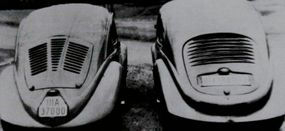
Neither of these early Beetle concepts, the Volkswagen V30 (left) and the Volkswagen V3 (right) had a rear window. Their "Beetle" form is obvious.
2007 Publications International, Ltd
Advertisement
1944-1945 Volkswagen Beetle
Nazi leader Adolf Hitler named the Volkswagen KdF-Wagen after a German Labor Front motto meaning Strength Through Joy.
2007 Publications International, Ltd
The final years of World War II had a devastating effect on the 1944-1945 Volkswagen Beetle, but the popular little car found a way to persevere.
In late 1944, the Porsches and their staff evacuated to the family estate at Zell am See, Austria, where son Ferry, Karl Rabe, and Erwin Komenda would fashion the first Porsche automobile. The tide of war had turned, and more than two-thirds of the Volkswagen KdF factory lay in ruins.
Advertisement
By spring 1945, with American troops advancing, some workers, including many Nazi-sentenced slave laborers, began destroying as much as they could of what little was left. In one of history's stranger moments, a few English-speaking expatriates actually sought out and surrendered to an American column a full four weeks before V-E Day.
With the partition of Germany, KdF-Stadt was renamed Wolfsburg and came under Allied protection, though it would have been in the Russian Zone had it been located just 10 miles further east. Because Britain and not the U.S. had charge of the region, the future of the Volkswagen Beetle, its factory, and the town fell to a detachment of the Royal Electrical and Mechanical Engineers commanded by Major Ivan Hirst.
Slowly and with great difficulty, Hirst and company got things moving again, providing food and shelter to war-weary inhabitants, restoring heat and electricity, and seeing what might be salvaged of Hitler's automotive dream.
Most successful of the military Volkswagens was the
2007 Publications International, Ltd
As it happened, a surprising amount of tooling and parts had survived Allied bombs, and they were dusted off to build a few more Kubels and even some Volkswagen Beetle sedans for British and French forces in need of light transport. Soon, Hirst had military orders for no fewer than 10,000 vehicles, and his workforce quickly grew from just 450 (versus some 16,000 in wartime) to over 6,000.
By the end of 1945 they had built either 1,785 or 2,490 vehicles (records vary). Somehow, after the most horrific war in history, the modest Wagen fur das Volk was still alive.
Advertisement
Cite This!
Please copy/paste the following text to properly cite this HowStuffWorks.com article: