Image Gallery: Concept Cars

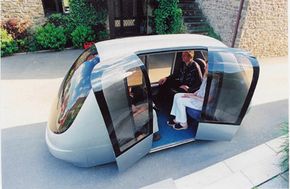
Image Gallery: Concept Cars The marketing manager of Team-LUX exhibits a driverless car at the Science Museum in London. See more concept car pictures.

Chris Young/AFP/Getty Images

Introduction to How Driverless Cars Will Work

We've all had those days: rushing around, trying to get errands done. You finally got the dry cleaning, and now you've got to get to the post office before it close­s. So you go, pedal to the metal, thinking about what you need to get at the grocery store for dinner, when it hits you -- or, you hit it. While your mind was some place else, the car in front of you stopped, and you rear-ended it.

What could have prevented the accident? The obvious answer is that you could have -- by paying attention. But that answer isn't so simple. Driver error is the most common cause of traffic accidents, and with cell phones, in-car entertainment systems, more traffic and more complicated road systems, it isn't likely to go away. But if drivers aren't going to concentrate on the road, who is? If technology continues on its current course, your car will do the concentrating for you. Automakers are developing complex systems that allow cars to drive themselves. They're also furthering existing technologies such as self-parking and presafe cruise control. You may even be surprised to find out your old clunker already sports some driverless technologies.

In this article, we'll learn about the technology behind cars that can operate with minimal input from drivers, including how far away these cars are from production and what some of the downsides are.

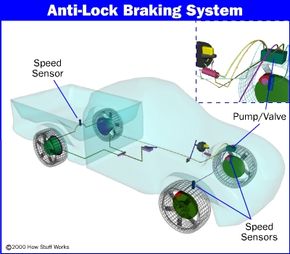
Anti-lock brakes, a standard feature in most cars, are a basic form of driverless technology.

2008 HowStuffWorks

Current Driverless Car Technology

One of the main impetuses behind the call for driverless cars is safety. Because driver inattention and driver error cause so many accidents each year, it's natural for carmakers to focus their efforts on systems that can make cars safe, even if drivers aren't. There's a continuum of these "driverless" systems -- some don't seem driverless at all, and others are on par with science fiction cars.

One of the driverless systems that you may not have realized was driverless is anti-lock brakes. Sounds surprising, doesn't it? After all, anti-lock brakes need the driver in order to work. Still, they represent one end of the driverless continuum because anti-lock brakes perform a function that drivers used to have to do themselves. When a car is braking hard and doesn't have anti-lock brakes, the wheels can lock up, sending the car into an out-of-control skid. In a car without anti-lock brakes, the driver has to pump the brake pedal to keep the wheels from locking up. With anti-lock brakes, the system does the pumping for the driver -- and does it better than the driver. The system can read the wheels and knows when they are about to lock and react faster and with a more appropriate response than a driver could. Anti-lock brakes are one of the first technologies that take cars in a driverless direction.

Another type of driverless system is traction or stability control. These systems are so transparent that usually only professional drivers recognize when they've taken control. Like anti-lock brakes, traction and stability control react better than a driver ever could. Unlike anti-lock brakes, these systems are very complicated and use multiple systems within the car to keep the driver from losing control.

Stability and traction control are systems that can detect when a car might go into an out-of-control skid or roll over and work to prevent that from happening. The systems are constantly reading the car's direction, speed and how well each wheel is connecting to the road. When it detects the car going out of control or starting to roll, stability or traction control will step in. Unlike a driver, these systems can apply brakes and increase or decrease power to individual wheels, which is often better than brakes or power being applied to all four wheels. When working properly, the system gives just the right response, unlike drivers, who often over-correct during emergency maneuvers.

Continue reading to learn about the more sci-fi driverless car tech already on the road.

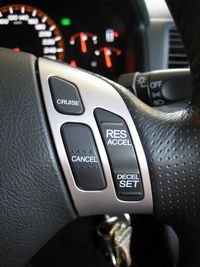
Cruise control is a basic driverless system. Adaptive cruise control falls closer to the sci-fi end of the spectrum.

Ye Liew/Dreamstime.com

Future Car Technology That's On the Road Today

­Now that we've talked about driverless systems that don't seem so driverless, let's look at some that fall a little bit closer to the sci-fi side of the spectrum. Pre-safe systems are starting to become common in certain luxury car brands. The systems differ depending on the car, but what all have in common is that they can anticipate crashes and prepare the car to keep the occupants safe.

Take the example of the rear-end collision from the first page. In a car with a pre-safe system, an alarm might go off as the driver nears the stopped car. At the same time, the pre-safe system might start priming the brakes so that just touching the pedal will apply their full force. While all that's going on, the car will start reducing engine power, which will slow the car and reduce the severity of the crash. Finally, if the system detects that a crash can't be avoided, it will prepare the airbags for deployment and tighten all of the seat belts, keeping occupants safe. What's really amazing is that it will do all that in less time than it takes the driver to slam on the brakes.

Cruise control is another common driverless system that's available in most cars. Cruise control keeps the car at a constant speed, set by the driver, without the driver constantly having to press the gas pedal. Cruise control isn't completely driverless, however, because the driver must watch constantly for slower moving cars in his or her path.

Adaptive cruise control takes care of that. Though it's currently available on only a few cars, it's very simple. Using radar sensors on the front of the car, adaptive cruise control can tell when an object is in front of it and, if the object is moving, how fast it's moving. When cruise control is set, adaptive cruise control will maintain a constant speed, but will also maintain a set distance between it and the car in front of it. That means that if you set adaptive cruise control at 60 miles per hour and come up on a car going 55 miles per hour, adaptive cruise control will automatically decrease your car's speed and maintain a safe distance between the two cars.

Want to go even further into the future? Head to the next page to learn about cars that can park themselves.

Self-parking Cars

It's probably a good guess that if you've damaged a car, it wasn't in a big accident but in a little parking fender bender. Parking is probably the least dangerous thing people can do in a car, but we still manage to mess it up anyway. Though some carmakers have put in rearview cameras, sensors that tell drivers how close they are to surrounding objects -- and even computer generated 360-degree views of the car -- people still manage to scrape, ding and dent their way into parking spaces.

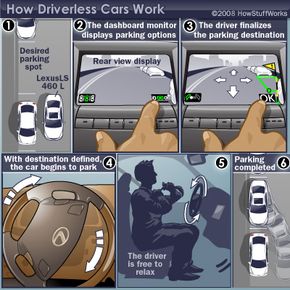
Drivers of the Lexus LS 460 L who opt for the car's Advance Parking Guidance System don't have those problems, though. The system uses sensors all around the car to guide it into a parallel parking space (yes, that means the driver takes his or her hands off the wheel and feet off the pedal). Of course, the system isn't ready for a cameo on "Star Trek" just yet. Before it can work, the driver has to find a parking space, position the car next to it, and use the in-cabin navigation screen to tell the car where it should go. Also, the parking space needs to be 6 feet (1.8 meters) longer than the car (and the LS isn't a short car). Still, the self-parking system is a big achievement in driverless car technology. With it, the car behaves like a driver might -- reading the area around it, reacting accordingly and going safely from point A to point B. While it's not the same as sitting back and relaxing while your car drives you home for the night, it's the first step in that direction.

The next move in driverless car technology may be just around the corner. In fact, some carmakers hope to have driverless cars on the road by 2018. Read on to find out what technology is needed and how it will be applied.

Automated Guided Vehicle Systems

We've all heard stories about kids or dogs that accidentally put a parked car in gear, causing an accident. But have you heard about the frog that can drive your car for you? We're not talking about one of Kermit's relatives; we're talking about FROG (Free Ranging On Grid) technology. FROG technology is used in Automated Guided Vehicle Systems, which are, well, driverless cars. The technology is similar to the self- parking system we discussed on the last page but takes things a little further.

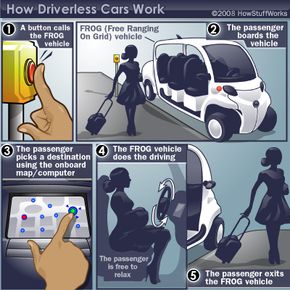
FROG vehicles are equipped with a computer that contains a map of the area in which the vehicle operates. The vehicle starts from a known location and uses the map to determine the route to its destination. It counts wheel revolutions to figure out how far it has traveled (sort of how you might count steps to figure out how far you've walked). To check itself, the vehicle also uses various calibration points (electronic landmarks for the vehicle) in the area it works. This technology is already in use at some ports. FROG vehicles can be loaded with cargo then sent on their own to the unloading area.

FROG can even be used in public transportation hubs. In these cases, passengers go to a stop and push a button -- just like calling an elevator. When the FROG vehicle arrives, passengers get in and push a button for their destination -- again, just like in an elevator. Using the on-board computer, map and calibration points, the FROG vehicle takes the passengers where they want to go.

The problem with FROG technology is that is can be used in only a limited area. Automated highways are being looked at as a way of extending driverless tech to larger areas. While different scenarios are being tested, at their core, automated highways would work together with smart cars: cars that have advanced systems sort of like adaptive cruise control. The highways would be relating information constantly about speed, road conditions, obstacles and directions to the cars, which would be able to interpret and react to the information.

In the next section, we'll find out about the ethics of handing over the driver's seat.

Urban Light Transport is a revolutionary driverless taxicab. It's yet to be seen whether the masses will place trust in driverless cars.

ATS Ltd/BWP Media/Getty Images

Driverless Car Ethics: On-ramps and Speed Bumps

Now, you may be thinking that all this driverless car tech is just around the corner and we're getting ready to step into a driverless utopia. Some agree with you. General Motors and Carnegie Mellon University researchers are working together to develop driverless cars and hope to bring one to the market by 2018. Advocates of driverless car technology point to improved safety (because driver error won't be a factor), decreased traffic and decreased pollution because of the reduced traffic.

Others aren't convinced. Let's be honest -- people like to drive their cars! Driving can be relaxing and freeing, and there are still a lot of bugs to work out of driverless car technology before people will be ready to trust it with their lives. There's also the flip side of driver error: human judgment. Driverless technology will always make the call that protects the car and the people in it. A driver might make a call that does more damage to their car, but saves others. For example, say you're on the road when a car in front of you skids out. There's no time to stop. On the left is a large truck. On the right is a group of children waiting to cross the street. Most drivers would choose to swerve into the truck to avoid hitting the pedestrians. Driverless car technology wouldn't necessarily recognize the children -- it would simply see the path of least resistance and steer the car towards it. It's an extreme example, but issues like this need to be resolved before we can hop in our car, tell it where to take us, and enjoy the ride.

To learn more about driverless cars and driverless systems, look over the links on the next page.

Lots More Information

Sources

  • Ashley, Steven. "Smart Cars and Automated Highways" Mechanical Engineering Magazine. May, 1998. http://www.memagazine.org/backissues/membersonly/may98/features/smarter/smarter.html
  • Greene, Kate. "Stanford's New Driverless Car." Technology Review. June 15, 2007. http://www.technologyreview.com/Infotech/18908/?a=f
  • Innovative Transportation Technologies. "ParkShuttle." http://faculty.washington.edu/jbs/itrans/parkshuttle.htm
  • Krishner, Tom. "GM Researching Driverless Cars." MSNBC. January 6, 2008. http://www.msnbc.msn.com/id/22529906/
  • Squatriglia, Chuck. "GM Says Driverless Cars Could Be on the Road by 2018." Wired Magazine. January 7, 2008. http://blog.wired.com/cars/2008/01/gm-says-driverl.html
  • Strauss, Eric. "CES 2008: A Driverless SUV Gives Tour of the Future." ABC News. http://abcnews.go.com/Technology/GadgetGuide/story?id=4101838
  • Tierney, John. "In the Future, Smart People Will Let Their Cars Take Control." The New York Times. December 4, 2007. http://www.nytimes.com/2007/12/04/science/04tier.html
  • Trillan, Calvin. "Park, He Said." The New York Times. January 26, 2007. http://www.nytimes.com/2007/01/26/opinion/26trillin.html