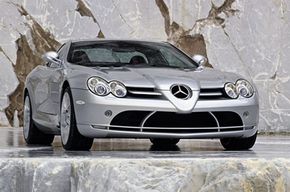
Just how much car does half a million dollars buy you? In the case of the Mercedes-Benz SLR McLaren, quite a lot. The SLR unites the Formula One-proven technology of McLaren with Mercedes engineering, listing a carbon fiber chassis and a 600-plus horsepowerengine among its features.
Most ultra-fast supercars have sacrificed comfort for performance, but the SLR tries to give drivers the best of both worlds. In this article, we'll see how McLaren and Mercedes have managed to create a world-class high-performance car with windshield wipers that still work at 200 mph.
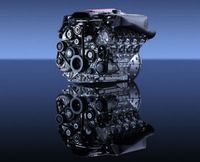
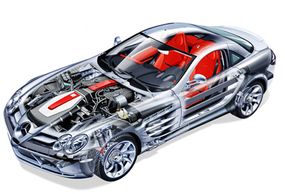
The SLR's eight-cylinder engine was developed by Mercedes-AMG.
Photo courtesy Daimler Chrysler
Here's a summary of what's under the hood (click on the terms for more information). Like most supercars, the SLR is built around an extremely powerful engine. The 332 cubic inch (5.5 L) V8 engine was hand-built by AMG, a company that usually modifies Mercedes-Benz street cars into full-fledged race cars.
Both the block and the heads are aluminum, with single overhead cams and an 8.8:1 compression ratio. A twin-screw Lysholm supercharger with two intercoolers cranks the horsepower up several notches. A dry sump system allows the engine to be mounted lower, dropping the car's center of gravity. This placement allows for 617 horsepower at 6500 RPM. The torque is just as impressive with 575 foot-pounds at 3250 RPM.
Advertisement
Photo courtesy Daimler Chrysler
Power transfer is handled by a five-speed "manumatic" transmission -- the driver can shift electronically at the push of a button. Mercedes' Electronic Stability Program (ESP) helps drivers handle all that power by constantly monitoring traction, adjusting torque, and selectively applying the brakes to prevent the car from spinning out of control. The ESP system has both a full setting and a setting that puts more control into the hands of the driver, but it can't be turned off completely. Mercedes feels that more than 600 horsepower is a bit much for even experienced drivers to handle, an opinion backed by test drivers at Car and Driver magazine.
McLaren reports that the SLR can go from zero to 60 mph in 3.8 seconds, with a top speed of 207.5 mph. Car and Driver reports an even faster zero to 60 time of 3.6 seconds [ref].
Next, we'll see how this dream car handles.
Advertisement
Control, Style and Function
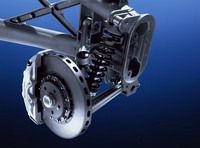
The fiber-reinforced ceramic brake discs.
Photo courtesy Daimler Chrysler
The SLR has independent control arms of unequal length, with coil springs on all four wheels and an anti-roll bar in the front. A rack-and-pinion steering system controls the specially designed Michelin Pilot Sport PS2 tires (Front: 245/35ZR-19 96Y; Rear: 295/30ZR-19 100Y), which are mounted to 19-inch cast aluminum asymmetric turbine wheels. Special ceramic disc brakes, manufactured for heat resistance and strength, provide up to 1.3 Gs of stopping power.
All of these features help to give the SLR a 40-foot turning radius and 161-foot braking distance from 70 mph. The rear spoiler acts as an automatic air brake, raising up to a 65 degree angle to provide additional downforce and stability. It drops back down for flat-out high-speed runs.
Advertisement
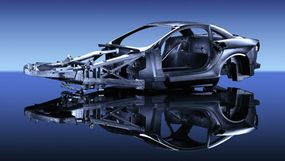
Just like a Formula One racing car, the bodywork of the new Mercedes-Benz SLR McLaren is made of carbon fiber.
Photo courtesy Daimler Chrysler
Just like a Formula One racing car, the bodywork of the new Mercedes-Benz SLR McLaren is made of carbon fiber.
Photo courtesy Daimler Chrysler
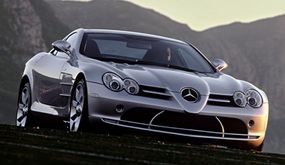
The SLR looks different from most supercars. Most have the engine mounted behind the driver, and aerodynamic considerations force the car's shape into a low, sleek profile. Mercedes and McLaren engineers decided to go with a front-mounted engine, which helps give the car its distinctive shape. The engine is mounted as far back in the compartment as possible, sitting behind the front axle. The gives the SLR nearly 50/50 front to rear weight distribution, a major factor in the car's overall handling. It also means that the engine compartment looks a bit strange. The engine itself peeks out from beneath the windshield, only about half of it extending out into the engine compartment itself. A giant air intake nozzle fills up most of the area beneath the hood. The resulting shape is a car with a long snout, a compact driver compartment, and a rounded-off rear.
The frame is also highly advanced, with a monocoque carbon-fiber tub making up the main chassis and sub-frames in the front and rear. The rear sub-frame is made from aluminum. Tubes and pockets made of carbon fiber within the frame are based on safety designs from McLaren's F1 efforts, and absorb four times as much energy as steel in an impact.
Styling on the SLR is further defined by large air vents in the body just behind the front tires, and sidepipe exhaust headers below. It retains the familiar Mercedes look, with a large badge and twin-lamp elliptical bi-xenon headlights. The body panels are made from carbon fiber reinforced plastic.
Up next, take a seat in an SLR.
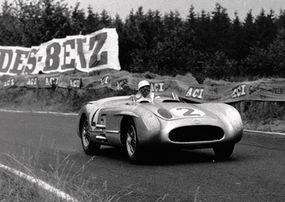
Juan Manuel Fangio took the race win in a 300 SLR at the 1955 Swedish Grand Prix.
Photo courtesy Daimler Chrysler
Advertisement
Inside the SLR
Photo courtesy Daimler Chrysler
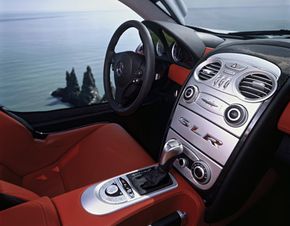
Many supercars skimp on creature comforts, and some of them don't even have interior carpeting. But Mercedes wanted the SLR to be something of a Bose sound system add to the luxury, and there's also a navigation system.
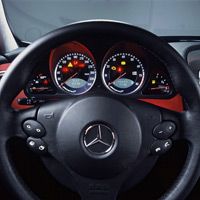
The carbon fiber bucket seats are covered in "Silver Arrow" red leather. Six air bags protect driver and passenger alike from impacts in eight directions. Switches controlling the air brake and transmission are mounted on a console in the middle of the dashboard, while shifting thumb switches are located on the steering wheel. The car is started with a flip-top covered button on the shift lever.
Advertisement
The SLR sports a multifunction steering wheel with F1-style manual gearshift buttons.
Photo courtesy Daimler Chrysler
Jay Leno (car collector and proud owner of an SLR) summed up the combination of performance and comfort features in a recent 4Car column: "One minute you can be tearing through the hills, hooligan stuff. The next minute you can take the wife in it, you can park it. I think the Mercedes-McLaren is the perfect compromise between road car and racer" [ref].
On the other hand, car purists might feel that the SLR's comfort diminishes speed and handling. After all, why build a 600-horsepower car and then weigh it down with power seats? Or, as Leno put it, "I have yet to play a CD in it; the SLR's entertaining enough without distractions" [ref].
Mercedes has set a retail price of $452,750 for the SLR, not including taxes. But even if you have the money, rarity could be an obstacle -- only 3,500 SLRs will be produced over the next seven years.
For more information on the Mercedes SLR and related topics, check out the links on the next page.
Carbon Fiber By Land And Air -- See the SLR next to a Beechcraft Premier 1
Sources
"Bruce McLaren: F1 King." The New Zealand Edge. http://www.nzedge.com/heroes/mclaren.html
"DaimlerChrysler announces the new Mercedes-Benz SLR." http://www.mclarencars.com/content/sections/press/slr99.htm
History of McLaren: TimeLine. http://www.mclaren.com/history/history_mclaren.htm
Leno, Jay. "Jay Leno -- The Mercedes-McLaren SLR." April 25, 2005. http://www.channel4.com/4car/feature/features-2005/leno-columns/mclaren-slr.html
McLaren Cars. http://www.mclarencars.com/
Mercedes Benz SLR McLaren: The Obession. http://www.mbusa.com/microsite/slr/index.jsp
Roebuck, Nigel. "Perfection Quest: McLaren's new headquarters is not your everyday race shop." Autoweek, January 31, 2005. http://www.autoweek.com/article.cms?articleId=101655
"Silver Arrow Set to Fly Again at Goodwood." German Car Fans. September 29, 2004. http://www.germancarfans.com/classics.cfm/ClassicID/5040331.021/mercedes/1.html
Winfield, Barry. "Pedigree, power, and paradox find a home in the new SLR." Car and Driver, January 2005. http://www.caranddriver.com/article.asp?section_id=3&article_id=8898&page_number=1
Winfield, Barry. "Sport. Light. Racing. Again." Car and Driver, February 2004.
Cite This!
Please copy/paste the following text to properly cite this HowStuffWorks.com article: