Car seats are a necessity when riding with a child. Betsie Van Der Meer / Getty Images
Most of us wouldn't even think of travelling in a car without fastening our seatbelt, and for good reason. In a crash, at just 30 miles per hour (48.3 kilometers per hour), an unrestrained passenger is thrown forward with a force thirty to sixty times their body weight. What if that unrestrained passenger were a small child? The child would almost certainly be hurled about inside the vehicle, injuring themselves and other passengers. Worse still, they're likely to be thrown from the vehicle through one of the windows.
It's not even safe to hold a child on your lap while driving. In a crash, the child could be crushed between your body and part of the interior of the car. Even if you were held in by a seatbelt the child would be pulled from your arms by the force of the collision. You simply wouldn't be able to hold on to the child, no matter how hard you tried.
Advertisement
The bottom line is that the safest way for children to travel by car is in a child seat that is suitable for their weight and size, and is fitted correctly. In this article, we'll examine the technology at work and find out how to choose the best child seat.
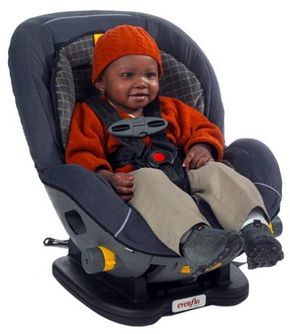
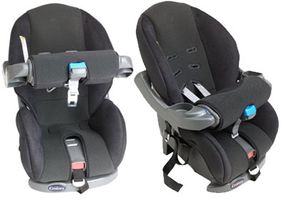
The safest place for your child is in a properly fitted child car seat. The seat pictured here is an Evenflo Triumph with LATCH system; featuring a 5-point harness.
Photo courtesy Amazon.com
When a vehicle collides with another object - a tree, a wall or another moving vehicle, for example - it is stopped suddenly by the impact. However, anything not held down inside the vehicle will keep moving, and that includes the passengers. This happens because of inertia. Inertia is an object's tendency to keep moving until something else works against this motion.
Imagine that you're coasting at a steady 50 miles per hour (80.5 kilometers per hour). Your speed and the car's speed are pretty much equal, so you feel like you and the car are moving as a single unit.
Advertisement
But if the car were to crash into a telephone pole, it would be obvious that your inertia and the car's were absolutely independent. The force of the pole would bring the car to an abrupt stop, but your speed would remain the same. Your face might hit the windshield, the steering wheel or the back of the seat in front of you. Your ribcage might hit the dashboard. You could even be thrown from the vehicle. Your internal organs, too, will keep moving. Your brain would be compressed towards the front of your skull, and your heart, lungs and kidneys could smash into each other or into bone. It sounds horrific, and that's why we wear seatbelts. Seatbelts are designed to hold you into the car and spread the destructive force of the impact over the more resilient parts of your body, increasing your chances of avoiding death or serious injury in a crash by up to 50 percent.
However, seatbelts are designed for adults. They go across your middle and over the shoulder, applying most of the stopping force to your ribcage and pelvis. For a seatbelt to do this effectively it must fit correctly, and on a small child the seatbelt is simply the wrong size to do the job. Instead, a specifically designed child car seat should be used.
There are three basic types of child car seats, each designed for different ages (and sizes) of children:
Rear-facing infant seats and convertible seats
Forward-facing child seats
Booster seats and backless boosters
First, let's take a closer look at rear-facing infant seats and convertible seats.
Learn More: Baby Names, Nuseries and Education
Over the last fifty years, American parents have radically increased the variety of names they give their children. In the 1950s, the 50 most popular names accounted for 63.4 percent of all boys born, and 52.1 percent of all girls. But by 2004, the top 50 names covered only 34.6 percent of the boys and 24.4 percent of the girls. Find out how baby names have evolved over the years.
From the moment you bring your precious infant home, his or her (or their!) room should be a special place for you and your child. So the sooner you feel comfortable in the nursery, the better. Find our more about decorating your nursery.
If you're like most parents with a baby or toddler, chances are the name "Baby Einstein" is part of your everyday vocabulary. Your playroom may, in fact, include copies of "Baby Mozart" and "Baby DaVinci" right alongside your child's building blocks, stacking rings and other toys. Read more about Baby Einstein products, and whether they're right for your family.
Advertisement
Rear-facing Infant Seats and Convertible Seats
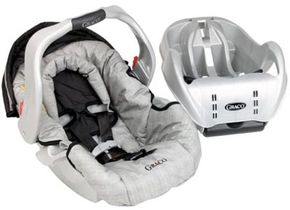
Graco SnugRideThis rear-facing seat has a separate plastic base that can be left in your vehicle, while the seat serves as portable unit.
Photo courtesy Amazon.com
Rear-facing infant seats are generally suitable for babies up to 22lbs (about 10 kilograms), roughly from birth to 12 months. Although they can be fitted in the front if absolutely necessary, it is much safer to install all child car seats in the back seat of the car. This is especially important if there is a passenger side air bag in the front seat. Were anything to cause the air bag to deploy, the force of the deployment would be enough to cause serious injury to a child in the front seat. In fact, according to the National Highway Traffic Safety Administration (NHTSA) all children age 12 and under should ride in the back seat.
The rear-facing design of these seats provides greater protection for the baby's head, neck and spine than forward-facing seats, and it really is best to keep your baby in a rear-facing seat for as long as possible. Of course, once the child has exceeded the maximum weight of the baby seat, it no longer offers adequate protection. The same is true if your child's head has become higher than the top of the seat, when it will no longer be properly cushioned against an impact. At this point, replacement with a seat specifically designed for toddlers is necessary.
Advertisement
Some infant seats come with additional features that may increase safety or simply make using them more convenient. Some models have detachable bases that attach to the car, to remain in place until the seat is no longer necessary. The actual safety seat simply snaps onto the base and locks in place, allowing you to use the seat as a baby carrier. This way your baby can be carried in and out of the car without having to re-install the entire seat each time. In some models, the base may be adjusted for comfort, or to give more room for growing babies.
If you're finding it difficult to locate a seat to fit your child's height and weight then shop around - some manufacturers offer convertible seats with higher weight and height limits. A convertible seat is bigger and heavier than an infant-only seat, and can be used longer and for larger children. Once your child reaches the appropriate weight or height, a convertible seat can be turned around and, by following the manufacturer's instructions, used as a forward-facing child seat.
Infant and convertible seats are fastened into the car using the vehicle's seatbelt and/or LATCH system (discussed later in this article), and the child is secured to the seat with one of the following harness styles:
The three-point harness has straps that cross over the shoulders and fasten to a buckle near the bottom of the seat.
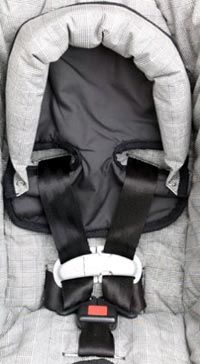
The five-point harness has five straps: two at the shoulders, two at the hips and one at the crotch.
The overhead shield features a padded shield that swings down around the child, similar to the restraints often found on fairground rides.
A t-shield consists of a padded t-shaped or triangular shield attached to shoulder straps. Rather than swinging over the child, this shield is attached to the front of the unit.
Three-point harness system
Photo courtesy NHTSA
Five-point harness system
Photo courtesy Amazon.com Graco SnugRide
Overhead shield harness system
Photo courtesy Amazon.com Graco Accel Overhead Convertible Car Seat
If you're thinking about purchasing a convertible seat rather than a dedicated rear-facing model, bear in mind that an overhead shield or t-shield may not be suitable for small children. In fact, the five-point harness is considered to be the best option because it is easily adjusted to perfectly fit your child.
Now, let's take a look at forward-facing child car seats.
Advertisement
Forward-facing Child Seats
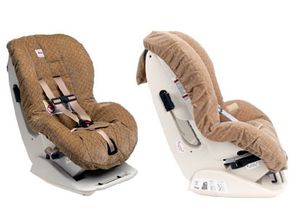
This convertible car seat is suitable for kids up to 40 pounds and should be installed rear facing for infants weighing 5-33 pounds and forward facing for children weighing 20-40 pounds.
Photo courtesy Amazon.com Britax Roundabout Car Seat
As your child grows they will quickly exceed the manufacturer's recommendations for using a rear-facing infant seat. For children older than 1 year and heavier than around 20lbs (9.1 kilograms) a forward-facing seat becomes suitable. If you have purchased a convertible infant seat, then by following the manufacturer's instructions, you will be able to turn your infant seat around and continue to use it. Alternately, you may choose to purchase a dedicated forward-facing child seat.
Advertisement
A forward-facing seat is best used in the rear of the car, where the seatbelt or LATCH system is used to secure the seat itself and integral restraints are used to secure the child. Although it can be installed in the front of the vehicle if necessary (maybe you're driving a truck with no back seat), this must never be done when a passenger air bag is installed. Some more recent model trucks have on/off switches for the passenger side air bags. If you must travel with a child in the front seat of a truck, and you do have an on/off switch, turn the air bag off.
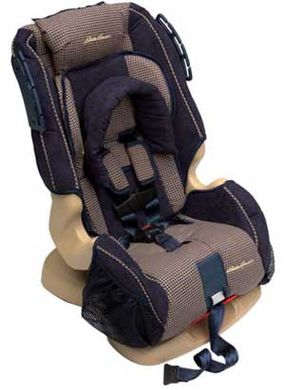
This convertible car seat can be a rear-facing infant seat, a forward-facing toddler seat, and a forward-facing booster seat for older children.
Photo courtesy Amazon.com Cosco Eddie Bauer 3 in 1 Car Seat
Safety Zone
Yes, the back seat is always best. According to the NHTSA, placing a child in the back seat instead of the front seat reduces the risk of death by 27 percent, whether the car has a passenger-side air bag or not.
Advertisement
Booster Seats
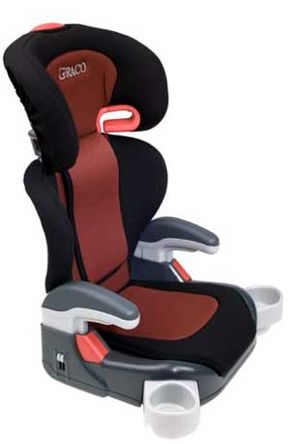
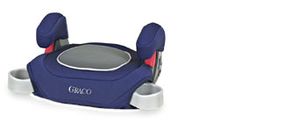
Graco TurboBoosterAppropriate for children from 30-100 pounds, this model comes complete with adjustable arm rests and dual slide-out cup holders.
Photo courtesy Amazon.com
When a child is too big for a harnessed car seat, it's time to use a booster seat. A child is to be considered "too big" if he/she exceeds the manufacturer's weight limit or the top of his/her head is higher than the top of the seat. Usually a child will need a booster seat between the ages of four and six.
Advertisement
We found out earlier that a seatbelt is designed to sit across the pelvis and ribcage, spreading the force of an impact over the strongest parts of our skeleton. A booster seat works by raising the child so that the adult seatbelt fits across these areas. Since the car's built-in seatbelt is being used, booster seats do not have an integral harness to hold the child in place; instead, the seatbelt holds in both the child and the seat. This means that it is extremely important to ensure the belt is correctly adjusted.
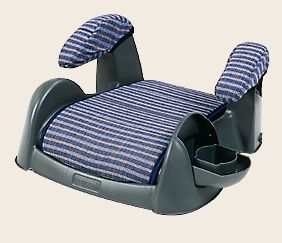
Backless Graco TurboBooster
Photo courtesy NHTSA
You want to make certain that:
The belt is fastened securely and is as tight as possible.
The belt should go over the pelvic region, not the stomach.
The diagonal strap should rest over the shoulder, not the neck.
Usually by the age of six, or when a child can sit up straight on their own, without slumping or slouching, he/she can graduate from a full booster seat to a backless booster seat. A backless booster seat is simply a standard booster seat without the backrest. As with other car seats, you can find convertible booster seats that transition from a backrest-inclusive model to backless. It's important to remember that, when sitting in a backless booster seat, your child should sit up straight so that the diagonal strap of the seatbelt rests on your child's shoulder and not across his/her neck.
Dorel/Cosco AutoBooster
Photo courtesy NHTSA
A child is not ready to use a regular seat belt until:
He/she is tall enough so that his/her legs bend at the knees against the edge of the seat.
He/she is mature enough to remain seated with his/her back flat on the seat, not slouching.
The lap belt sits high on the thighs or low on the hips, not on the stomach.
The shoulder belt crosses the shoulder and chest, avoiding the arms and the neck.
A child ready to use an adult seat belt without the aid of a booster seat will be around 4 feet, 9 inches (about 1 1/2 meters) tall and roughly eight years old. Please keep in mind that, because children do vary in size by age, some children could still need a booster seat at the age of 10 or 11.
Advertisement
Buying a Car Seat
LATCH System
Photo courtesy NHTSA
What you'll be looking for when you go to buy a car seat will depend on several factors, including the age of your child and the type of vehicle you drive. There is no 'best' car seat; the best seat is one that is suitable for both the weight and size of your child. All current car seats on the market pass necessary safety standards. Select the one that best fits your child and your vehicle. Some models have different features; choose the one that helps you use it correctly every trip and don't be tempted to assume that a higher price means a higher level of safety.
Advertisement
Make sure that the harness fits your child snugly, that the car seat is well fitted and that your vehicle seatbelts are in good condition. If you can't try the car seat out before buying it, then make sure there is some sort of return policy. If the seat doesn't fit your child or vehicle, or you decide it's just not the right seat for your child, you'll want to be able to return it for a refund or store credit.
It is tempting to purchase second hand car seats. If you are considering a second-hand model, pay particular attention to the age of the seat. Try to avoid car seats over six years old or those which may have been in a crash, and look carefully for cracks or signs of wear on the seat and restraints. Whether you're purchasing something new or second-hand, pay attention to recall notices. For more information regarding child car seat recalls, check out the U.S. Consumer Product Safety Commission Web site or the NHTSA Web site.
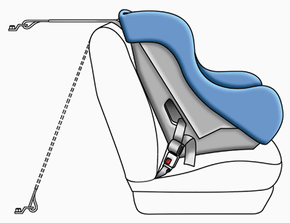
When looking for car seats you may see references to LATCH. This is a new system developed to make car seats easier to use safely. LATCH stands for "Lower Anchors and Tethers for Children" and eliminates the need to use seat belts to secure the child car seat to the vehicle. However, your vehicle must be fitted with the anchor system. Starting in the year 2002, most new vehicles began to be manufactured with the LATCH system installed. LATCH is not necessarily safer than using seat belts to secure a car seat, though it may make it easier to achieve a safe installation. Your child car seat retailer will be able to advise you on suitability for your vehicle. Many of today's child car seats can be used with both the LATCH system and regular seatbelts. So if you have two cars, one with the LATCH system and one without, but only have one car seat, you'll want to find a seat that works with both restraint mechanisms.
Advertisement
Buying-time Checklist
Infant Car Seat
Here's what to look for when buying an infant car seat:
Use a rear-facing seat, rated for up to 20 pounds (9.07 kilograms). You will be able to find models that go to 22, 30 or 35 pounds (9.8, 13.6 or 15.9 kilograms), if necessary.
A 5-point harness is preferred.
A front adjuster to tighten the harness makes it easier to use.
Newborn babies and infants should have a maximum recline of 45 degrees. Some car seats have built in angle indicators and adjusters to help get the correct recline.
Most models with a handle will require that the handle be lowered when traveling.
A rear-facing tether, impact foam and rebound bar may improve safety.
Dedicated infant seats may fit your child better than convertible models.
Some models may include a complete base system and stroller, while others may just have a convenient base. Select the system that is most suitable for you.
Convertible Car Seat
When looking for a convertible car seat, you'll want to keep the following in mind:
Advertisement
A rear-facing seat is safer. Select a model with a 30 or 35 pound (13.6 or 15.9 kilogram) rear-facing weight limit and keep your child rear-facing as long as possible.
Your seat should be converted to front facing when the top of your child's head reaches the top of the seat, or when the child reaches the 30 or 35 pound (13.6 or 15.9 kilogram) rear-facing limit.
Try to find a model with a 5-point harness and a front harness adjuster.
Some models feature tethers that can be used rear-facing and have impact foam for added safety. And, some models may also have built-in locking clips.
Booster Seats
When buying a booster seat, consider this:
A booster seat is best used after your child reaches 40 pounds (18.1 kilograms), and is used with a lap and shoulder belt.
Use the booster seat until the manufacturer's weight limit is met or until your child can wear a seatbelt properly.
Use a high backed model if your vehicle has low seat backs with no head rests. A backless model is fine if your vehicle has headrests.
Many booster seats have adjustable head supports and extra padding for comfort.
Advertisement
Getting It Right
We've seen that children are safer in the back of the car and should be placed in an appropriate car seat or booster until they can be seated properly using the seat belt. We also know that for a car seat to be effective it has to be fitted correctly.
Sadly, many people buy and install their car seats but fail to ensure it is securely fastened and properly installed. You should always use the correct harness slots and make sure they are snug; all seats are different but the instructions will offer guidance on the correct route for the seat belt. The seat should be tightly secured - pulling on it as a check before each journey is a good habit to get into. The seat should not move easily from side to side or towards the front of the car. Your seatbelt might have a locking system built in, but if not you'll need to invest in one.
Advertisement
When your child is in the seat, it is important to have the harness chest clip in the right place - the child's mid-chest or at armpit level. Straight harnesses with the straps positioned at or slightly above the child's shoulders are a must. If your child needs a blanket or another covering, place it over the top of the harness rather than trying to stretch the straps of the harness over the covering.
Of course, all seats come with a full set of instructions and it's well worth double-checking to make sure you've installed your car seat as safely as possible. Remember, following the instructions is vital to ensuring the safety of your child.
For more information on child car seats and related topics, check out the links on the next page.