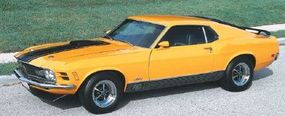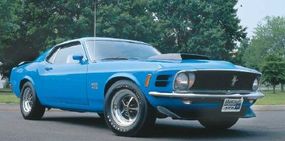
1969, 1970 Ford Mustang Overview
As rapidly as they had climbed in the early years, sales of Dearborn's sporty car were plummeting as preparations continued on what would become the 1969 Ford Mustang. Was Mustang losing it's magic? The question was particularly important to a new company president, recruited from a surprising source, who immediately made his mark with two of the greatest cars in performance history.
Success has many fathers, the old adage says, but Mustang had only one -- or so the public was told. We know better now, but there's no question that the Mustang's instant phenomenal success was a huge career boost for Lee Iacocca. By 1968 he had been moved up to executive vice-president of Ford's North American Operations.
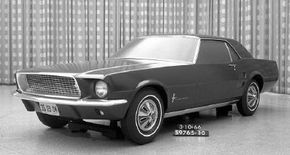
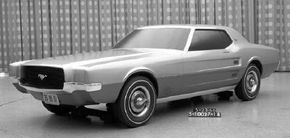
![]() When design work toward the '69 Mustang began in October 1965, efforts immediately focused on much greater size and luxury-car styling cues. See more pictures of the 1969 and 1970 Ford Mustangs. |
Words and pictures tell only part of the Mustang story. For vehicle dimensions, engine data, annual sales figures, prices and other information, check out 1969 and 1970 Ford Mustang specifications.
He brought to Ford genuine car-guy sense, an eye for clean design, and an outspoken personality. Let him tell you about it in Larry Shinoda: Creator of the Ford Mustang Boss 302. In the 1960s, it was the premier venue for fender-to-fender pony car racing and was contested by some of the biggest names in motorsport. Dive into the action with The Ford Mustang Goes Trans-Am Racing. The 1970 Ford Mustang Boss 302 was a Chevrolet Camaro Z28 fighter. Learn about this unique muscle car, and see photos and exclusive specifications. |
Such was the background on February 6, 1968, when Ford announced that its chairman had selected a new president: veteran General Motors executive Semon E. "Bunkie" Knudsen. Detroit was astonished. Here was probably the most startling managerial shift since 1922, when Bunkie's father, William S. Knudsen, left Ford for Chevrolet after an argument with Henry Ford I. "Big Bill" quickly built Chevy into a Ford-beater, and his son made Pontiac number-three in the late Fifties before taking command at Chevrolet. Now Bunkie aimed to remake Ford. Ironically, he accepted HFII's invitation after being passed over as GM president in favor of Ed Cole.
Author Gary Witzenburg observed that "Knudsen, like Iacocca, was a hard-charging, dynamic, ambitious leader who…arrived at Ford amid a tornado of press and public attention and [was] full of big ideas on how to attack his former employer in the marketplace." Rumors of a management shake-up were flying even before Bunkie moved into Ford's "Glass House" headquarters. Though he did make some changes, there was no wholesale cleanout. But several Ford execs did resign after Knudsen came in, and Iacocca reportedly threatened to. Knudsen, for his part, was content to work with the Mustang's celebrated papa, but their relationship was uneasy at best, the two men clashing on several occasions.
Knudsen was too late to influence the Mustang's planned 1969 redesign, which had been pretty much locked up for a year before he arrived. But he was able to add two very hot mid-season models while laying the groundwork for bigger, bolder future Mustangs. Knudsen loved burly high-performance cars, especially low, sleek fastbacks. He also loved NASCAR stockers and Trans-Am racers, perhaps because they resembled showroom wares.
Mustang sales had been waning since 1966, but Bunkie didn't seem concerned. "We are comparing today's Mustang penetration with [years] when there was no one else in that particular segment of the market," he explained. And he had thoughts on how to fire up sales. "The long-hood/short-deck concept will continue," he promised, but "there will be a trend toward designing cars for specific segments of the market." He also assured the press that Ford would continue in NASCAR and Trans-Am.
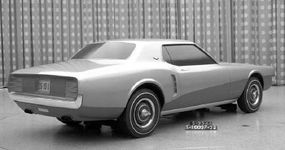
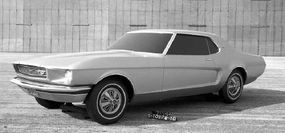
![]() Ford managers ordered "more Thunderbird influence" in the '69 Mustang design, which inlcuded experimentation in May of '66 with busy side sculpturing, big square grilles, and hidden headlamps. |
Almost immediately, Knudsen decided that Ford needed to develop "the killer street car," to use Witzenburg's term -- and that it should be a Mustang. To help create it, he hired designer Larry Shinoda away from GM and teamed him with Dearborn talents like Harvey Winn, Ken Dowd, Bill Shannon, and Dick Petit. With engineering assistance from Ed Hall, Chuck Mountain, and others, Shinoda's crew whipped up a bevy of eye-opening concept cars like the King Cobra, a slicked-down Torino fastback designed for high-speed stock-car racing, while feverishly working on Knudsen's ultimate Mustang.
Shinoda and Knudsen were old friends by now. They'd first met at Daytona Beach in 1956, when Bunkie took note of a very "trick," very fast Pontiac that Shinoda was working on. Shinoda, a teen-age hot-rodder in his native Southern California, knew how to shape a car for top straight-line speed and how to tune a chassis for top cornering speed. He came to Ford after working closely with GM design chief William L. Mitchell on various experimental projects and production cars including the 1963 Corvette Sting Ray and its '68 "shark" replacement. With all this, Shinoda's hiring was no less shocking than Bunkie's.
Want to find out more about the Mustang legacy? Follow these links to learn all about the original pony car:
- Saddle up for the complete story of America's best-loved sporty car. How the Ford Mustang Works chronicles the legend from its inception in the early 1960s to today's all-new Mustang.
- In 1967, the original pony car was up for its first major revamp. Learn how Ford retooled and updated the 1967-1968 Ford Mustang to meet public expectations and to keep pace with the competition.
- With sales down and criticism abounding, the Mustang struggled in the early '70s. Learn what went wrong (and what went right) for the 1971-1973 Ford Mustang.
- The 1969 Ford Mustang Mach 1 428 Cobra Jet was the muscle car Mustang fans had waited for. Gallop into its profile, photos, and specifications.
1969 Ford Mustang Design
Work toward the '69 Mustang had begun in 1965 in the Ford Division studio, still captained by Gale Halderman. Joe Gilmore was now chief product planner, replacing Ross Humphries. From the very first studies in October 1965, designers seemed determined to blow up the car into a little Thunderbird, contemplating billowy contours, hidden headlamps, knife-edge fender lines, and other luxury-car cues.By early 1966 they had been told to work in some "Thunderbird influence" -- which sounded like Iacocca talking. Regardless, the directive led to more large rectangular grilles, boxy rear ends, and some fairly desperate detailing. Judging from the photographic record, we might be grateful the designers changed course.
![]() A March 1966 mockup anticipates the final '69 side treatment and general shape, but the front is a cautious evolution of 1967. |
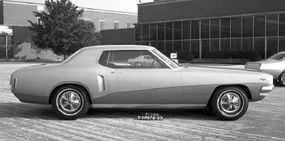
Ford again toyed with additional Mustang body styles during the '69 program. By mid-1966, designers had done full-size tape drawings of a "breadvan" wagon with near full-length side windows and a targa-top convertible with integral rollover bar (previewing the ragtop '68 Shelbys). The wagon had a tall "Kamm" tail like the short-chassis fastback, plus a long, tapering roofline and extreme rear-fender hop-up. The targa's lower body was curvy, almost GM-like. Though the targa was abandoned, the wagon design was refined into a full-size fiberglass mockup with slightly different treatments on each side.
![]() This mockup from 1966 shows some of the design ideas rejected for 1969. |
Mustang Grows Up
Save last-minute details like taillights and trim, the '69 styling package was basically settled by early 1967. The result was a more impressive Mustang in both size and appearance. Though wheelbase stayed at 108 inches, overall length grew to 187.4 inches, up 3.8 inches, most of it in front overhang. Width swelled to 71.3 inches overall, while height came down slightly to 51.2. Base curb weight rose to just over 2800 pounds.
![]() This mockup from mid-1966 shows Buick-style bodyside "sweepspears" that were ultimately rejected for the final design. |
Want to find out more about the Mustang legacy? Follow these links to learn all about the original pony car:
- Saddle up for the complete story of America's best-loved sporty car. How the Ford Mustang Works chronicles the legend from its inception in the early 1960s to today's all-new Mustang.
- In 1967, the original pony car was up for its first major revamp. Learn how Ford retooled and updated the 1967-1968 Ford Mustang to meet public expectations and to keep pace with the competition.
- With sales down and criticism abounding, the Mustang struggled in the early '70s. Learn what went wrong (and what went right) for the 1971-1973 Ford Mustang.
- The 1969 Ford Mustang Mach 1 428 Cobra Jet was the muscle car Mustang fans had waited for. Gallop into its profile, photos, and specifications.
1969 Mustang Styling and Models
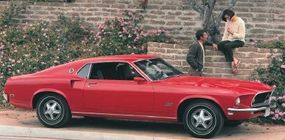
Though recognizably Mustang, the '69s somehow looked more "adult," more serious. Surprising many, the galloping horse and "corral" were gone from the grille, replaced by a small pony tri-color on the port side. The grille itself was visibly vee'd and made broader to cradle high-beam headlights at its outboard ends -- the first quad-lamp Mustang. Low beams nestled in the flanking "sugar scoops."
![]() Though recognizably Mustang, the '69s were markedly different in size and appearance. |
Rooflines changed too, with more steeply raked windshields and, for hardtops and convertibles, wider "formal" rear-roof quarters. The SportsRoof sported a "faster" roof sloping down to a vestigial spoiler, plus first-time rear-quarter windows, which flipped out instead of rolling down. All models lost front vent windows, adopting a new forced-air ventilation system with hidden extractor outlets. A big, round Mustang medallion replaced roof louvers on fastbacks.
![]() Renamed "SportsRoof," the '69 fastback looked faster even in the standard trim shown here. |
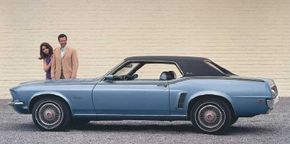
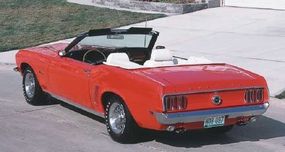
Knudsen's comment about "models for specific segments of the market" only parroted a previous Ford decision to expand the Mustang line. The model year opened with two additions. One was the Grande, a personal-luxury hardtop pitching the same buyers as cousin Mercury Cougar and the Pontiac Firebird. Priced about $230 above the $2635 standard issue, the Grande featured a vinyl-covered roof with identifying name script; pointy color-keyed "racing" door mirrors; wire wheel covers; two-tone paint stripes beneath the beltline; and bright wheelwell, rocker panel, and rear-deck moldings. The interior was upgraded with standard clock, convincing imitation teakwood accents on the dash and door panels, and seats with "hopsack" cloth inserts and vinyl bolsters. Appropriate for its upscale character, the Grande got a slightly softer suspension than the base hardtop and an extra 55 pounds of sound insulation.
![]() As ever, the '69 Mustangs could be optioned for a happy blend of performance and luxury. This ragtop is outfitted with the Deluxe Interior Decor Group. |
Want to find out more about the Mustang legacy? Follow these links to learn all about the original pony car:
- Saddle up for the complete story of America's best-loved sporty car. How the Ford Mustang Works chronicles the legend from its inception in the early 1960s to today's all-new Mustang.
- In 1967, the original pony car was up for its first major revamp. Learn how Ford retooled and updated the 1967-1968 Ford Mustang to meet public expectations and to keep pace with the competition.
- With sales down and criticism abounding, the Mustang struggled in the early '70s. Learn what went wrong (and what went right) for the 1971-1973 Ford Mustang.
- The 1969 Ford Mustang Mach 1 428 Cobra Jet was the muscle car Mustang fans had waited for. Gallop into its profile, photos, and specifications.
1969 Ford Mustang Mach 1
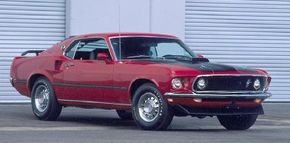
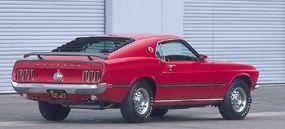
1969 saw a new $3139 intruder into Shelby-Mustang territory, the Mach 1 fastback. This packed a 351 V-8 with dual exhausts, handling suspension with styled-steel wheels and white-letter Goodyear Polyglas tires, reflective i.d. striping along the body sides and around the tail, pop-off gas cap, and a matte-black hood with simulated air scoop and NASCAR-style tiedowns. A separate rear spoiler was available. So was a new "shaker" hood scoop, so-called because it attached directly to the air cleaner through a hole in the hood, vibrating madly for all to see. Also on the standard-equipment list were racing mirrors, high-back bucket seats, center console, the Rim-Blow steering wheel, and the Grande's pseudo-teak interior accents.
![]() The 1969 Ford Mustang Mach 1 packed a 351 V-8 with dual exhausts, handling suspension with styled-steel wheels and white-letter Goodyear Polyglas tires, and a matte-black hood with simulated air scoop and NASCAR-style tiedowns. |
The Mach 1's 351 V-8 claimed 250 standard horsepower via two-barrel carburetor or 290 optional via four-barrel and elevated compression (10.7:1 vs. 9.5:1). These, too, were available for other '69s. Developed to fill a yawning displacement gap in Ford's corporate engine lineup, the 351 was directly descended from the original 1962 small-block. Essentially, it was a 302 with a half-inch longer stroke (3.50 inches) on the same 4.00-inch bore. As author Phil Hall noted in his book Fearsome Fords, actual displacement was 351.86 cid, but Ford used "351" to avoid any confusion with its 352 Y-block V-8 of the 1950s.
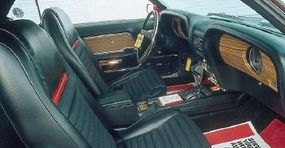
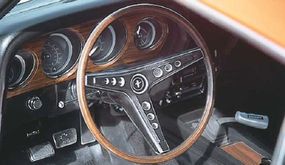
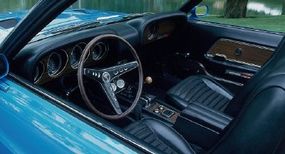
![]() The Mach 1's standard-equipment list included racing mirrors, high-back bucket seats, center console, and the Rim-Blow steering wheel. |
Note that we're talking here about the 351 "Windsor" V-8, not the vaunted "Cleveland" unit. The Windsor got its nickname from the Canadian plant that began building it in fall 1968, a full year before the Cleveland entered production (in Ohio). Both had the same bore/stroke dimensions and 4.38-inch bore spacing, but the Windsor boasted extra bulkhead strength, a 1.27-inch higher deck, and a different crankshaft with larger main and crankpin journals. It also used a drop-center intake manifold and "positive-stop" studs for the valve rocker arms. Once the Cleveland came along, the Windsor was relegated to mainstream Dearborn models, typically with two-barrel carburetors and mild compression.
Ford spent about $100 million to tool up the Cleveland V-8, which would power most of the company's 1970-74 high-performance cars. This 351 used a unique block cast with an integral timing chain chamber and water crossover passage at the front, plus an inch-higher deck than on the 302. Cylinder heads differed dramatically from the Windsor's, as valves were canted 9.5 degrees from the cylinder axis to form modified wedge-type combustion chambers. In addition, the intakes were angled 4 degrees, 15 minutes forward and the exhaust valves 3 degrees rearward for larger port areas that improved gas flow and efficiency. Toward the same ends, the valves themselves were made as large as possible. Intakes had a 2.19-inch head diameter, while the forged-steel exhaust valves had aluminized heads measuring 1.71 inches across.
Ford sixes got their own performance tech for '69: "center percussion" (forward sited) engine mounts for smoother operation. But competition manager Jacque Passino wanted to go much further: "We've been putting out [six-cylinder Mustangs] kind of artificially since '64 to fill up production schedules when we couldn't get V-8s. I think there is a real market for an inexpensive hop-up kit for the 250-cubic-inch engine." But that never happened, nor did a fuel-injected six he also favored. A pity. Either would have been very interesting. But neither was as interesting as the mighty Cobra Jet.
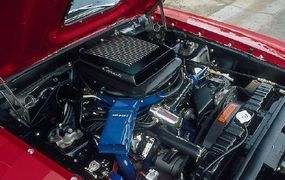
![]() The 428 Cobra Jet engine made the 1969 Ford Mustang Mach 1 one of the world's fastest cars. |
Developed by Ford's Light Vehicle Powertrain Department under Tom Feaheny, the 428 Cobra Jet made the 1969 Ford Mustang Mach 1 one of the world's fastest cars.
Even saddled with automatic transmission, Car Life magazine's CJ Mach 1 took just 5.5 seconds 0-60 mph and flew through the standing quarter-mile in 13.9 seconds at 103 mph. "The best Mustang yet and quickest ever," said the editors, who also declared it "the quickest standard passenger car through the quarter-mile we've ever tested (sports cars and hot rods excluded)." Yet Car Life found the CJ Mach 1 to be "a superb road car, stable at speed, tenacious on corners, with surplus power and brakes for any road situation…. By choosing the optimum combination of suspension geometry, shock absorber valving, and spring rates, Ford engineers have exempted the Mach 1 from the laws up momentum and inertia up to unspeakable speeds."
![]() The Mustang Mach 1 came standard with the Grande's pseudo-teak interior accents. |
Good comments about Mustang's handling by Car Life and Donner notwithstanding, the Chevrolet Camaro Z-28 handled even better -- and captured another Trans-Am championship in 1969.
Want to find out more about the Mustang legacy? Follow these links to learn all about the original pony car:
- Saddle up for the complete story of America's best-loved sporty car. How the Ford Mustang Works chronicles the legend from its inception in the early 1960s to today's all-new Mustang.
- In 1967, the original pony car was up for its first major revamp. Learn how Ford retooled and updated the 1967-1968 Ford Mustang to meet public expectations and to keep pace with the competition.
- With sales down and criticism abounding, the Mustang struggled in the early '70s. Learn what went wrong (and what went right) for the 1971-1973 Ford Mustang.
- The 1969 Ford Mustang Mach 1 428 Cobra Jet was the muscle car Mustang fans had waited for. Gallop into its profile, photos, and specifications.
1969 Ford Mustang Boss 302
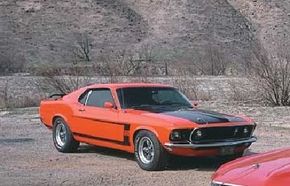
Bunkie Knudsen and Larry Shinoda's "killer" fastback was ready by March and out to even the score with anything Mustang's pony car competition could offer, at least on the street. They were going to call it "Trans-Am" until Pontiac grabbed the name for its hottest '69 Firebird, so they settled on Boss 302. Trans-Am rules required 1000 copies be built for sale to qualify as "production," but Ford ended up turning out 1934 of the '69s. Despite even that low number, the Boss brought people into Ford showrooms like no Mustang since the original.
![]() The Boss 302 fastback was one of the most thrilling '69 Mustangs. It was a low-volume hot rod built to meet racing rules. |
Of course, there was an increase in power, and it was huge, too. Though the Boss's high-output 302 V-8 was said to produce 290 horsepower at 4600 rpm, actual output was estimated at closer to 400 (in prevailing SAE gross measure, not today's more realistic net horsepower). Ford spared no expense to ensure this would be a Trans-Am-worthy powerplant, installing new "dry-deck" Cleveland-style heads with 2.33-inch intake valves and no head gaskets, solid lifters, an aluminum high-riser manifold, super-high-flow Holley four-barrel carburetor, high-capacity dual-point ignition, four-bolt central-main-bearing caps, cross-drilled forged crankshaft, and special pistons. To prevent accidental over-revving, an ignition cutout interrupted current flow from the coil to the spark plugs between 5800 and 6000 rpm.
![]() The Boss 302 was a street version of Ford's all-out Trans-Am racer. |
Like the engine, the chassis was loaded with premium hardware: power brakes with 11.3-inch-diameter front discs and heavy-duty rear drums, high-rate springs, heavy-duty Gabriel shock absorbers (also staggered at the rear), and fully machined axle shafts with larger splines and nodular-iron centers. All '69 Mustangs boasted wider tracks, but they were even broader on the Boss: 59.5 inches at each end. Shinoda radiused the wheel wells to snug around F60 3 15 Polyglas tires -- or racing rubber.
![]() The Boss 302's small-block V-8 was rated at 290 bhp, but made close to 400 actual. |
Want to find out more about the Mustang legacy? Follow these links to learn all about the original pony car:
- Saddle up for the complete story of America's best-loved sporty car. How the Ford Mustang Works chronicles the legend from its inception in the early 1960s to today's all-new Mustang.
- In 1967, the original pony car was up for its first major revamp. Learn how Ford retooled and updated the 1967-1968 Ford Mustang to meet public expectations and to keep pace with the competition.
- With sales down and criticism abounding, the Mustang struggled in the early '70s. Learn what went wrong (and what went right) for the 1971-1973 Ford Mustang.
- The 1969 Ford Mustang Mach 1 428 Cobra Jet was the muscle car Mustang fans had waited for. Gallop into its profile, photos, and specifications.
1969 Ford Mustang Boss 429
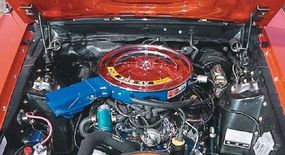
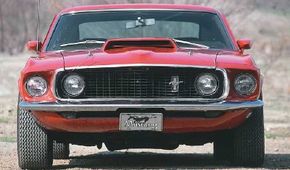
The Boss 302 was a stunning car -- but so was the other "ultimate Mustang" that Knudsen cooked up, the Boss 429. This big-block brute was born of Ford's desire to certify a new "semi-hemi" 429 V-8 for stock-car racing. NASCAR required at least 500 production installations, but didn't specify which models. So although Torinos showed up at the track, Ford qualified the engine by selling it in Mustangs.
![]() The Boss 429 was one of the most thrilling '69 Mustangs, built to meet racing rules. |
Shoehorn Job
The semi-hemi was too large for even the wider '69 Mustang engine bay, so Knudsen ordered engineer Roy Lunn to find a solution. Lunn turned to Kar Kraft, the Brighton, Michigan, specialty shop that built many of Ford's racing cars at the time. Together they found just enough space by modifying the front suspension, front wheel openings, and inner fenders and moving the battery to the trunk. For all that, front track increased only 0.8-inch. To resist body flex in hard acceleration, diagonal braces were added between the wheelhouses and firewall. Kar Kraft set up a special mini-assembly line for the Boss 429, but the engine installation was a time-consuming shoehorn job and production was slow to get rolling. Even so, a creditable 852 examples were built between mid-January and July.
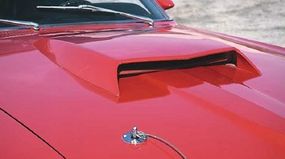
![]() The Boss 429 was a bit more stealthy outside than the Boss 302, but both came with competition-style hood pins. |
At $4798, the Boss 429 was the costliest non-Shelby Mustang to date, which partly explains why the model was killed after only 505 more were built to 1970 specs. Then again, neither Boss was meant to make money; they were "homologation specials" that had to be sold to meet racing rules.
![]() The Boss 429 was ready-made for the dragstrip and enabled Ford to qualify an exotic new "semi-hemi" V-8 for stock-car racing. |
Want to find out more about the Mustang legacy? Follow these links to learn all about the original pony car:
- Saddle up for the complete story of America's best-loved sporty car. How the Ford Mustang Works chronicles the legend from its inception in the early 1960s to today's all-new Mustang.
- In 1967, the original pony car was up for its first major revamp. Learn how Ford retooled and updated the 1967-1968 Ford Mustang to meet public expectations and to keep pace with the competition.
- With sales down and criticism abounding, the Mustang struggled in the early '70s. Learn what went wrong (and what went right) for the 1971-1973 Ford Mustang.
- The 1969 Ford Mustang Mach 1 428 Cobra Jet was the muscle car Mustang fans had waited for. Gallop into its profile, photos, and specifications.
1969 and 1970 Shelby Mustang
If enthusiast-magazine journalists judged the 1969 Ford Mustang Boss 302 a superior overall road car than the 1969 Shelby Mustang, that's probably because the '69 GT-350 and GT-500 were Ford's work, not Carroll's.
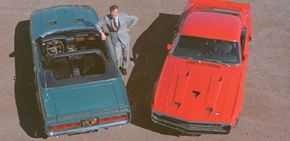
![]() Carroll Shelby flashes the usual Texas-size big grin in posing with two of "his" Mustangs for 1969. Actually, the cars were conceived and built entirely by Ford. |
But the sad fact was that the '69s were the tamest Shelbys yet, hobbled by more weight and less power. The GT-500 was no longer "King of the Road," but retained that '68 model's CJ 428. Horsepower remained at 335 advertised but actually was down 25 by most estimates. The GT-350 graduated to the new 351 Windsor but claimed no more horses than before -- or the more affordable new Mach 1 -- leading Yates to call it "a garter snake in Cobra skin." Adding insult to these injuries were record prices ranging from $4434 for the GT-350 fastback to just over five-grand for a GT-500 ragtop.
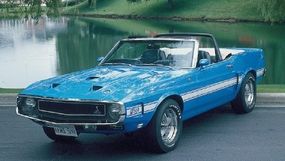
![]() The '69 Shelby Mustangs, like this GT-500, were the tamest yet, just regular Mustangs with a specific big-mouth fiberglass front, scoops and scallops all over, and more wide taillamps. |
A Thoroughbred Fades Away
After seeing his cars win only one Trans-Am race in 1969, Carroll Shelby decided to leave the car business (though he would return) and asked Ford to put the Shelby Mustang out to pasture. Ford agreed but not before exploring an interesting in-house proposal to salvage part of the '69 car. This envisioned a "1970 1/2" replacement for both the Shelby Mustangs and the Boss 429. Dubbed "Composite Mustang" by those involved, it was basically the big-engine Boss with a Mercury Cougar interior and a '69 Shelby front end with the scoops filled in.
![]() The 1969 Shelby Mustangs were reduced to just a custom styling job carried out on stock fastbacks and convertibles at Ford's Southfield, Michigan, plant. |
Want to find out more about the Mustang legacy? Follow these links to learn all about the original pony car:
- Saddle up for the complete story of America's best-loved sporty car. How the Ford Mustang Works chronicles the legend from its inception in the early 1960s to today's all-new Mustang.
- In 1967, the original pony car was up for its first major revamp. Learn how Ford retooled and updated the 1967-1968 Ford Mustang to meet public expectations and to keep pace with the competition.
- With sales down and criticism abounding, the Mustang struggled in the early '70s. Learn what went wrong (and what went right) for the 1971-1973 Ford Mustang.
- The 1969 Ford Mustang Mach 1 428 Cobra Jet was the muscle car Mustang fans had waited for. Gallop into its profile, photos, and specifications.
The 1970 Ford Mustang
In 1969, Ford bean-counters tallied another decline in total Mustang sales. Though the model-year loss was modest -- only 5.5 percent vs. '68 -- it looked ominous after all the money spent on the '69 program. Interestingly, of 184,000 cars delivered in the first half of calendar '69, the Grande accounted for only about 15,000 sales while the Mach 1 ran close to 46,000. On cue, division general manager John Naughton promised "heavy emphasis on performance" with "hardware to meet the action requirements of buyers everywhere."
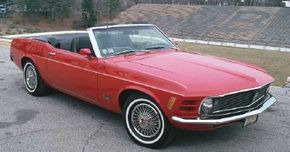
![]() Mustang styling was visibly cleaner for 1970, especially on standard-trim models like this convertible. |
The Mach 1 picked up rectangular driving lights inboard of the main beams, plus ribbed rocker-panel appliqués, "honeycomb" back-panel trim, twist-type hood locks, and revised striping. The Boss 302 traded C-stripes for "hockey stick" decals, and its rear-window louvers were newly optional for any fastback. All 1970s got recessed taillamps, standard high-back bucket seats, and, as Washington now required, three-point lap/shoulder belts, tamper-proof odometer, and steering-column ignition lock.
![]() Like other 1970 fastbacks, the Mach 1 lost its upper-bodyside scoops but gained the Boss 302's rear-window louvers as a new option. |
The Boss 429 roared back with a little-changed 820T engine, then substituted an 820A unit with minor adjustments in the Thermactor emissions-control system -- a sign of the times. A newly available Drag Pack fortified any 428 engine with stronger con rods, heavy-duty oil cooler, and other upgrades for quarter-mile duty.
![]() A combination of low production, high performance, and historical interest has made every 1969-1970 Boss Mustang a modern collector classic worth many times its original price, even adjusted for inflation. |
With this, plus softening demand for pony cars in general, Mustang model-year sales fell an alarming 36.4 percent to 190,727 units. Hardtops plunged 35 percent, fastbacks and convertibles by around 40 percent each. While the Mach 1 still accounted for a solid proportion of fastback sales, other performance models at Ford and rival manufacturers were overshadowing it. A small bright spot was the Boss 302, which soared to 6319 sales despite its specialized nature, limited availability, and stiff price.
On September 11, 1969, Bunkie Knudsen was abruptly fired after less than two years as Ford president. Larry Shinoda fast followed his patron out the door. Henry Ford II would only say "things just didn't work out," though he never elaborated on that in line with his longtime motto, "never complain, never explain." But insiders suggested that Bunkie, like his father, had stepped on too many toes. "Knudsen moved in and started doing things his way," wrote analyst Robert W. Irvin of trade weekly Automotive News. "Knudsen was almost running the company and [some said] he had alienated many other top executives.
Others said Knudsen's departure was an indication of how the Fords don't like to share power. Tellingly, Irvin wrote that in July 1978 on the firing of Lee Iacocca. To soothe ruffled feathers, Ford's chairman set up a presidential troika of R. L. Stevenson for International Operations, R. J. Hampson for Non-Automotive Operations, and Iacocca for North American Operations. But that lasted less than a year. Iacocca was named sole company president in 1970, finally snatching his long-coveted brass ring.
Mustang fans will forever thank Knudsen for the legendary Boss 302 and 429. All things considered, they were an amazing achievement for his brief tenure. Yet how ironic that the "father" of the pony car would be left to preside over the new Mustang breed that Knudsen also rushed through, but wouldn't be around to introduce. Though Lee Iaccoca was no doubt happy to see Knudsen dumped so unceremoniously, Bunkie would exact a sort of unintended revenge when his big new '71s proved the most controversial Mustangs yet.
Want to find out more about the Mustang legacy? Follow these links to learn all about the original pony car:
- Saddle up for the complete story of America's best-loved sporty car. How the Ford Mustang Works chronicles the legend from its inception in the early 1960s to today's all-new Mustang.
- In 1967, the original pony car was up for its first major revamp. Learn how Ford retooled and updated the 1967-1968 Ford Mustang to meet public expectations and to keep pace with the competition.
- With sales down and criticism abounding, the Mustang struggled in the early '70s. Learn what went wrong (and what went right) for the 1971-1973 Ford Mustang.
- The 1969 Ford Mustang Mach 1 428 Cobra Jet was the muscle car Mustang fans had waited for. Gallop into its profile, photos, and specifications.