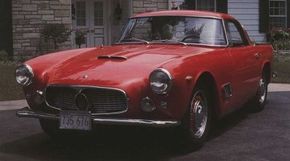
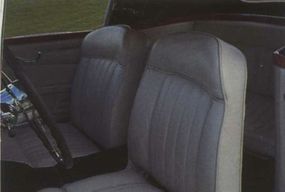
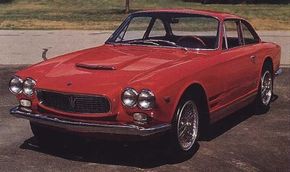
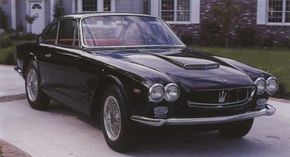
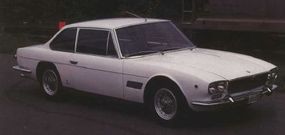
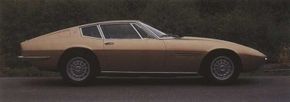
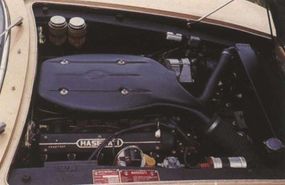
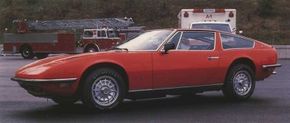
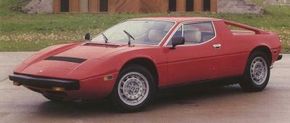
The Maserati 3500GT was Maserati’s breakthrough car, and began a streak of highly successful sports cars.
Maserati is synonymous with hot-blooded Italian automobiles, and the sports cars featured in the pages that follow are some of the best of the breed. But first, let's get started with a little history.
Maserati is the family name of six brothers from Bologna, a car-building clan that gained renowned when their Tipo 26 took first in class in the 1926 Targo Florio, the demanding Sicilian road race.
Advertisement
Throughout the 1930s, the cars and engines built by the Maseratis were among the fastest, most technically advanced, and most beautiful sporting machines of their age. Their production-based machines won the biggest European road races, and one of their single-seater even won the Indianapolis 500 in 1939 and 1940.
Postwar financial pressures forced the brothers to sell out to deeper pockets; they went on to form Officine Specializate Costruzione Automobili (OSCA) in 1947 and to build racecars into the 1960s.
The Maserati marque, meanwhile, passed through a succession of owners, the name remaining associated with competition glory on such luminaries as the F1-chamption 250F and the Birdcage sports racer. A small number of road cars wore the Maserati trident after World War II, but the breakthrough was the 3500GT of 1957, an elegant coupe powered by a race-worthy inline-six.
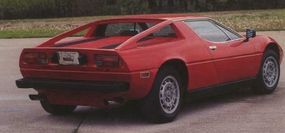
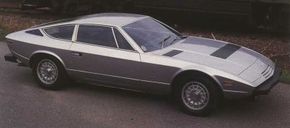
The Sebring coupe and convertible and the striking Giugiaro-styled Ghibli were among the succeeding Maseratis to follow this formula before the next breakthroughs, the midengine V-8 Bora of 1971 and V-6 Merak of 1972.
Led by the Biturbo series, Maserati relegated his sporting instincts to coupes and convertibles through most of the 1980s and 1990s. Ownership by now was under the giant Fiat group, and for a time, Maserati was partly controlled by another Fiat holding, none other than its old rival, Ferrari.
We'll get started in the next section with the Maserati A6/1500.
To learn more about Maserati and other sports cars, see:
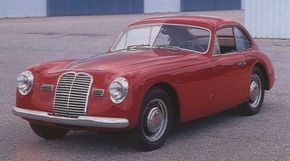
Though several coachbuilders’ work graced Maserati’s first roadgoing chassis,this Pinin Farina coupe was the definitive “production” A6I 1500 style, though itdidn’t appear until the Turin show of 1948.
Maserati in Italy built only competition cars in its early years (the Twenties and Thirties), albeit with great success. But there was a change of emphasis soon after the Maserati family sold out to the Orsi group in 1938. After World War II, Maserati began a more serious effort to produce not just race cars but road cars too. Thus, the first roadgoing Maserati, titled A6/1500, was formally announced in 1947 (after two were built the previous year).
Maserati was still a small concern struggling to recover from wartime devastation, so this was a simply engineered machine. As you might guess from the designation, power was supplied by a six-cylinder engine of approximately 1500-cc displacement.
Advertisement
It was, in fact, descended from the supercharged 6CM twincam racing unit of 1936. (Which hadn’t been forgotten, just laid aside for still-sportier cars to come.) It was considerably less potent though. With normal aspiration and a single overhead camshaft operating opposed valves through rocker arms, it delivered a mere 65 horsepower compared to its parent’s 175 bhp. One reason: tuning for postwar Italy’s limited quantities of low-grade fuel. The gearbox was a newly designed 4-speed unit from another of the Orsis’ many businesses.
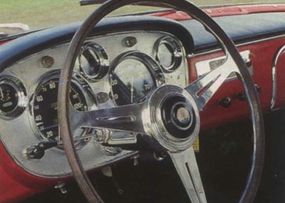
The Maserati A6/1500's interior was rather humble and modest.
Like other specialist cars of these years, the A6/1500 had a conventional separate chassis, with tubular side-rails and cross-members. Front suspension was independent via coil springs and wishbones; a live axle located by trailing arms rode on coils at the rear.
A6/1500 design work had begun as early as 1943, when Ernesto Maserati laid out the engine, but the war zone crept steadily closer to Modena, so engine bench-testing didn’t begin until 1945. The original prototype had a crude, narrow body with separate Allard-like cycle fenders, but was subsequently rebodied by Pinin Farina, whose carrozzerie supplied identically styled shells for the entire production run of just 61 units.
Predictably, all these Maseratis were effectively handbuilt cars. After the two 1946 examples, the firm completed three in ’47, nine the following year, 25 in 1949, and 22 the year after that. Included in the totals is a handful of Farina spiders and one Zagato-bodied coupe.
As for performance, the A6/1500 was claimed to do 95 mph all out, though it probably couldn’t go that fast. But its chassis was a good one, and would serve well with more powerful 2.0-liter and twincam engines to come. The A6 even made one or two competition appearances, though on a private basis.
Humble it may have been, but the A6/1500 was at least a beginning for roadgoing Maseratis. By the Sixties, they’d have engines three times as large producing 500 percent more horsepower -- and price tags to match -- but from such tiny acorns do mighty oaks grow.
To learn more about Maserati and other sports cars, see:
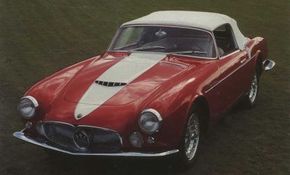
An outside look at an A6G/2000 with spider bodywork by Frua.It’s clearly a mid-Fifties design, most evident in the modestly wrapped windshield.
Although still more interested in and involved with race cars, Maserati was sufficiently encouraged by the success of its first “production” model, the A6/1500, to plan a successor. In retrospect, the new A6G series was a long way from Maserati’s first supercar, the 3500, but was definitely a step in the right direction.
Actually, there were two Maserati A6G series in 1951-57. Both used an evolution of the A6 chassis, a simple, robust tubular assembly spanning a 102-inch wheelbase. They also had six-cylinder engines. The difference is that the later Maserati A6G/2000 had a very different twincam engine.
Advertisement
It was generally agreed, even within the Orsi family, that any A6 replacement would need better handling and more power, if only to keep pace with Ferrari. Accordingly, the Maserati A6G received a modified rear suspension with leaf instead of coil springs (it was good enough for Enzo), and a larger 1954-cc engine with 100 horsepower versus the previous 65. The latter retained the previous opposed valves and single overhead camshaft. Body choices were greatly expanded to include cabriolets by Pietro Frua and coupes by Frua, Pinin Farina, Alfredo Vignale, and the occasional Ghia and Bertone one-off.
Despite all this, buyers waited still more. At a time when twincam Masers were competing successfully against Ferraris on the track, the single-cam Maserati A6G had nowhere near the performance of Ferrari’s roadgoing V-12s. Thus, after a mere 16 A6Gs, Maserati hustled out the improved A6G54 or A6G/2000.
The “54” in the factory designation stood for introduction year, but the real significance was in the “2000” title, for it signalled that Maserati’s first roadgoing twincam engine was ready at last. This wasn’t a return to the Thirties 6CM unit or even a twincam conversion of the existing single-cam six. Rather, it was nothing less than a detuned version of Maserati’s already famous Formula 2 powerplant. Its bore/ stroke dimensions were different from the sohc engine’s, giving exact capacity of 1985 cc. At a rated 150 bhp even in “low-output” form, it was a far cry from the 65-bhp engine of just a few years earlier. The basic Maserati A6 chassis was retained, and though it had to cope with two-and-half times the power in the 2000, it was well up to the job.
The Maserati AG6/2000 bowed at the 1954 Paris Salon, with first deliveries of what was definitely a 120-mph roadgoing Maserati commencing in the spring of 1955. Considering its high price and Maserati’s still-primitive manufacturing facilities, the firm did well to sell 61 of these cars in three years.
The interior of the Maserati A6G was at once modest and aesthetically pleasing.
Here, too, coachwork was farmed out to various carrozzeria (again, it was good enough for Enzo). A skim through factory records shows that all 2000s built were two-seat coupes and spiders. Among participating coachbuilders were Frua, Zagato, and Allemano but not Farina, at least on this occasion.
Sad to say, time quickly caught up with the quickest roadgoing Maserati to date. By 1957, the firm’s racing program had produced much-modified and much more powerful 3.5-liter twincams, while a new V-12 and V-8 were on the way.
But so was a new grand touring Maserati, one that truly deserved those oft-abused GT initials. With the 3500, Maserati would move to the front ranks of high-performance Italian road cars.
To learn more about Maserati and other sports cars, see:
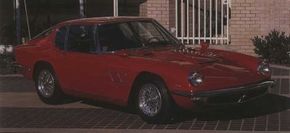
Maserati’s first real challenge to Ferrari was the understated but highly capable 3500GT. It came as the 2+2 coupe pictured or as a two-seat convertible on a shorter wheelbase.
The Maserati 3500GT shook up the world of sports cars. By the late 1950s, everyone knew a sports car looked like a Jaguar XK 140 or an MGA. But there was another species, one less obviously racy, more scarce, very costly, and quite self-assured: the Maserati 3500GT.
The Maserati brothers started building racing cars in the 1920s, and for four decades their trident was a force from the Grands Prix of Europe to the bricks of Indianapolis. In 1957, Juan Manuel Fangio won his fifth Formula 1 Championship in a Maserati. The brothers had by then sold out to deeper pockets (and continued racing by founding OSCA), but Maserati’s new owners developed money problems of their own and sought a cure through “volume” production of sporting road cars.
Advertisement
The 3500GT was actually the third Maserati streetmachine; about 140 others had trickled out since World War II. But it was the first to match the benchmark Ferrari in prestige and performance, and it did so with little fanfare and no lack of confidence. Motor Life’s Wayne Thoms gained a new perspective driving a 3500GT coupe around Beverly Hillsin 1961. “The Maser embodies the secret of a modern classic, a design so handsome, so simple, that it blends unobtrusively with whatever surrounding is at hand,” he wrote. “[I]t was a pleasant thing, driving an extremely expensive, extremely rare, highly sporting machine without feeling obligated to win two or three stop light drags every mile.”
Aside from the engine, little about the car was extraordinary, but the blend worked exceptionally well and was wrapped in elegant coach-work. Buyers could choose a 2+2 coupe from Touring of Milan or a convertible by Vignale of Turin on a two-inch shorter wheelbase. Both used a chassis of steel tubes and panels that was unadventuresome but sturdy. There were coil springs in front, a live axle and leaf springs in back. Front disc brakes and a limited-slip differential were options after 1958, but rack-and-pinion steering never arrived.
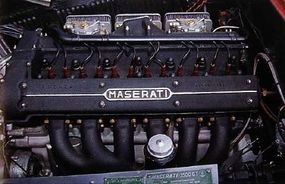
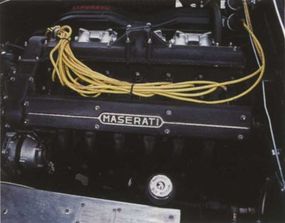
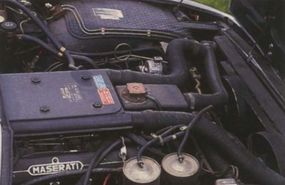
The all-alloy twincam six was a detuned Maserati racing engine. In 1961, fuelinjection replaced the three Webers shown here and brought a GTI designation.
Underhood was the real treat: a detuned Maserati sports-racing engine. The all-aluminum twincam inline-six had hemispherical combustion chambers and twin spark plugs. It drove through a four-speed ZF gearbox, with a five speed optional from 1960 and standard from ’61. The trio of Webers eventually was supplanted by Lucas mechanical fuel injection, bringing another 15 hp and a GTI badge. The 3500GT was followed by a long line of Maserati GTs, but none approached its understated self-assurance.
To learn more about Maserati and other sports cars, see:
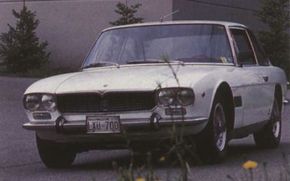
The Maserati Sebring in initial Series I form, Series II modelswore a lower-profile hood scoop and hooded headlamps.
The Maserati Sebring attempted to build on the sucess of earlier models. Having earned its stripes in the 1950s as a GT power to be reckoned with, Maserati entered the 1960s intent on expanding this success. With two new models, it would do just that. First to arrive, and our subject here, was the Maserati Sebring, introduced at Geneva in 1962.
It combined all the best, newly developed elements of the 3500GTI with more comprehensive equipment and stylish new 2 + 2 bodywork shaped and supplied by Vignale.
Advertisement
Designer Giovanni Michelotti was still associated with Vignale in those days, so it wasn’t surprising that this new notchback coupe looked much like his TR3A-based Triumph Italia being built at the same time. Highlights included quad headlamps, a rectangular mesh grille bearing the famed Maserati trident, a pair of functional air vents behind the front wheelarches just above the rockers, and a straight-through fenderline linking headlamp pods and taillight clusters. B-pillars were raked to match A-pillar angle, glass area was generous, the tail neatly cropped.
Options proliferated, mainly with the American market in mind. Air conditioning and automatic transmission were new -- and unheard-of -- in a Maserati. Special paint, wire wheels, and radio were also offered.
Beneath this relative luxury was an improved version of the 3500GTI spider chassis with a shorter, 98.4-inch wheelbase. It was more rigid than before, but only an Italian automaker would have bothered with such a labor-intensive design comprising multiple tubes, pressings, stiffeners, and brackets.
The Maserati Sebring featured a powerful 6-stroke engine which, while
A total of 444 Sebrings, all with the same Vignale bodywork, were produced in two series between 1962 and ’66. Series I models used the GTI’s 235-horsepower twincam six. Most Series II examples, all of which were built in 1965-66, carried a 245-bhp, 3694-cc enlargement, though a few had an even larger 4.0-liter, 255-bhp extension. Both these engines were also used in the contemporary Mistral (see entry).
In its most potent form, the Sebring could touch 150 mph flat out. Alas, that wasn’t enough to keep pace with Ferrari’s new-generation V-12s and new V-8 models from Maserati itself. But the GTI platform wasn’t finished yet: the Mistral had blown in, and it was no ill wind.
To learn more about Maserati and other sports cars, see:
Styled by Pietro Frua, the Mistral was the last of the front-engine six-cylindercars on which Maserati had built its postwar success as aproducer of roadgoing GTs.
Named for the famous Mediterranean wind, Mistral was the second of Maserati’s new six-cylinder 1960s models. Previewed at the ’63 Turin show, it aped the Sebring in using an improved version of the Maserati 3500GTI chassis but with an even shorter wheelbase. This aided torsional stiffness, as did new folded members along the rocker panels, reinforcements over the rear wheelarches, and more sheetmetal around the tail.
The Maserati Mistral was offered in coupe and convertible models, the latter introduced at Geneva in 1964. Both were two-seaters, unlike the 2 + 2 Sebring. Styling, by Pietro Frua, was different too, more rounded and flowing, with a lower beltline and an airier greenhouse with more markedly curved glass.
Advertisement
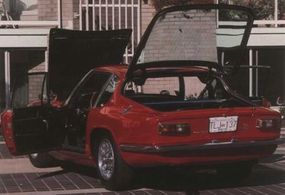
The coupe featured a large lift-up hatch window somewhat reminiscent of the later Porsche 924/944 treatment. In retrospect, overall appearance forecast the Frua-designed AC 428 of 1968 (even some panels were apparently shared). Doors, hood, and rear deck (hatch on the coupe, trunklid on the convertible) were aluminum; the rest of the shell was steel. Maggiora of Turin supplied both bodies under contract.
While a few early models carried the familiar 3.5-liter Maserati twincam six, most Mistrals had the more potent 3.7- or 4.0-liter versions. Peak power outputs were the same as the Sebring’s and allowed Maserati to boast about beating the “1 hp per cu in.” figure so magical to Americans in those heady days.
Porsche may have been inspired by the Mistral’s lift-up rear window whendesigning its later 924. Open Spider version was arguably prettier, definitely rarer.
The Maserati Mistral proved quite popular. Most of the total 948 units were built in 1964-68 (though the last example, a 4.0-liter spider, wasn’t completed until 1970). As ever, coupes way outsold the convertibles, which accounted for just 120 units.
Nevertheless, Maserati was moving on to bigger and better things, so the Mistral would be the last of the traditional front-engine straight-six Masers on which the company had built its great postwar success. Beginning in 1967, the future belonged to the new V-8 Mexico and Ghibli.
To learn more about Maserati and other sports cars, see:
Mexico 2 + 2 rode a shortened version of the chassis developed for Maserati’s 1963 Quattroporte sedan, was essentially its two-door counterpart.
The road that lead to the Maserati Mexico was long and winding. In 1965, Maserati could look back on two decades of steady improvement and steadily increasing success in road cars. While more grand tourer than pur sang sports machine, they were still Maseratis, and thus exciting, entertaining, and eminently desirable.
But it was time to move on in ’65. Maserati’s twincam six had done yeoman service, but was at the end of its development life. Then too, more powerful new V-12 models from Ferrari and upstart Lamborghini represented a competitive challenge that Maserati’s pride could not allow to go unanswered.
Advertisement
As with the six, the answer again came from competition. Nine years before, Maserati had fielded a massive and brutishly powerful 90-degree twincam V-8 for the 450S sports-racer, then went on to apply it to the equally famous Type 165 and Type 65 two-seaters of the early Sixties. A detuned version of this 5.0-liter engine had also powered a small run of roadgoing 5000 GTs (31 built) in 1959-64.
Chief engineer Giulio Alfieri set about “productionizing” the V-8 for Maserati’s new-generation road cars of the late Sixties and beyond (changing, for example, the cam drive from a train of gears to a simple chain). Its first roadgoing application was Maserati’s first sedan, the aptly named Quattroporte (four-door) of 1963.
With a 3.5-inch shorter wheelbase, the QP chassis served as the foundation for a new close-coupled four-seat coupe, unveiled at the 1965 Turin show as the Maserati Mexico. Much more complex than any previous Maserati design, its chassis retained the classic front-engine/rear-drive layout and still took much of its strength from large-diameter tubular members, but was further stiffened with several boxed and fabricated steel sections.
In its first two years, the Quattroporte had used a De Dion rear suspension, then reverted to an orthodox live axle on semi-elliptic leaf springs. The latter was retained for the Mexico, along with Maserati’s usual coil-and-wishbone front suspension, recirculating-ball power steering, and all-disc brakes.
The V-8 was large and beefy enough to accommodate displacements of 4.2 to 4.9 liters. In initial Maserati Mexico guise it was sized at 4.7 liters and delivered 290 horsepower, good for a top speed of over 155 mph. Together with a solid chassis and capable road manners, it made the Mexico one very fast and very desirable GT.
Alas, you wouldn’t know it from the Vignale styling, which was obviously Italian but rather bland. Overall, the Maserati Mexico resembled a somewhat larger Sebring with most of the character removed.
The Maserati Mexico's vignale styling is neat if a tad bland for a Latin exotic.
Which explains why it was overshadowed for sheer beauty and sex appeal by other period supercars, including Maserati’s own Ghibli (see entry) -- which in turn perhaps explains why it didn’t sell as well as Maserati hoped. Historians tell us that most Mexicos went to France and Switzerland. A few landed in Italy, fewer still in the U.S. Certainly none went to Mexico!
In fact, the Maserati Mexico virtually disappeared after its erstwhile replacement, the shapely Vignale-designed Indy, came along, but remained in the catalog all the way through 1973, though production was miniscule after 1968. A 4.1-liter option with “only” 260 bhp was instituted the following year, mainly to position the car downmarket from the Indy and Ghibli.
As with most “facts” concerning Italian specialty marques, it’s wise to be cautious about production figures. Several respected sources claim the total was 250 units, while another lists 468. Is the latter more nearly correct?
To learn more about Maserati and other sports cars, see:
Sleek and stunning, the Maserati Ghibli marked a departure from the boxy styles of previous Maseratis. See more pictures of Maserati sports cars.
Has there ever been a car more beautiful than the Maserati Ghibli? Even acknowledging the subjectiveness of the question, few peers come to mind. There’s certainly no disputing its tremendous impact. By any standard, the Ghibli was the most memorable Maserati yet. More than two decades after its late-1966 debut, there are those who say it still is.
Like the Mistral and the later Khamsin, the Maserati Ghibli was named for a famous European wind (reflecting Maserati’s penchant for such names at the time). And indeed, as road tests soon showed, it was a real stormer. But for many, it was enough to simply gaze upon the beast, conceived in 1965-66 by Giorgio Giugiaro, then chief designer at Ghia. No wonder the world motoring press sat up and took real notice of this remarkably gifted young Italian.
Advertisement
Turning to more mundane matters, the Maserati Ghibli shared basic chassis and running gear with the Quattroporte sedan and Mexico coupe (see entry), no surprise coming from a small automaker. Wheelbase, however, was reduced 3.5 inches from the Maserati Mexico’s for this strict two-seater GT.
The Maserati Ghibli thus had the same tubular chassis stiffened by pressings, foldings, and fabrications, and had to make do with a simple live rear axle on semi-elliptic leaf springs. Like the Maserati Mexico, it had disc brakes all-round. If none of this seemed very exciting next to obvious competitors like the Ferrari 275 GTB and Lamborghini 400 GT, nobody seemed to mind, and it didn’t hurt performance or readability one bit.
Fittingly for the prettiest Maserati to date, the Ghibli arrived with the 4.7-liter version of the firm’s excellent twincam V-8 in its most powerful form to date: 330 horsepower. A 5-speed ZF gearbox was standard; Borg-Warmer 3-speed automatic became optional in 1969.
The Maserati Ghibli complimented its good looks with a powerhouse of an engine; a 330 hp V8 that was Maserati's strongest at the time.
The styling, of course, turned every head. Long, low, and wide, the MAserati Ghibli crouched on the road like no previous Maserati -- which was no illusion. Overall height was only 46 inches, so interior headroom was rather limited, though that didn’t dissuade basketball ace Wilt “The Stilt” Chamberlain from Ghibli ownership. At 180 inches long overall, this was also one of the lengthiest European two-seaters ever built, but the long-hood/short-deck proportions were flawless.
The Maserati Ghibli’s neat, low, hidden-headlamp nose with wide bifurcated grille would show up again on the Giugiaro-designed Bora and Merak mid-engine Maseratis of the Seventies. Some say the Aston Martin DBS of 1967 borrowed some Ghibli details (check the side-window shape and see if you agree), but surely no one except Giugiaro could have produced such an artful yet aggressive car, long on personality if short on practicality.
Some of this applies only to the original fastback coupe, which in 1969 was joined by a spider companion that, if anything, was even lovelier. It was a full convertible, of course, blessedly free of “targa bars” and other excrescences. Its fabric roof stowed completely out of sight beneath a hinged cover behind the cockpit; a detachable hardtop was optionally available for winter driving. At the same time, interiors were spruced up and the dashboard redesigned.
The Maserati Ghibli became even more desirable in 1970, when Maserati substituted its ultimate 4.9-liter V-8 with 335 bhp in European trim. This was mainly a concession to emissions controls for the American market, where output was somewhat lower. Spiders so equipped were tagged SS (which must have irked Chevrolet).
Alas, all good things must come to an end. The Maserati Ghibli’s came in 1973 with the introduction of its direct successor, the Khamsin. Though more technically advanced, it wasn’t nearly as inspiring to look at. Which means that the 1274 Maserati Ghiblis built still aren’t enough to go around.
To learn more about Maserati and other sports cars, see:
Clean-lined Indy was Maserati’s first V-8-powered 2 + 2, effectively replacing boththe Sebring and Mexico. Vignale styling somewhat disguises the car’s true size.
The Maserati Indy was part of a change of direction for this classic automaker. Maserati was positively booming by 1969, and ready to finish overhauling its entire lineup. Straight-six models were being phased out, while their V-8 replacements -- the two-seat Maserati Ghibli and four-seat Maserati Mexico coupe and Quattroporte sedan -- were looking after their respective markets. All that remained was a new 2 + 2. It appeared in ’69 as the Maserati Indy.
Conceived in 1968, the Maserati Indy was first displayed as a Vignale prototype at that year’s Turin show, though it was so obviously a production design that no one was surprised when it appeared in Maserati showrooms. It was billed as having unit construction, which meant that the Vignale-built body was now welded to the chassis instead of bolted on.
Advertisement
Carefully sized between Maserati’s Quattroporte and Ghibli, the Indy rode a 102.4-inch wheelbase but strode wider tracks than either of its stablemates, signalling that Maserati, like most other carmakers, was moving toward wider, roomier bodies. Suspension, steering, and brakes were the usual fare, but the Indy used somewhat simpler chassis construction than other Masers. As announced, it carried the Mexico’s smaller 4.1-liter 260-horsepower engine, mating to standard ZF 5-speed gearbox or optional 3-speed Borg-Warner automatic.
Despite a certain visual similarity with the Maserati Ghibli, the Maserati Indy had nothing in common with it and only a few shared elements, namely hidden headlamps, a high-tailed fastback roofline, and flowing lower-body contours. Aside from standing five inches taller, it differed in having token “ + 2” seating (assuming small and/or limber back seaters), more prominent B-posts, longer rear quarter windows, and a lift-up rear hatch for cargo-hold access.
It also neither looked as fast nor was as fast as the exceptional Ghibli. But it was a very worthy Maserati. And, of course, a more modern 2 + 2 than the Sebring and Mexico it effectively replaced.
The interior of the Maserati Indy offered a modern centralized dash and + 2 seating in the rear, setting it apart from the Maserati Ghibli.
Changes during the Maserati Indy’s relatively brief, five-year life consisted mainly of upgraded V-8s that were borrowed from the Ghibli: the 290-bhp 4.7, offered beginning in 1970, and the 335-bhp 4.9 from 1973. Some might call this confusing the issue, but Maserati likely viewed it as offering its customers the widest possible choice.
A total of 1136 Indys were produced between 1969 and ’74. At one point, the factory was turning out four Maserati Ghiblis and five Maserati Indys a week. Among the latter was a specially tailored U.S. version, predictably called Indy America.
Alas, time and circumstance precluded a direct Indy successor, at least from Maserati. Alejandro de Tomaso was in control by 1976, and he ushered in a reengineered version of his Mercedes SL-lookalike Longchamps as Maserati’s “new” Kyalami.
To learn more about Maserati and other sports cars, see:
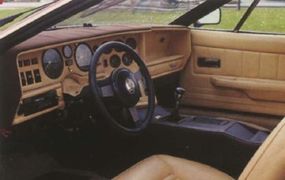
Styling on the Maserati Bora, by Giugiaro’s Ital Design studio, was less radicalthan some rivals, but furnished more pleasing accommodations.The two-seatcockpit was well appointed and featured the world’s first adjustable pedals.
The Maserati Bora represented was Maserati's attempt to join the brigade of mid-engine sports cars. After the well-bred 3500, Maserati introduced a series of ultra-conventional GTs that, except for the Giugiaro-styled Ghibli in 1966, failed to ignite much passion. By 1970, the hottest exoticars were mid-engined, a movement Maserati finally joined in 1971.
This was another Giugiaro work, one Road & Track called “strikingly handsome, clean and slightly brutal-looking.” It employed an all-steel unibody and a longitudinal drivetrain mounted to a bolted on subframe. Separated from the two-seat cabin by double-pane rear glass and an upholstered cover was another tamed Maserati racing engine: a 310-hp quad-cam 4.7-liter V-8. It drove the rear wheels through a five-speed ZF transaxle as used in Ford’s GT40 endurance racers. In 1975, Maserati substituted its 4.9-liter 320-hp V-8 to compensate for power losses on emissions-regulated American models. This engine was standardized for Europe in 1976.
Advertisement
Suspension was independent coil all-round, steering was manual rack-and-pinion. Citroën had taken over Maserati in the mid-1960s and its presence showed in Bora’s all-wheel disc-brake system, which was actuated by the French company’s unique high-pressure hydraulics.
The Bora used a conventional brake pedal rather than Citroën’s mushroom-shaped button, but enjoyed the same “no-travel” action. All pedals were adjustable for reach -- a first for any production car -- and with the standard tilt/telescope steering wheel, air conditioning, and power windows, Bora was more accommodating than most Latin supercars.
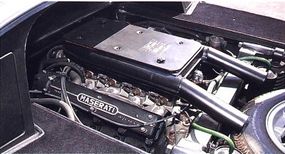
The rear body section of the Maserati Bora lifted to reveal a racing-derived quad-cam V-8. This 1973 model has the 4.7-liter version; later models used a 4.9.
Around town it could feel heavy and the engine, spitting and hacking at low revs, didn’t seem to promise much, what with the modest 5500-rpm redline. But the Bora came alive in the hands of a smart, fast driver. Third gear was good for 118 mph and the communicative steering and well-sorted suspension made it, in R&T’s opinion, “one of the best-handling cars money can buy.”
From 1972 through ’83, Maserati sold a version of this car called the Merak with
a V-6 engine that allowed for +2 rear seats. After Citroën sold out to Alejandro deTomaso in the mid-1970s, deTomaso kept both cars alive, but no improved versions were developed, leaving the Bora as the pinnacle of Maserati’s roadgoing performance.
To learn more about Maserati and other sports cars, see:
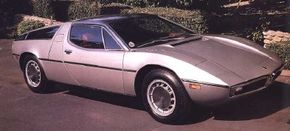
The Maserati Merak shared most of the Maserati Bora's characteristics.Between-lamps air intake marks this as a Merak SS.
When Maserati started working on its first mid-engine road car in 1968, it had two versions in mind. One was a V-8 model, which materialized as the Maserati Bora. The other would be a less expensive V-6 car with more components borrowed from new owner Citroën. The result arrived a year behind the big-engine middie as the Merak, which looked back to the great six-cylinder Maseratis of the Fifties and Sixties and ahead to the brave new Seventies world of mid-engine high performance.
The Maserati Merak shared the Bora’s chassis, suspension, steering, high-pressure hydraulic brakes, basic styling, and forward structure ahead of the B-pillars. The principal differences showed up in and behind the cockpit, and were sufficient to give the Merak its own unique character.
Starting outside, the Maserati Bora’s heavy rear hatch and triangular side windows were replaced by a flat engine cover flanked by glass-less, unstressed, purely decorative “flying buttresses,” thus keeping a fastback profile. Beneath the deck, in longitudinal midships position, was the new 3.0-liter twincam V-6 Maserati had designed for Citroën’s front-drive SM sport coupe, situated to turn the rear wheels through a modified version of the same 5-speed transaxle.
The V-6 was shorter than the Bora’s V-8, and combined with a fuel tank re-sited to the nose to liberate a little more cockpit space. This was given over to a pair of tiny “+ 2” seats lacking in the Bora, hard up against the rear bulkhead. They were frankly useless except for carrying luggage, as the cushions were almost on the floor and the backrests bolt-upright.
A more startling difference -- and a reminder of the Citroën/Maserati “marriage” -- was the Maserati Merak instrument panel, lifted intact from the SM along with its steering wheel. This generated decidedly mixed reactions, and would be abandoned (after Citroën and Maserati “divorced”) in favor of a four-spoke wheel and new Italianate dash with proper round (versus oval) instruments.
The Giugiaro-styled V-6 Maserati Merak looked much like the V-8Maserati Bora but had a flat deck and “flying buttresses.”
Unfortunately, sharing so much with the Bora left the Merak barely 150 pounds lighter. And with just 190 horsepower on tap, it was decidedly slower (and disappointing, even, to some critics). On the other hand, it was cheaper by some $5000, still quite a hunk of change in the early Seventies, and its performance wasn’t all that bad: about 9.5 seconds 0-60 mph and 135 mph flat out.
In fact, many people were happy to settle for a Maserati Merak, which looked as good as a Bora, handled and stopped as well, and had the same sort of exoticar prestige. The burly Bora was okay for Europe, but the Merak made more sense and offered better value for speed-limited Americans.
The Maserati Merak saw little change through the end of 1975, then gave way to the much-modified Merak SS. This was prompted by the aforementioned “divorce” and Maserati’s subsequent takeover by De Tomaso, which quickly set about ridding itself of inherited Citroën engineering influences. Thus, the Bora’s ZF transaxle and conventional brakes were substituted along with the new dash, and the body contract shifted from Padane to Osi.
Workmanship didn’t improve much, but handling did, thanks to wider wheels and tires; a modest chin spoiler was added for better high-speed stability. Performance improved too, in Europe, with a V-6 tuned to 220 bhp. Alas, U.S. models remained at about 180 bhp (SAE net). Shortly afterwards, De Tomaso issued a detrimmed 2.0-liter “tax break” special for Italian buyers only.
Though the Maserati Bora disappeared in 1980, the Maserati Merak carried on through 1983. Still, it was not a big success volume-wise. Maserati’s sporadic presence in the U.S. market after 1975, where the car could have sold much better than it did, hardly helped. The 2.0-liter (dropped in ’79) saw only 133 copies, while 3.0-liter production totalled just 1699. Thus ended another one of those good automotive ideas robbed of a fair chance by a combination of unforeseen circumstances and unfortunate timing.
To learn more about Maserati and other sports cars, see:
The distinctively styled Khamsin was the first Bertone-bodied Maserati.Today it’s considered by some as one of the better values amongSeventies supercars and a definite “comer” among collectible automobiles.
The Maserati Khamsin, named after the hot violent wind of the Egyptian desert, bowed at the 1972 Turin show and again at Paris ’73, but didn’t go on sale until 1974. Maserati’s traditional front-engine GT needed freshening again by the early 1970s. The result was a new model effectively replacing both the Maserati Indy and, in fact if not spirit, the Maserati Ghibli.
The Khamsin was as much a departure for Maserati as the mid-engine Bora and Merak. First, it was a cross between the two-seat Maserati Ghibli and 2 + 2 Maserati Indy, a sort of “2 + 1” if you will. Second, it was the first Maserati shaped by Bertone, with Marcello Gandini of Lamborghini fame doing the honors. Last but not least, it was the first front-engine Maserati to bear the unique engineering stamp of Citroën, which then controlled the Italian concern.
Visually, it owed more to the Maserati Ghibli than the Maserati Indy, with the same sort of squashed fastback roof and lengthy hood, though the sharply pointed nose and crisp contouring were quite unique. As he had on Lamborghini’s Espada, Gandini penciled in a glass panel between the taillamps, and it was just as useful in this low-rider.
Following Indy precedent, the Maserati Khamsin employed a unitized steel structure (supplied by Bertone). Some chassis engineering also carried forward, but there were major differences too. Rear suspension was now fully independent (a first for a front-engine Maser), with coil-and-double-wishbone geometry (as on the midships Bora/Merak) matching that at the front. Rack-and-pinion steering was another departure, as was the use of Citroën high-pressure hydraulics to power both steering and the all-disc brakes.
The Maserati Khamsin's Twincam V-8 powered Citroënhydraulic steering and brakes.
Under the hood and mounted somewhat back in the chassis was the latest version of the familiar twincam V-8. Unlike previous Maseratis, though, all Khamsins carried the same 4.9-liter unit with a genuine 320 horsepower for Europe, 315 bhp in emissions-legal U.S. trim. Transmission choices still comprised the ubiquitous 5-speed manual (preferred by more sporting buyers) or optional Borg-Warner 3-speed automatic.
The Maserati Khamsin was apparently just as slippery as previous Maseratis, for top speed ranged from 140 to 160 mph depending on transmission and engine tune. But less than flat out, it was a curious combination of the traditional and futuristic. The latter was exemplified by the hydraulically powered steering and brakes, both of which took a lot of practice for smooth driving.
As on Citroën’s SM, the steering would self-center even with the car at rest, was fingertip light, and lightning quick at a mere 2.0 turns lock-to-lock. The brakes were just as touchy, easy to lock up with a shade too much pedal pressure. Handling, by contrast, was easy to get used to, and very balanced thanks to the near even fore/aft weight distribution.
Inside, the driving stance was pure Italian supercar, but ergonomics were far from state-of-the-art and the basic climate system was just that. The ride was harsh, rear-seat accommodations the usual token gesture.
With all this, the Khamsin was not a successful effort even by Maserati standards. Had it not appeared on the eve of the first Energy Crisis, which precipitated Citroën’s sudden pullout and several tough years for Maserati, it might have sold better. As it was, only 421 were called for over eight years of production. The peak year was the first, 1974, when a grand 96 were built.
To learn more about Maserati and other sports cars, see:
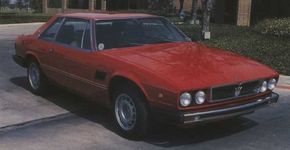
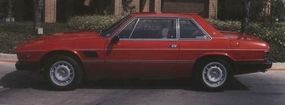
The front of this Maserati Kyalami displays the slightlyreworked nose and restyled wheels used on late examples.
It was the first -- and so far only -- ”badge-engineered” supercar, but the Kyalami had a genuine Maserati heart. To understand why, you have to go back to the early Seventies and the De Tomaso Longchamp.
Alejandro de Tomaso had produced the mid-engine Pantera (see entry) with Ford’s help and encouragement. The next of his Dearborn-powered cars appeared at the end of 1970. This was the Deauville, a shapely four-door sedan with front-mounted Ford V-8 and Ghia styling much like that of the Jaguar XJ6, which it also aped in size. The Longchamp arrived two years later on a shortened version of this platform, with trim notchback coupe styling by Frua emulating the lines of Mercedes’ SL.
In 1975, De Tomaso took over Maserati after Citroën had decided to solve one of its many financial problems of the time by abandoning its erstwhile Italian partner. In an effort to boost Maserati sales while saving time and money, Alejandro decided to spin off his two “copycat” cars into restyled variants with Maserati power. The respective results were a “new” Quattroporte and the Kyalami, named for South Africa’s famous Grand Prix circuit.
Kyalami became the first “badge-engineered” Maserati when Alejandro de Tomasomodified his Longchamps coupe with a trident grille and Maserati twincam V-8.
Predictably, the Kyalami shared the Longchamp’s simple, all-steel unit body/chassis structure and square-rigged Frua styling, but got a reworked front with quad headlamps and a typical Maserati grille, plus minor rear-end changes. The Longchamp’s all-independent suspension, which naturally differed from previous Maserati setups, was also retained, but the Italian twincam V-8 was installed instead of the physically similar 351 Ford.
De Tomaso was already using the ZF 5-speed gearbox Maserati specified for the Khamsin, so this was retained, but not its optional Borg-Warner automatic, which gave way to Chrysler TorqueFlite (replacing the Longchamp’s Ford transmission). The upshot of all this was that De Tomaso had two very similar 2 + 2s that effectively competed with each other.
In an apparent effort to distance the new hybrid from the 4.9-liter Khamsin, the first 100 Kyalamis carried the 4136-cc V-8, with a rated 255 SAE net horsepower giving a top speed of “only” 147 mph. The big engine became optional in 1978, this time with 280 bhp (SAE net), and both sizes continued for the rest of the car’s career.
Despite De Tomaso’s intentions, Maserati customers never took to the Kyalami. The thoroughbred Maserati engine was a big plus over the Longchamp’s American iron in both performance and prestige, but most buyers understandably viewed the car itself as a half-breed. Production wound down in early 1983 after only 150 units, and the Kyalami quietly faded away in favor of the first “mass-market” Maserati, the very different Biturbo sports sedan.
To learn more about Maserati and other sports cars, see: