
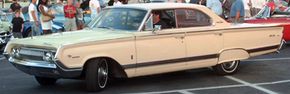
The 1960 Mercury was a quieter presence than bolder, earlier models. Mercury models of the late 1950s could make a sensitive soul shriek in horror. Recalled today as veritable icons of their time, the big boats were laden with chrome, sharply sculptured angles, and windshields curved so severely as to defy the imagination -- everything, in short, that signified excess.
Advertisement
Sure, sales slipped in 1958 -- the year of what many consider the most excessive Mercury of all, and a rough year for the industry. Yes, fewer yet were sold in 1959, when Mercurys displayed a slightly less cluttered look -- but added even more inches. Nevertheless, thousands of Americans took these overstuffed Mercurys to heart and eagerly brought them home; just as thousands of others were overjoyed to acquire the latest Edsel.
What looks hideous in retrospect, of course, didn't seem half bad at the time -- at least in the minds of many a middle-class motorist. And today, plenty of collectors covet the most glaring examples of American overstyling.
Mercury wasn't alone in catering to questionable tastes, to be sure; plenty of makes were comparably baroque. Depending on one's taste, Mercury was either the best or the worst example of the lot. If nothing else, they were unique, with an undeniable identity.
Overall, the 1960 Mercury face-lift was an improvement, with less chrome decoration and rounded lines softening the former sharp edges, even though the basic shapes and rooflines remained.
Slim, vertical taillights encased within upright bumper pods replaced the huge triangular lenses of 1959, and though vestigial fins were discernible above, it made for a more subtle attitude. Quad headlights moved down into the new concave grille, giving the front end a less immense and blocklike stance. Both windshields and backlights again displayed startling compound curves.
Continuing on a 126-inch wheelbase, the 1960 Mercurys were mighty big cars, offered on three levels. Montereys carried a 312-cid V-8 (383-cid optional), while the more costly Montclair and upscale Park Lane stuck with their Lincoln-derived 430-cid V-8, reduced to 310 bhp from its former 345, via reduced compression. Cutting back on power came as a surprise after the Fifties horsepower race, but was triggered by the severe recession of 1958.
Also for economy, 2.71:1 and 2.91:1 axles were available with the 383- or 430-cid engine. Still, with 460 pounds/feet of torque on tap, the 430 V-8 remained a mighty machine. No one need have feared, in any case: before long, bhp figures would be rising again.
Learn more details about the differences between the 1960 Mercury Monterey, Montclair, and Park Lane on the next page.
For more information on cars, see:
- Classic Cars
- Muscle Cars
- Sports Cars
- Consumer Guide New Car Search
- Consumer Guide Used Car Search
Advertisement