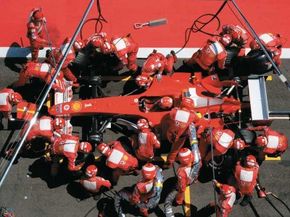
Ferrari F1 pit-crew members swarm the car of Michael Schumacher in 2004. See more pictures of Ferrari cars in action.
Ferrari F1 puts the red cars of Maranello at the center of the world's most demanding form of motorsport.
This article tells the story of the sleek, open-wheel single-seat Ferraris that compete in the most technically demanding form of auto racing. With circuits on every continent, no other form of auto racing matches Formula 1 for financial stakes, worldwide audience, historical sweep, or sheer glamour.
Advertisement
Discover how Ferrari's involvement began before this was known as F1, with company founder Enzo Ferrari in association with Italian automaker Alfa Romeo as a race driver and team manager.
Known before World War II as Grand Prix racing, it adopted the name Formula 1 in 1947. Ferrari's first F1 car, the 125 F1, appeared in 1948. Since then, Ferrari F1 cars have won more races and more world championships than any other maker's.
This article has profiles and pictures of such classic Ferrari F1 cars as the 375 F1, D50, and Dino 156 F1, as well as the inside story on modern-day mounts like the F1-2000 and F2007.
Learn about the immortal drivers who captured world championships in Ferrari 1 cars, from Alberto Ascari and Juan Manuel Fangio in the 1950s, through Phill Hill and John Surtees in the 1960s, Niki Lauda and Jody Scheckter in the 1970s, right up to Michael Schumacher's unparalleled run of five consecutive titles starting in 2000.
The thrilling story of the machines and men who make up the Ferrari F1 saga begins on the next page.
For more fantastic Ferrari information, check out:
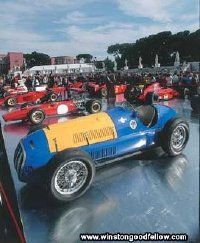
The Ferrari 125 F1 showed promise asFerrari's first Grand Prix racer.
After World War II, Formula 1 took longer to gel than sports-car competition. It was called Grand Prix racing prior to the war, when it was a technological tour de force and teams benefited from government backing as part of the political propaganda machine. After the war, financing for proper engineering, materials, fuel, and even the venues was in short supply.
Advertisement
When Ferrari entered the fray in 1948, he used his 125 S sports-racer as the starting point for the first Ferrari Grand Prix racer, the 125 F1. Like the sports-racer, it used Ferrari’s compact, high-revving 1497cc V-12. But chief engineer Gioachino Colombo exploited F1 rules and followed the era’s typical practice of supercharging. This boosted horsepower from 118 in the 125 S to 230. Both used a five-speed gearbox.
Known originally as the 125 Grand Prix, this was the first single-seater to wear the Ferrari badge. Its torpedo-shaped body was a pleasing design, with a large eggcrate grille, long nose, exposed wheels, and proper proportions. The frame was of steel tubes with struts and crossmembers. The front suspension followed the lead of the 125 S, with double wishbones, a transverse leaf spring, and shock absorbers. In the rear were longitudinal struts, a torsion bar, and shock absorbers.
The Ferrari 125 F1 first appeared in September at the race in Turin. Three started, and the one driven by Raymond Sommer finished third overall. A month later, Giuseppe “Nino” Farina drove a Ferrari 125 F1 to Ferrari’s first Grand Prix victory, at Garda, in Italy.
The winner at Turin, and the cars to beat during this period in F1, were the Type 158s from Alfa Romeo. Four of the sophisticated monopostos had survived the war, and with a bit of refurbishment, they were dominating the competition. Ironically, it was Enzo himself who had helped build the foundation for this dominance in his prewar stint at the helm of Alfa’s racing effort.
For the 1949 Italian Grand Prix at Monza, Ferrari introduced a new 125. This car had a longer chassis with similar underpinnings, but the big news was the engine. It now had double overhead cams and a two-stage Rootes supercharger, boosting horsepower to 280.
Formula 1 as a description for Grand Prix racing came into use in 1947, with the establishment of the sport’s governing body, the Federation Internationale de l'Automobile (FIA), headquartered in Paris. In 1950, the FIA established F1’s World Championship of Drivers, based on points per race. The FIA would not designate an F1 constructors championship until 1958, so in these early years, the manufacturers looked to the drivers for reflected glory.
Late in 1950, Ferrari shortened the 125’s chassis and modified the rear suspension by using a de Dion tube and leaf springs. The new four-speed gearbox became integral with the final drive. That made the car extremely competitive, but it still wasn’t enough to unseat Alfa Romeo. Alfa won all six Grand Prix races it entered and its driver Nino Farina, who had left Ferrari after the 1949 season, was F1’s first world champion.
For more fantastic Ferrari information, check out:
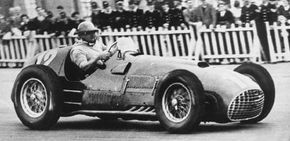
The final 125 served as the basis for the Ferrari 375 F1, the model that broke Alfa Romeo’s stranglehold on Formula 1.
Rules allowed use of a 1.5-liter engine with supercharger or a maximum of 4.5-liters with natural aspiration. Supercharging generated incredible power, and had been Alfa’s strength. But supercharging also consumed lots of fuel, and Ferrari now felt it was his principal rival’s Achilles' heel.
Advertisement
And so was born the Ferrari 375 F1. It continued use of the 125’s tubular chassis in its longer wheelbase form of 91.3 inches (2320mm). The suspension and four-speed gearbox were carried over. But instead of a supercharged 1.5, the V-12 was a naturally aspirated 4.5-liter of 330-380 horsepower. This was the culmination of an Aurelio Lampredi-designed series of unsupercharged Ferrari F1 V-12s that began as a 3322cc unit in the 275 F1, followed by a 4101cc engine for the 340 F1.
The 4.5 made its debut at the all-important Italian Grand Prix at Monza in September 1950. It just missed setting the pole, and ran a close second for the majority of the race before retiring with six laps to go.
But the die had been cast, and the man who punctured Alfa’s F1 dominance was a young Argentinean in his first year as a Ferrari works driver. Froilan Gonzalez, 29, was the son of a Chevrolet dealer and an immensely talented driver who originally came to Europe as a companion for countryman Juan Manuel Fangio. Fangio was now driving for Alfa, and the turning point was July 14, 1951, at the British Grand Prix.
“Two to three days before the British Grand Prix Juan drove me around the Silverstone circuit in the Alfa,” Gonzales recalled in Ferrari 1947-1997. “’Pepe,’ he said after we had studied the course, ‘I think you are going to win this one.’”
Fangio was right. The Alfas were extremely thirsty, averaging just 1.8 mpg, giving Ferrari the advantage of one fewer fuel stop, critical in what for the period was a short race.
“I still have a photograph of us looking across at each other as we drove side by side down the main straight,” Gonzales remembered. “But his advantage went away at his first pit stop when his crew put in too much fuel, making his car too heavy.”
The stocky Argentinean beat Fangio to the checkered flag. That ended an amazing run in which Alfa Romeos had finished first in every postwar Grand Prix event in which they were entered, more than two dozen races in all. The triumph over his former employer was a satisfying, if poignant, start to Enzo Ferrari’s F1 legacy.
An interesting footnote to F1’s first decade was that all its races, typically eight or so per season, were run in Europe -- with one notable exception. From 1950 to 1960, America’s Indianapolis 500 was among the events counted toward the F1 world championship. Thus, fabled Indy 500 winners such as Bill Vukovich and Rodger Ward are listed among drivers with F1 points.
For the traditional F1 field, travel to America for one race was impractical, and Indy was never treated seriously as a points opportunity. But Ferrari’s U.S. importer and chief promoter, Lugi Chinetti, saw the publicity possibilities.
Ferrari thus prepared a variation of the Ferrari 375 F1 to run in the Memorial Day classic. Called the 375 Indy, its naturally aspirated 4.5-liter was tuned for 400 horsepower, the chassis was strengthened, and aerodynamics were improved. As a shakedown run, three were sent to the 1953 Turin Grand Prix, where Luigi “Gigi” Villoresi’s finished first.
A fourth was prepared for Ferrari works driver Alberto Ascari, and he qualified it for the ’52 Indy 500 at just over 134 mph, good enough to start in 19th position. The red 375 proved ill-suited to a long afternoon of punishment at the Brickyard, however. It lasted 40 laps, spinning in the fourth turn when a wheel hub collapsed. It was the only Ferrari to compete in an Indy 500.
For more fantastic Ferrari information, check out:
After the 375 F1 victory at Silverstone in 1951, Ferrari easily defeated Alfa Romeo’s 159s in the next two races, setting up a showdown at the season’s final race in Spain. Alfas finished first and third, Ferraris second and fourth. That gave the championship to Alfa driver Juan Manuel Fangio.
But it was evident that the 159 and its supercharged engine were no longer capable of holding off Ferrari and its larger, naturally aspirated V-12. Alfa’s owner, the Italian government, was unwilling to contribute funds to the company to develop an all-new car, so at the end of the season, Alfa Romeo reluctantly withdrew from racing.
Advertisement
With Alfa gone, the FIA recognized that Formula 1 faced a serious shortcoming. There were no other strong competitors to challenge Ferrari, let alone fill the grid. In April 1952, a decision was made to use the less-expensive Formula 2 series for the World Championship. F2 had been popular since its inception in 1948, due in part to its limiting maximum engine capacity to 2.0-liters.
Ferrari was ready. He began competing in F2 with the V-12-powered 166 F2. This was, in essence, a modified 166 Spyder Corsa sports-racing car. For 1949, the 166 F2 used a 125 F1 chassis, winning every race in which it entered. In 1950 it won 13 of 17 races.
In charge of 1952’s F2 project was Ferrari chief engineer Aurelio Lampredi. “I would go into the factory on Sunday mornings to look over my affairs,” he recounted in Ferrari I Quattro Cilindri. “Ferrari turned up and told me they’d launched the new project, an F2 with 2000cc capacity.
“‘What would you do?’ he asked.
“’I’d make a 4-cylinder,’ I replied.
“’Do make me a sketch then, now.’”
A few intense hours later, Lampredi was finished. The 185- horsepower 1985cc inline-four was placed in a chassis that followed lessons learned in F1. The combination was virtually unbeatable.
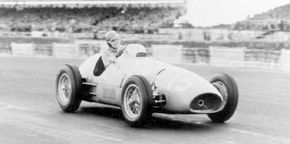
The Ferrari 500 F2 won seven of eight races in 1952, and made team driver Alberto Ascari Ferrari’s first world champion. The car won seven of nine races in 1953, and Ascari was again world champion.
On the way to his two titles, the former motorcycle racer from Milan finished first in nine consecutive races in which the Ferrari 500 F2 competed. It was a Grand Prix record that would last the century, and beyond.
For more fantastic Ferrari information, check out:
The Ferrari D50 featured Formula 1's first V-8 engine.
In 1954, the Grand Prix world championship ended its two-year hiatus under Formula 2 rules and was reconstituted under revised Formula 1 regulations. Now, engine capacity was limited to 2.5-liters naturally aspirated or 750cc supercharged.
Like most competitors, Ferrari went the naturally aspirated route. He continued use of Lampredi-designed four-cylinder engines in an update of his 553 F2 machines called the 553 F1. (The 533 F1’s generous midsection reminded some of a shark’s torso, and the car was nicknamed “Squalo.”)
Advertisement
But there were two thorns in Ferrari’s side that season. First, the 250 F from crosstown rival Maserati was a masterfully balanced machine, and it won the year’s first two races. Then Mercedes-Benz entered F1 in the season’s fourth race, and thereafter dominated the proceedings, winning the championship behind the driving of Juan Manuel Fangio.
At 1954’s last race, in Spain, Lancia entered the fray. The Turin automaker’s innovative Vittorio Jano-designed Ferrari D50 showed considerable promise, setting fastest lap before retiring with mechanical problems. No one could know that Lancia would influence Ferrari’s fortunes in a most unexpected way.
For 1955, Ferrari revised his cars’ chassis, suspension, and bodywork and coaxed more horsepower out of the engine. The new racer was called the 555 F1 “Super Squalo,” but it was to no avail. Mercedes dominated the season, the “Super Squalo’s” lone victory coming at Monaco.
Soon after the start of the season, racing lost one of its immortals. Two-time world champion Alberto Ascari died at Monza in the wreck of a Ferrari he had borrowed for practice. Ascari was at the time Lancia’s lead F1 driver. Lancia was already experiencing financial troubles, and Ascari’s death was another layer of misery.
In July, after protracted negotiations, Lancia handed over to Ferrari six D50s and the services of engineer Vittorio Jano. Fiat agreed to offer financial support so Ferrari could compete against the German onslaught.
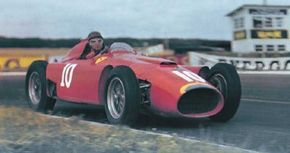
The Ferrari D50 was loaded with innovations. It boasted F1’s first V-8 engine. Its gearbox and clutch were in unit with the final drive. And it wore its fuel tanks as bodyside pods. The tanks’ placement helped in weight distribution and acted as aero-dynamics aids.
Still, it wasn’t enough to unseat Mercedes, and Fangio again won the 1955 world championship. But in the wake of the 1955 carnage at Le Mans, Mercedes decided to withdraw from Grand Prix and sports-car racing.
Fangio came over to Ferrari for the ’56 F1 campaign. The Ferrari D50 evolved, with Ferrari’s men creating a modified body that incorporated the main fuel supply in the tail while retaining the side pods as auxiliary tanks. The suspension was altered, and additional bracing was employed in the engine compartment.
Fangio and the Ferrari D50 claimed the world championship for Ferrari, its first since Ascari’s in 1953. It was a thrillingly tight title charge, the great Argentinean finishing with 30 championship points to 27 for Stirling Moss in the Maserati. Ferrari’s Peter Collins was third, with 25.
For more fantastic Ferrari information, check out:
For 1957, Ferrari continued modifying the Lancia D50, now calling it the 801. But the car had changed so much it was unrecognizable from its original guise.
The coachwork was completely different, the front and rear suspension changed, the V-8’s bore and stroke modified. Alas, its best individual race results were three second-place finishes, and Ferrari came in a distant runner-up to Maserati in the Grand Prix season.
Advertisement
But there were benefits to what appeared to be a bleak campaign. Ferrari was having great success in Formula 2 with its superb Dino 156 (1.5-liters, 6-cylinders). Named for Ferrari’s first son, the 156 served as the basis for 1958’s Ferrari Dino 246 F1.
In Formula 1 guise, the six-cylinder engine was enlarged to 2417cc, good for 280 horsepower. The model was first tried at the final F1 race of 1957, then returned for 1958 with a number of modifications. These included telescopic shocks in front, and disc brakes in place of large drums in the rear.
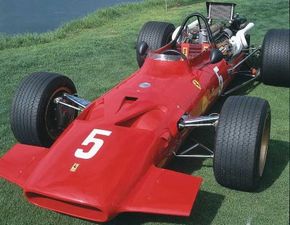
Identified by the clear cover over its sextet of carburetor stacks, the Ferrari Dino 246 F1 propelled team driver Mike Hawthorn to the F1 world championship, the third for a Ferrari driver. The title was won through consistency.
Over the 10 races, Hawthorn had only one victory, at Reims in France, but his five seconds and one third were enough to snare the championship by one point over fellow Brit Stirling Moss, who had four victories driving the Cooper-Climax and Vanwall cars. (This was the first year in which the FIA established an F1 Constructors Championship to go along with the driver’s crown. Vanwall beat out Ferrari for the ’58 title.)
The Dino returned in 1959 as the Ferrari Dino 246 F1. It was a prettier car, with more aerodynamic bodywork, and was fitted with Dunlop disc brakes at each corner, a new suspension, and a 2474cc V-6.
Ferrari ran both the Ferrari Dino 246 F1 and 256 F1 during 1959, but was still at a disadvantage in a season that marked a watershed change in motorsport.
Brit Tony Brooks was a Ferrari team driver that year, and piloted the Ferrari Dino 246 F1 to victories in the French and German Grands Prix. But he finished second in the points hunt to Australian Jack Brabham, 31 to 27. Brabham’s championship was the first in F1 to be won in a rear-engine car.
As Brooks explained in Ferrari 1947-1997: “Our Dino-engined V6 cars were strong and reliable, but on slow and medium-speed circuits they were no match for the lightweight rear-engine British cars. Even at the fast Reims circuit Jack Brabham was quick enough to split Phil Hill and me on the front row of the grid. It was only thanks to our superior power that I was able to pull away from Brabham at the start and lead all the way to the finish.”
In 1960, it wasn’t even close. The lone Dino victory was Phil Hill’s at Monza, as Brabham and the rear-engine Cooper-Climax ran away from the field to take both the driver and constructors titles. Lotus-Climax was second, Ferrari third.
For more fantastic Ferrari information, check out:
Ferrari’s single victory in the 1960 F1 campaign certainly didn’t reflect well on the Scuderia, but actions behind the scenes showed Enzo played the Grand Prix game better than anyone.
When, in October 1958, the FIA announced that starting in 1961 engine capacity would be reduced from 2500cc to 1500cc, the British teams protested loudly and threatened to withdraw. Ferrari simply shrugged his shoulders and had his men make a car to meet the new specifications.
Advertisement
Ferrari chief engineer Carlo Chiti and his crew once again drew on their Formula 2 experience to make their F1 car. The result, the Ferrari Dino 156 F1, was not unfamiliar in some regards: steel tubular chassis and independent suspension front and rear with double wishbones, coil springs and tubular shocks, and Dunlop disc brakes at each corner. But there was one characteristic somewhat foreign to Ferrari: The engine was in the rear.
Ferrari had actually debuted its first rear-engine F1 car in 1960, at the season’s first race in Monaco. It was essentially an experiment, and, driven by Richie Ginther, it finished a distant sixth. The car continued to race the rest of the year as largely a development exercise, then was modified over the winter by Chiti.
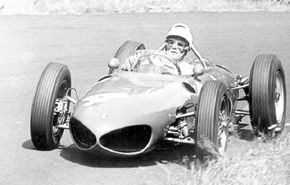
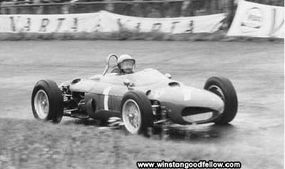
He swapped its 65-degree V-6 for a more-powerful 120-degree V-6. That propelled what would become one of the most distinctive of all Ferrari race cars. The Ferrari Dino 156 F1 had an evocative twin nostril “sharknose” and attractive tail bodywork that enclosed the engine, gearbox, and clutch. The car was beautiful, successful, and historic.
With it, Phil Hill in 1961 became the first American F1 world champion, beating out teammate Wolfgang von Trips by a single point. Their performance helped Ferrari win its first official F1 constructors title.
But the good fortune wouldn’t carry into 1962. In November 1961, Maranello was rocked by the infamous Purge, in which Chiti, team manager Romolo Tavoni, and a number of others left the firm. The 1962 F1 season was a disaster, exacerbated by the fact that the British teams were running strong V-8s. Ferrari didn’t score a victory and finished tied for fifth in a constructors championship won by BRM.
For 1963, the 156 got a revised body that traded the sharknose for a single-inlet form. New chief engineer Mauro Forghieri did his best to improve the mechanical package with a revised suspension and later, a semimoncoque chassis. Still, Ferrari scored just one victory, a win at Germany’s Nurburgring by former motorcycle world champion John Surtees. It finished fourth among eight constructors in a makes championship won by Lotus-Climax.
The Ferrari Dino 156 F1 carried Phil Hill to victory as America’s first world champion.
For more fantastic Ferrari information, check out:
In practice for the 1963 Italian Grand Prix the Scuderia showed it was already looking ahead to the 1964 campaign. Alongside the V-6 Dino models that would actually contest the race, it tested a new car, the 158 F1. The name signified its 1.5-liter 8-cylinder engine, a 90-degree V-powerplant good for 210 horsepower, a more than 10 percent increase in output over the F1 V-6.
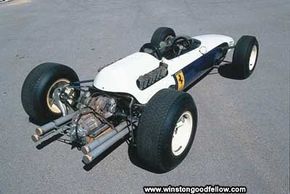
The chassis also followed new thinking. Instead of being Ferrari’s customary assemblage of tubes, it was a monocoque structure tailor-made for the engine and featured aluminum panels riveted to its framework. The V-8 had an extremely strong crankcase, so it was used a stressed member.
Advertisement
The 158 F1 didn’t capture a checkered flag until the ’64 season’s sixth race, but thereafter, team drivers John Surtees and Lorenzo Bandini were consistent podium finishers. It was enough to give Ferrari the constructors title over BRM, and for Surtees to win the World Driving Championship, the fifth Ferrari driver to do so. Surtees’ margin at the end was one point over fellow Englishman Graham Hill in the BRM.
Interestingly, Ferrari’s F1 colors for the final two races of the season switched from red to the blue and white of Luigi Chinetti’s North American Racing Team -- fallout from Enzo’s dispute with international racing authorities over the homologation of the 250 LM sports-racer.
The imbroglio did nothing to dim the luster of the season for Surtees. “The best of my years in Italy, as far as motor racing was concerned, was 1964, the year of the F1 world title with the Ferrari 158,” the seven-time motorcycle world champion recalled in Ferrari 1947-1997.
Though the 158 F1 ran again in 1965, Ferrari’s mainstay F1 machine that season was the Ferrari 512 F1. It had a 225-horsepower 1490cc “flat” 12 instead of the V-8. The car looked good on paper, but no rival was a match for Lotus and Jim Clark; they dominated to take the constructors and driver championships. The best the Ferrari 512 F1 could muster was two second-place finishes.
It would be 11 years before another Ferrari driver was F1 world champion.
Such technologies as the monocoque structure and the flat-12 demonstrated that Ferrari could welcome fresh ideas in racing. More difficult was dealing with the diverse elements tugging the company this way and that.
“Where Ferrari is concerned, I do have one regret,” Surtees noted. “I could have won another three world titles, in 1963, 1965, and 1966, when the cylinder capacity for Formula 1 was increased from 1500cc to 3000cc. But, for one reason or another, we ended up by giving away an incredible number of victories.
“[A]t Ferrari in those years [there were an] incredible number of activities, which led inevitably to energy being expended in different sectors. For example, when cars had to be prepared for Le Mans, Formula 1 was clearly overlooked, although we could compensate in part for our disappointments by the success of the sports prototype cars. I must say the Ferrari ‘P’ models, from the 250 to 275, P2 and P3, were wonderful cars to drive, very powerful, very well-balanced and a joy to race.”
For more fantastic Ferrari information, check out:
The Ferrari 312 F1 was a disappointment, winning only three races in four F1 seasons.
For 1966, Formula 1 again changed its engine rules, now allowing up to 3.0-liters displacement naturally aspirated or 1.5 supercharged. Ferrari was ready. Chief engineer Mauro Forghieri turned to the company’s sports-racing 3.3-liter V-12. He left the bore at 77mm, reduced stroke 5mm to 53.5mm, and came up with a displacement of 2989cc. He increased the compression ratio, fitted twincam heads with two plugs per cylinder, and topped it off with Lucas fuel injection.
The resulting car was called the Ferrari 312 F1. Though Ferrari’s John Surtees started the racing calendar with a win in the nonchampionship South African Grand Prix in January, he felt the 312 lacked power. During the official F1 season, he and team manager Eugenio Dragoni were constantly battling. Surtees would win in Belgium in June, but by September had left the team. Ludovico Scarfiotti’s victory in Italy accounted for Ferrari’s only other F1 win, as it finished a distant second to Brabham-Repco for the constructors title.
Advertisement
For 1967, the Ferrari 312 F1 used a revised 36-valve V-12, and the chassis was modified to make it lighter. But the updates were to no avail. Ferrari didn’t win an F1 race.
It did win the following year, but just once: Jacky Ickx’s victory in France. The Ferrari 312 F1 now ran four-valve heads that helped make it the first F1 Ferrari with more than 400 horsepower. Perhaps the season’s most noteworthy Ferrari moment came in June at the Belgium Grand Prix, where Maranello introduced an aerodynamic aid that caught everyone’s attention.
A number of cars had experimented with small wings on the nose and rear, but Ferrari mounted an aerofoil on supports high above the gearbox, just behind the cockpit. By September, at Monza, the wing could be controlled by the driver.
The Ferrari 312 F1 failed to score a victory in 1969. After the Italian Grand Prix, the eighth race of the 11-race season, Ferrari temporarily withdrew from F1 to concentrate on development of its new flat-12 engine. Luigi Chinetti’s North American Racing Team ran the cars in the final three races, the best finish a fifth by Pedro Rodriguez at Watkins Glen. In all, the 312 won just three races in four F1 seasons.
For more fantastic Ferrari information, check out:
The Ferrari 312 T won the 1975 world championship for driver Niki Lauda.
Ferrari’s drought in Formula 1 continued well into the 1970s, relieved only briefly by a second-place showing in the 1970 constructors championship. Its F1 car that season was the innovative 312 B, which had a semistress-bearing flat-12 engine; it won four races.
A burr under Maranello’s saddle that season -- since 1967, in fact -- was the Ford DFV V-8. Built by Cosworth and financed by Ford Motor Company, this stupendous engine won its very first time out at Zandfoort, in a Lotus, and would soon spread to most every other team.
Advertisement
In 1974, the tide began to turn. Ferrari withdrew from endurance sports-car racing to concentrate its resources on Formula 1. It hired Austrian Niki Lauda, late of BRM, as its No. 1 racing driver. Chief engineer Mauro Forghieri returned after a one-year absence. And Luca Cordero di Montezemolo became team manager and was a tremendously equalizing force, eradicating much of the political intrigue that hounded the team.
With the last of the 312 Bs, the 312 B3, Lauda won the Spanish and Dutch Grands Prix, teammate Clay Regazzoni won in Germany, and Ferrari finished second to McLaren-Ford in the constructors championship
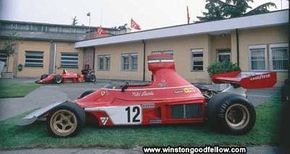
For 1975, Ferrari introduced the Ferrari 312 T Series. The “T” stood for transversale and indicated that the five-speed gearbox was mounted east-west ahead of the rear axle for a better center of gravity. The suspension was altered front and rear, and Lauda’s superb ability as a test driver honed the machine.
The Ferrari 312 T entered competition in the season’s third race, in South Africa. By the sixth race, at Monaco, it and Lauda were in the winner’s circle. In all, the Ferrari 312 T won six of the last 11 races. Lauda was world champion, and Ferrari had its first constructors title since 1964.
Ferrari and Lauda appeared well on their way to a repeat in 1976, with the 312 T2. Underneath, the car was nearly identical to the 312 T. But the body was quite different, with higher side panels and different wings and spoilers. With Lauda and Regazzoni, the 312 T2 won five of the year’s first eight races.
Then, in the German Grand Prix at Nurburgring, Lauda had a horrendous, life-threatening crash. He was pulled from his flaming 312 T2 by four fellow drivers and a track marshal; a priest read him the last rites in the hospital.
Miraculously, Lauda recovered, and incredibly, was back in a 312 T2 five weeks later for the Italian Grand Prix. He finished fourth. Ferrari accumulated enough points to repeat as constructor champion. Lauda withdrew from the season’s last race, in Japan, because of appalling, monsoonlike conditions, and lost the driver’s championship by one point to McLaren-Ford’s James Hunt.
The 312 T2 returned in 1977, and Lauda’s loss of the driving championship in 1976 seemed a fluke. He and teammate Carlos Reutemann consistently scored points, often placing on the podium. Ferrari handily won the constructors crown, and Lauda had his second driver’s title.
Nonetheless, the season was dogged with controversy. Animosity between Lauda and the team over a number of incidents during the 1976 campaign caused the World Champion to leave Ferrari at the end of the 1977 season. (Lauda and Enzo Ferrari patched up their disagreements years later.)
Ferrari’s mount in 1978 was the 312 T3, which showed important differences from the T2 in aerodynamics and front suspension. It was introduced at the South African Grand Prix, the season’s third race. Carlos Reutemann won with it in the fourth race, the U.S. Grand Prix West, at Long Beach, California. He won two more races in the car, and Gilles Villeneuve won one as Ferrari placed second to Lotus-Ford in the constructors championship.
In 1979, Ferrari brought in as its No. 1 driver Jody Scheckter, who had driven for Wolf-Ford the previous season. The South African and the Canadian Villeneuve proved the consummate GP tag team.
“We weren’t just teammates,” Scheckter recalled in Ferrari 1947-1997, “we were friends and wanted to work together to win races, so we made an agreement to share all our technical information.”
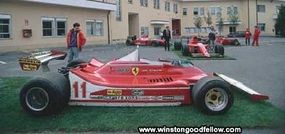
The arrangement worked quite well, indeed. The duo finished 1-2 in the debut of Ferrari’s new car, the 312 T4, in South Africa for the season’s third race. The T4 represented Ferrari’s transition from mere areo design to true ground effects, in which the car’s structure and shape managed airflow along the sides and underbody to generate maximum adhesion.
Each the winner of three races, Scheckter was World Champion, Villeneuve was runner-up, and Ferrari handily won the makes title, its fourth in five years.
The next season saw the final development of the 312 series, the 312 T5. Bodywork was once again modified, but the rapidly changing science of ground effects had moved beyond what Ferrari could do with its flat-12 engine, a powerplant that was wider and thus more difficult to package in terms of airflow management than the Ford-Cosworth V-8 that powered Alan Jones and his Williams-Ford to the championship.
The 312 T5’s best showings were fifth-place finishes at Long Beach, Monaco, and Canada. Ferrari was famous for its 12-cylinder engines, but the close of the 1980 season marked a period of nine years before one of its F1 cars would again be powered by a twelve.
True ground effects were added for the Ferrari 312 T4, making it a winner in 1979.
For more fantastic Ferrari information, check out:
The turbo-charged Ferrari 126 C Series netted two makes titles for Ferrari.
The 312’s flat-12 engine had been Ferrari’s mainstay F1 powerplant for a decade, but in 1980, the handwriting was on the wall. Even as the team raced with little success that season, Ferrari was hard at work developing a state-of-the-art turbo-charged engine. It was unveiled on the second practice day for the Italian Grand Prix at Imola in September, and it was a half-second faster than the naturally aspirated flat-12 312 T5.
Development continued over the winter for what would be called the 126 C. It reprised Ferrari’s tradition of a tube frame overlaid with aluminum sheeting, but was powered by a 1496cc V-6 with two German KKK turbochargers, a pair of intercoolers, and four valves per cylinder. Horsepower was quoted at 540, 25 more than Ferrari’s most-powerful flat-12.
Despite its newness, the engine proved remarkably reliable, but the chassis was a handful. Still, on the strength of Gilles Villeneuve’s brilliance and the new engine’s prodigious power, the 125 C won the Monaco Grand Prix, just its sixth race. The Canadian won again in Spain, but wrecks and chassis problems plagued the team the rest of the year, and Ferrari finished fifth among 11 entries in 1981 constructors points.
To rectify the chassis situation for 1982, Ferrari hired Englishman Harvey Postlehwaite. His 126 C2 chassis of composite materials reinforced by carbon fiber made all the difference, as did an even more-powerful turbo engine.
But drivers Villeneuve and Frenchman Didier Pironi were never the team that Jody Scheckter and Villeneuve had been. When Pironi deprived Villeneuve of a victory at Imola against team orders, the two never spoke again.
Then, in May 1982, racing lost one of its stars. In practice for the Grand Prix of Belgium, Villeneuve crashed the Ferrari. He died in the hospital hours later. In June, a crash in Canada sidelined Pironi for the season. Frenchman Patrick Tambay and American Mario Andretti filled in ably, sustaining enough points for Ferrari to win it first constructors championship since 1979.
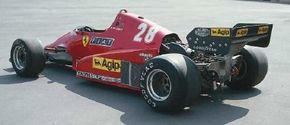
With ground-effects side skirts banned for 1983, Ferrari’s 126 C3 showed completely revised bodywork. Tambay was joined by countryman Rene Arnoux as team drivers and they finished third and fourth, respectively, in points. Arnoux’s three victories, Tambay’s one, and consistently high finishes were enough to capture for the Scuderia a second consecutive constructors championship.
In 1984, the 126 C4 and the rest of the field were outclassed by McLaren’s MP4 and its drivers Niki Lauda and Alain Prost. They won 12 of the season’s 16 races, and Ferrari finished a distant second in the constructor chase.
F1’s Turbo era lasted through 1988, but Ferrari’s only other strong showing came in 1985, with the 156/85. It boasted Maranello’s first bodyshell designed completely by computer. Italian Michele Alboreto won twice with it, at Canada and Germany, and the team finished second to McLaren-TAG for the constructors championship.
For more fantastic Ferrari information, check out:
In the second half of the 1980s, Formula 1’s turbocharged engines were producing prodigious power -- Ferrari’s F1/86 and F1/87 delivered almost 1,000 horses in qualifying, and nearly 900 in race trim. In an effort to calm things down, the FIA for 1988 dramatically reduced the allowed turbo boost. For 1989, it banned turbos altogether.
The return to naturally aspirated engines saw Ferrari once again utilize the V-12. The one in its F1/89 displaced 3498cc, had five valves per cylinder (3 intake, 2 exhaust), and produced 600 horsepower at 12,500 rpm.
But the big news the was the F1/89’s gearbox. It was an innovation that revolutionized race- and sports-car technology.
Ferrari had developed a seven-speed electro-hydraulic transmission that was, in essence, a manual gearbox that could be upshifted or downshifted automatically by touching a switch on the back of the steering wheel. No longer did the driver have to remove his hands from the steering wheel and reach for a shift lever to change gears. The advantages were impossible to ignore, and soon every F1 rival had a version of Ferrari’s innovative gearbox. Within a few years, paddle-shifted manuals would be in many high-performance road cars as well, including several from Ferrari.
The F1/89 came from the drawing board of Ferrari’s England based designer, John Barnard, and the car got off to a magnificent start when it won the ’89 season’s first race, at Brazil, with Brit Nigel Mansell driving. Then electronic gremlins started hounding the car. Mansell won the season’s ninth race, in Hungary, and Gerhard Berger won in Portugal. But that was it, and the team finished a distant third in the makes chase.
Ferrari was optimistic about 1990. It had a new car, the Ferrari F1 641. It had revised bodywork, and the V-12 had a shorter stroke, weighed less, and produced nearly 700 horsepower. Joining Mansell in the cockpit was one of the world’s top drivers, Alain Prost. The Frenchman was coming off his third F1 world championship, captured just the year before with McLaren-Honda.
The season turned into a dogfight between Ferrari and McLaren, then into one between Prost and Mansell. The intra-team rivalry was much to the detriment of Ferrari.
“If we had been able to cooperate as I had hoped,” Prost observed in Ferrari 1947-1997, “I am sure Ferrari would have had a world championship to celebrate that year.”
Instead, it was as close as Ferrari would come to another makes or driver’s title for almost a decade. Prost lost the championship in the season’s last race, when archrival Ayrton Senna pushed his Ferrari off the Australian Grand Prix’s Adelaide Street Circuit. Senna won the race and the title, in a McLaren-Honda.
For more fantastic Ferrari information, check out:
After losing the 1990 constructors championship to McLaren-Honda by just 11 points, Ferrari fell into disarray, and the team went three full seasons without a victory. The car that broke the spell was 1994’s 412 T1.
The 412 T1 marked two returns. First, Ferrari revived a conventional pushrod suspension system; 1993’s F93A had used an electronically controlled active suspension system that was plagued with reliability issues. Second, it welcomed back engineer John Barnard, who had been briefly lured away by Benetton.
With more-efficient airflow management and improved balance, the 412 T1 demonstrated Barnard’s talent for original thinking. He substantially redesigned the nose, making it higher than the F93A’s. And he moved the air ducts on the side pods, and thus the radiators, further forward.
The car proved relatively reliable, and Ferrari secured podium finishes in the season’s first five races. But the engine was starving for air, so the modified 412 T1B made its debut at the French Grand Prix in July, the year’s seventh race.
Gerhard Berger finished third with the car, and two races later broke Ferrari’s three-plus season drought two races later, with a victory in Germany. Meanwhile, teammate Jean Alesi was also scoring a number of podium finishes, and Ferrari placed third overall in the constructors championship. The Scuderia looked to be regaining its form.
In 1995, a rules change reduced maximum engine capacity to 3.0-liters. Ferrari responded with a new, more-compact V-12 that produced over 600 horsepower at 17,000 rpm. It went into a new car called the Ferrari 412 T2.
Compared to the T1, the Ferrari 412 T2 was slightly shorter in wheelbase and in overall length -- enough to allow the engine to be moved about 3.5 inches (10cm) closer to the platform’s center. The 37-gallon (140-liter) fuel tank was similarly relocated, and the Ferrari 412 T2 proved more balanced and easier to drive than its T-series predecessors.
Against the dominating Renault-powered Benetton and Williams cars, however, it was competitive but not top-tier. The Ferrari team had a number of podium finishes, the most memorable Jean Alesi’s victory at the Canadian Grand Prix in Montreal. Once the Frenchman took over the lead, he was overcome with joy.
“I started to cry in the car,” he recalled in Ferrari 1947-1997. “I couldn’t see the road because when I braked the tears were getting in my visor. It was not the way I expected to react. I told myself to get back to driving and see what happened.”
That emotional victory would be the last for a Ferrari V-12 in Formula 1. The following season a new engine and a new driver would come on the scene, laying the foundation for a period of domination unlike any the sport had seen.
For more fantastic Ferrari information, check out:
The Ferrari F310B was a 10-cylinder, 7-speed automatic with improved aerodynamics.
A revolution was taking shape at Ferrari in the second half of 1995.
After studying several engine types, including V-8s and V-12s, Maranello announced it would use a V-10 in F1 for 1996. It marked the first time the Scuderia had tried a 10-cylinder configuration.
And rumors swirled that Ferrari was actively courting two-time world champion Michael Schumacher, widely recognized as the fastest driver in F1. Schumacher was at the time driving for Benetton-Renault, and two weeks after he won at the Hockenheimring in his German homeland, it was announced he would indeed be with Ferrari in ’96. He was signed to a two-year contract worth $24 million.
Ferrari’s new F1 car for 1996 was the F310. Among the benefits of its 10-cylinder engine was a compact size that allowed much-improved aerodynamics. The 2998cc unit initially produced 700 horsepower, a figure bumped to 725 later in the season.
As for Schumacher, his importance was obvious to longtime F1 reporter Andrew Frankl.
“Five aspects seem to stand out in an analysis of his talent,” Frankl reported in 1996 in FORZA, a magazine devoted to Ferrari. “They are: his never-ending commitment to the testing process; his technical ability; his confidence in his own driving ability; his incredible attention to detail, which emanates from a quest for precision and perfection ... And last -- and not wholly unimportant, his will to win.”
Schumacher’s teammate was also new to Ferrari. Irishman Eddie Irvine had come over from the Jordan team, and he scored the F310’s first points with a third-place finish in the season’s inaugural race at Australia. Schumacher followed with a third in the next race, at Brazil. He retired in Argentina, then went on a tear.
In the season’s final 13 contests, Schumacher scored three victories, three seconds, and a third. He finished third in a driver’s championship won by Williams-Renault’s Damon Hill. Ferrari was a distant runner-up to Williams-Renault in constructors points.
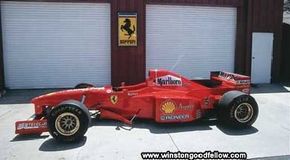
Ferrari upped the ante in 1997 with the Ferrari F310B. The aerodynamics were revised, the V-10’s output increased to 750 horsepower, the transmission was upgraded, and a new differential was used in an attempt to solve reliability issues. Ferrari was again second to Williams-Renault in the constructors championship, but the points margin was slimmer than in ’96. In the driver’s chase, Schumacher went into the season’s final race, at Jerez in Spain, leading Williams-Renault’s Jacques Villeneuve by one point, 78-77.
The race was the setting for one of F1’s most controversial moments. On lap 48, Villeneuve’s blue-and-white Williams pulled alongside Schumacher’s red Ferrari in a corner, and appeared about to pass. Suddenly, Schumacher veered, and his right front tire made contact with Villeneuve’s sidepod. Schumacher ended up in a gravel trap, but his rival was able to continue, and finished in third place.
Villeneuve ended the season with 81 points. Schumacher accumulated 78, but FIA officials judged his Jerez move an intentional bid to take Villeneuve out, and disqualified the Ferrari driver in the championship standings.
For more fantastic Ferrari information, check out:
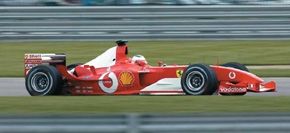
Michael Schumacher raced the Ferrari F2003-GA to a record sixth driving championship.
By 1998, Ferrari’s goal was nothing less than F1 supremacy. It was expected by everyone inside and outside the organization, and by fans around the world.
Michael Schumacher had also grasped the magnitude of the situation, comprehending how his new “home” was indeed different from its competition. “In a way,” he observed in Ferrari 1947-1997, “I wasn’t ready for the ‘Ferrari legend.’ I observed it from the outside, as a mere spectator, but I had no idea what it meant to be part of it….
“But on that first visit to Maranello [in 1995], I couldn’t stop at mere analytical considerations. I began to sense something, like goose pimples. I felt I was in a new atmosphere, which is not easy to define. It was an important moment; I understood that after two world titles at Benetton, I was now embarking on a new stage of my career and even my life.”
The final piece of this new reality, one that would shuffle in an era unprecedented in the history of Formula 1, fell into place in 1998, when the influence of two talented men came to the fore. Rory Byrne was a South African designer who had been in Formula 1 for 15 years. He had masterminded Schumacher’s two Benetton world championship cars. He joined Ferrari in late 1996, and his first car for the Scuderia was 1998’s F300.
Ross Brawn was Ferrari’s Technical Director, and he, like Byrne, had played an integral role in Schumacher’s Benetton titles. Not only would Brawn oversee the day-to-day development of the F300 and its successors, he proved a master racing strategist, able to work off preset plans or create them in the heat of battle.
And 1998 was a season-long battle between Ferrari and McLaren-Mercedes. Of the season’s first 12 races, McLaren-Mercedes’ Mika Hakkinen won six and Schumacher five. The Ferrari driver pulled even in wins with a victory in Italy, the 13th race of the 16-event schedule. But Hakkinen sealed the championship for himself and for McLaren-Mercedes with wins in the final two races.
Ferrari’s car for 1999 was the F399. The V-10 was moved forward in the chassis, and aerodynamics were enhanced with a new front wing, side pods, and air intake. Ferrari claimed more than 750 horsepower from 2997cc.
Once again Ferrari’s nemesis was McLaren-Mercedes. Ferrari’s Eddie Irvine won the first race, Hakkinen the second, Schumacher the third and fourth. And so the fight went until the midway point, the British Grand Prix, when Schumacher had a tremendous crash that sidelined him for the next six races with a broken leg.
Schumacher returned for the inaugural Malaysian Grand Prix, the season’s penultimate race, and was on his way to the win, but let Irvine take the checkered flag. Irvine had upped his game after Michael’s crash, with wins in Austria and Germany, and was in fact leading Hakkinen in the driver’s championship at the last race in Japan. But the tough Finn won the showdown and took the driver’s crown, 76 points to Irvine’s 74.
All was not lost for Ferrari, however. Irvine and Schumacher had accounted for six wins overall, helping Ferrari to its first F1 constructors championship since 1983. That wasn’t enough to satisfy Maranello, however.
“We’ve got a great team, both from a human and technical point of view,” Brawn said as he introduced the logically named F1-2000 and the team’s new No. 2 driver, Rubens Barrichello. “We deserve nothing less than both world titles this year.”
Though the F1-2000 looked similar to the F399, it was in design quite different. The first car developed in Ferrari’s new wind tunnel, its slimmer nose, reprofiled flanks, and superior undertray airflow improved aerodynamics by 10 percent, a huge number. The V-10 was lighter, produced around 800 horsepower, and its mounting location was adjustable. In all, the F1-2000 was so light that nearly 180 pounds of ballast was needed to bring it up to minimum weight requirements.
Schumacher won the first three races and appeared to be cruising to a championship. Then McLaren and Hakkinen returned to form. With four races left, Hakkinen led. But Schumacher closed the season with a string of victories to become Ferrari’s first F1 world champion since 1979. Ferrari also won the constructors crown in an equally hard-fought battle with McLaren-Mercedes.
The wind tunnel again played a key role in designing the F2001. Rule changes stipulated that the front wing be situated two inches higher than the previous year’s, so the F2001’s nose was lower than the F1-2000’s, and the wings curved upward to meet the regulations.
“Testing in the wind tunnel proved that for this car this configuration is best,” Byrne said of the team’s unique approach. “The first few races will show who was right in their design.”
And that they did, as the F2001 dominated the season. Ferrari scored a then-record 179 points for the constructors crown, and Schumacher’s 123 points on the way to his second-consecutive world driving championship were almost double those of second-place finisher, McLaren-Mercedes’ David Coulthard.
The F2002 sported new sidepods, revised rear suspension, and a lighter, shorter gearbox that delivered even faster shifts. Two-way telematics were now legal, so information and settings could travel between the car and pits.
All that spelled bad news for the competition. The F2002 won 15 of 17 races, with Schumacher taking 11 and Barrichello four. Ferrari set another constructor’s record with 221 points (runner-up Williams-BMW had 92) and Schumacher tied Juan Manuel Fangio’s record of five driver’s world championships.
Ferrari’s string of four consecutive F1 constructor championships and Shumacher’s run of three straight world titles was in jeopardy for much of 2003.
The team started the season with the F2002, and Schumacher didn’t set foot on the podium in the first three races. As the season neared the halfway point, leading in driver’s points was McLaren-Mercedes’ new hotshoe, Kimi Raikkonen, and his team was atop the constructors standings.
Then, in the fourth race, at San Marino, Ferrari unleashed its F2003-GA. (GA was a tribute to Fiat’s Gianni Agnelli, who died shortly before the car’s launch.) Versus the F2002, the GA had better aerodynamics and cooling, a two-inch-shorter wheelbase, and a V-10 that revved to a shrieking 19,000 rpm.
Schumacher won the F2003-GA’s debut race in Spain, and the following race in Austria. The season had morphed into an all-out brawl between Williams-BMW and Ferrari. A victory by Schumacher in Canada was sandwiched between Williams-BMW wins by Juan Pablo Montoya at Monoco and by Schumacher’s younger brother, Ralf, at Nurburgring. The BMW-powered rivals won again in France and with three races left, Williams-BMW was leading in constructors points. The driver’s championship, meanwhile, was a battle royale among Schumacher, Raikkonen, and Montoya.
In Italy, Schumacher fought off a pressuring Montoya for the win, and when the German won the next race, a rainy U.S. Grand Prix at Indianapolis, he was assured of the driver’s crown and a record sixth championship. Barrichello’s victory at the season finale, in Japan, secured Ferrari’s record fifth straight constructors title.
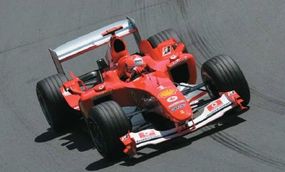
The F2004 may have looked like the F2003-GA, but as Rory Byrne pointed out at its introduction, “Every area of the car has been revised in order to make a further step forward in performance. So almost every component has been redesigned.” This included the engine, gearbox, chassis, and suspension.
It all led to what may have been the most dominant season ever in Formula 1. Schumacher won the first five races. An accident in the tunnel at Monaco halted the streak. Then he reeled off another seven wins in a row. He finished the season with a record 13 first-place finishes, bringing his record all-time victory total to 82. With Barrichello’s two victories, Ferrari won 15 of the season’s 17 contests.
Schumacher was World Champion for the seventh time (with a record 148 season points), and the Ferrari team set two more records -- a sixth-straight constructors title and 262 season points.
The Ferrari F2004 gave the Ferrari team a dominant season and led to a seventh championship for Schumacher.
For more fantastic Ferrari information, check out:
The demands of Le Grande Epreuve leave little time for savoring one’s triumphs, and so it was for Michael Schumacher and Scuderia Ferrari after their historic achievements of 2004. “It was definitely a fabulous season,” Schumacher told reporters in January 2005. “Not just because we were so successful, but also because of the atmosphere within our team, which is incredibly good ... Formula One is a team sport.
It’s about everyone working together, not a one-man show. The people at Maranello give us a solid foundation to work with when we’re at the race track ... It’s not a coincidence that we went for more than 50 races ... without having to retire due to technical failure. It shows how much effort is made and it shows Ferrari’s heart. The victories and titles belong to every single one of them.”
Schumacher paid that tribute soon after his 36th birthday, which some felt made him a bit elderly for Formula One. Asked if he was starting to feel his age, he admitted to the occasional small discomforts, but declared “All in all I feel very, very fit ... much younger than 36. I play soccer with my colleagues quite often, with people like [Team Renault driver] Fernando Alonso, who is 10 years younger ... and I don’t see much of a difference.” Unfortunately, Michael and the Ferrari team would see a difference in the 2005 season, and a dispiriting one at that.
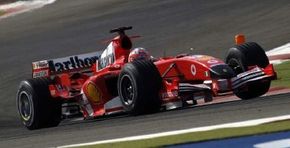
A record 19 events were scheduled that year, including a second Grand Prix of China as the season finale. For the first two rounds, Ferrari’s car was the F2004 M (modificata), a mild update of the previous year’s all-conquering monoposto.
Then, starting with the April Bahrain GP, the Scuderia competed with the further-evolved F2005. Taking account of all the latest rules, it incorporated a good many aerodynamic refinements, such as a reshaped tail and a “winglet” added atop the roll hoop behind the driver, plus structural strengthening to satisfy stricter crash standards set by the FIA governing body. The gearbox was made more compact to suit, and there were numerous small changes to the rear suspension, brakes and electronics.
In addition, the 3.0-liter “053” V-10 was beefed-up to become the “055” engine, the aim being to double service life in line with a new mandate that the same engine be used for two consecutive races. Another new rule required using the same type of tires for an entire race -- no more switching between “dry” and “wet” compounds -- hence the rear-suspension changes.
The new regulations apparently aimed at fostering closer competition, a response to Schumacher’s utter dominance of the previous four seasons. But though many expected 2005 to be another Maranello cakewalk, it was anything but. Indeed, Ferrari was vexed at most every venue.
Tire problems proved both persistent and seemingly insoluable, and the competition had not been idle over the winter. Incredibly, Schumacher ended the campaign with only one victory -- at the June U.S. Grand Prix in Indianapolis -- and finished third in points with just 62, far behind the champion. Who was none other than young soccer buddy, Fernando Alonso, who amassed 133 points to best McLaren-Mercedes ace Kimi Raikkonnen (112). Schumacher’s teammate, Rubens Barrichello, finished eighth in the driver’s standings with 38.
Considering its season-long woes, Ferrari did well to claim third in the constructor’s championship with 100 points, trailing Renault’s 191 and runner-up McLaren-Mercedes’ 182. But that was scant consolation for team manager Jean Todt, who seemed ready to fall on a sword, judging by the apologies he made all season long.
The 2006 campaign offered hope for redemption, mainly because all teams basically had to start afresh. To lower track speeds in the interest of safety, the FIA mandated a new V-8 formula with engines of no more than 2.4 liters. Teams still had to use the same powerplant for two consecutive events, but were again permitted to make tire changes during a race.
Maranello responded with the aptly named 248 F1. Though it closely resembled the F2005 in size, layout, construction, and even appearance, Ferrari’s 52nd Grand Prix monoposto evidenced many improvements apart from its new “056” V-8.
Because the new formula made lower-speed aerodynamics more critical to handling and thus lap times, designers refined the shape and/or size of the air intake, engine cover, side pods, rear bodywork, chassis floor, even the rearview mirrors. Other refinements involved the cooling system, electronics, the fuel cell, spring and shock-absorber calibrations and -- again -- rear-suspension geometry.
While everyone contended with new cars in 2006, the Scuderia also had to deal with a significant personnel change, as Rubens Barchiello went off to join the Honda effort. But Schumacher’s new teammate would prove a shrewd choice: another young Brazilian hotshot, 24-year-old-Felipe Massa, who’d been waiting several years for just this chance and was eager to prove himself. That would be no easy task, as the formidable Fernando Alonso was again lead pilot for Renault and Kimi Raikkonnen was back for McLaren-Mercedes.
There were 18 events on the 2006 calendar. Alonso wasted no time picking up where he’d left off, winning six of the first nine contests and coming second in the remaining three. Schumacher managed but a trio of runner-ups in the season’s first half, but then returned to form with another victory in the U.S. Grand Prix, followed by wins in France, Germany, Italy and China.
But something had changed since Schumacher told the press, back in early ’05, “I’m someone who generally always tends to look ahead.” Perhaps it was the many frustrations of the 2005 series. Or maybe he was feeling more the little aches and pains he had acknowledged. Or perhaps, in looking ahead now, he didn’t like what he saw.
For whatever reason, rumors circulated all season that Michael would soon retire, and in early October, at Monza, he made it official even while celebrating a 90th Formula 1 victory. An era had ended.
But Schumacher would have one last glorious moment. Fittingly, it came at the season-ending Brazilian GP in late October. Alonso was only one point from a second straight driver’s championship, and a tire puncture ended Michael’s chances for a podium finish. Nevertheless, he drove like a man possessed.
As AutoWeek’s Nigel Roebuck related: “Rejoining [the field] stone last, almost a lap down on Massa, Schumacher maintained a searing pace to the end, with nothing at stake save his own pride, his own pleasure ... Most of those he passed en route to fourth place put up little fight [except for Kimi Raikkonnen], a fellow unusually devoid of sentiment ... How many, with the good life beckoning, would have tried a risky move against one as tough -- if fair -- as Raikkonnen?
As it was, Schumacher was not to be denied, and thus his final act in an F1 car was to pass the man who will replace him at Ferrari, the man whose signing, many believe, drove him out of F1 before he was ready to go.”
Massa won easily at Interlagos, to the delight of the hometown crowd, not to mention Jean Todt. Alonso came second, followed by teammate Giancarlo Fisichella, then Schmacher and Raikkonnen. For the season, Michael finished second in the driver’s standings with 121 points to Alonso’s 134. Massa was third with 80, besting Fisichella (72) and Raikkonnen (65). In the constructor’s derby, the Scuderia was doubtless relieved to close the gap with Renault, finishing just five points behind (201 to 206).
Schumacher did not disappear, gladly lending his considerable expertise to help the Scuderia prepare for 2007. Raikkonen’s arrival in Maranello was just one of many driver changes among the major teams that season, but Ferrari was also now without the services of technical director Ross Brawn, who was now off “fishing,” explained team manager Todt. That raised as many eyebrows as Michael’s absence from the cockpit.
As Nigel Roebuck noted, Brawn’s “near-telepathic relationship with Schumacher was responsible for so many strategic victories.” But his replacement was Mario Almondo, a man with “ample experience at Ferrari,” Todt said, “[though] he has different responsibilities and a different role than Ross. The Scuderia was regrouping for a new era. Other key changes included naming Aldo Costa to lead chassis development and Gilles Simon to oversee engine work.
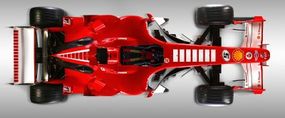
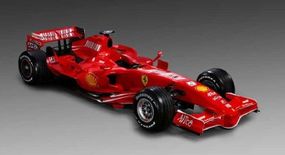
There was another new car, logically designated F2007, and it, too, raised a few eyebrows. As Roebuck observed: “Against the flow of thought elsewhere, [it’s] a bigger, longer-wheebase car ... and other designers wonder why [Costa] has taken this route. Given Ferrari’s long association with Bridgestone (on whose tires all must run this year), is there something he knows that they don’t?"
Perhaps, but a dispute between the FIA and Michelin had ended the French tiremaker’s role as sanctioned Formula One supplier, which might have given Ferrari a leg-up on rivals new to the mandated Bridgestones.
Costa didn’t explain the 3.4-inch longer wheelbase, but did admit that aerodynamics for the Ferrari F2007 were “completely remodeled, above all the front suspension; the air inlets on the main body and the rear axle are tighter and more tapered, to benefit also from [a new gearbox] architecture.
We worked a lot on the chassis considering the new crash tests, which are much more severe ... The suspension has been revised [to accommodate the] new tires, while the gearbox has a new quick shift system ... We have also modified the [location and angle] of the radiator. As far as the rear suspension is concerned, it is continuing to evolve,” he said cryptically.
As for the engine, Simon it was basically the same 056 V-8, as the rules specified, but produced more torque near the 19,000-rpm redline thanks to revised valves, pistons, combustion chambers, and crankshaft.
The F2007 had the makings of a winner, but what about the drivers? Raikkonnen had been dissatisfied with recent Mercedes-McLarens, and had signed with Ferrari in hopes of getting a ride equal to his talents.
If the F2007 proved reliable, then he was, as Roebuck reported, “most watchers’ favorite to win the championship.” On the other hand, “Some doubt [he] is the man to motivate Ferrari as Schumacher did, and [some] also doubt that he will dominate Felipe Massa, who knows Ferrari inside and out and won twice last year. It helps that Massa is managed by the son of team boss Jean Todt. In the new era, goes the word, there will be no ‘team orders,’ no ‘No. 1 driver.’ Massa, sprightly, and confident, has his own hopes for 2007.”
Though the season is just underway as we write, it seems Ferrari might benefit from a little “sibling rivalry.” Raikkonnen promply won the season opener at Albert Park in Australia. Massa came back to take round three at Bahrain.
But in between, at Malaysia, both were humbled by Alfonso, who wields a McLaren-Mercedes this year. Of course, three races do not make an F1 championship, and there are 14 left on the 2007 card, so it remains to be seen whether the Scuderia can be as dominant as it was in the Schumacher years. One thing we do know: Ferrari will never stop striving to be the best in the most demanding of motorsports.