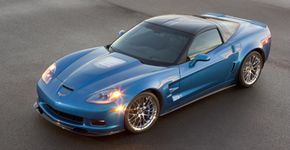
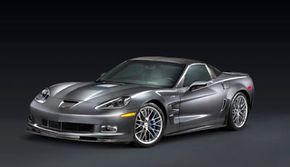
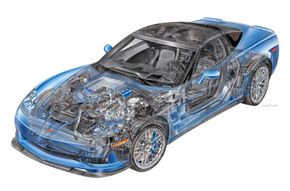
The ZR1 takes most of its styling cues from the rest of the C6 line, but to reduce weight, GM used a number of carbon-fiber panels. The fenders, hood, chin-spoiler, rocker panels and roof are all made of the lightweight but strong material, and some of the pieces have been left unpainted, so you can actually see the carbon fiber, which is an industry first. Usually, carbon-fiber yellows and cracks when exposed to ultraviolet light, but Chevrolet uses a special coating (that reportedly costs $60,000 a gallon) to protect the carbon-fiber on the ZR1.
The ZR1 also has a few specialized exterior flourishes. The more powerful braking system requires front and back brake vents that are larger than on other Corvettes. The brake vents aren't all about utility, though: The front vents feature horizontal gills, in an homage to the 1963 Corvette. The ZR1's hood also has a slight bulge in it (to contain the engine), which features a window that looks down on the engine. An air intake at the front of the hood helps bring air into the engine, and a larger chin spoiler helps the ZR1's nose stay planted. A full-width spoiler does the same for the rear.
For a $100,000 car, the ZR1's interior can be surprisingly basic. That's because Chevrolet wanted to appeal to buyers looking for a stripped-down track car, as well as those looking for luxury. While the interior design isn't changed much from a base Corvette's, the ZR1 has a boost gauge and ZR1 logos on the headrests and tachometers. A leather-wrapped interior is available.
With all of that hardware, it's not surprising that the ZR1 can produce some truly amazing numbers.
- The ZR1's 6.2-liter V8 produces 100 horsepower per liter. That's right: 620 horsepower is standard, along with 600 foot-pounds of torque.
- The ZR1's top speed hasn't been released yet, but GM expects it to top 200 mph.
- The zero-to-60 time is expected to be less than 3.5 seconds, with a quarter-mile time in the low 11 seconds.
- The ZR1 weighs about 200 pounds more than the Corvette Z06, but with all the extra power, the extra weight shouldn't be a problem. Even with its 3350 curb weight, the ZR1's power-to-weight ratio is 10 percent better than the Z06's and 12 percent better than the Ferrari 599 GTB's.
Of course, there are some downsides to the ZR1's performance -- not that anyone with $100,000 to spend on a car will notice. The ZR1 is the first Corvette to be subject to the gas-guzzler tax, even though the EPA hasn't released its estimated fuel economy for the car. Car and Driver magazine estimates to fuel economy to be 14 mpg in city driving and 23 mpg on the highway [source: Car and Driver]. Premium fuel is required, but that's a small price to pay for premium performance.
General Motors is hoping to position the ZR1 as a bargain alternative to other supercars. The ZR1 should compete with the Porsche 911 GT2, Ferrari 599 GTB and the Lamborghini Murciélago. While no head-to-head comparisons have been done, the ZR1 appears to be an able challenger.
- The Ferrari 599 generates roughly 600 horsepower and foot-pounds of torque like the ZR1 but needs a V12 engine to do it. The Ferrari 599 also takes 3.7 seconds to get to 60.
- The Porsche 911 GT2 produces 530 horsepower and 505 foot-pounds of torque, and can get to 60 in 3.6 seconds.
- The Lamborghini Murciélago, like the Ferrari, uses a V12 engine to produce 572 horsepower and 479 foot-pounds of torque. It has a 3.8 second zero-to-60 time.
On paper, it looks like GM's bet may pay off: The ZR1 can hold its own, at about half the price of other supercars.
To learn more about the Corvette and other sports cars, cruise to the links that follow.