Chevrolet Origins
William C. Durant founded General Motors in 1908 but was ousted two years later, so he formed Chevrolet in 1911, intending to make it a powerful lever for regaining control. He did. By 1915, Chevrolet was a force to be reckoned with; by 1918 it was part of General Motors; by the mid-'20s, it was GM's largest volume division -- and has been ever since.
Early Chevys were largish, medium-price cars with six-cylinder and even V-8 power. The make's historic turn to the low-price field came with the four-cylinder "490" of 1915, named for its advertised list price. It was a big success, outflanking Ford's Model T with more attractive styling and more features. Its closely related successors were Chevy's mainstay products into the late '20s.
However, Chevy didn't pass Ford in production until 1927, the year Dearborn stopped building the aged T to retool for the Model A. Then, in 1929, Chevrolet introduced its new "Stovebolt Six," also known as the "Cast-Iron Wonder." The nicknames stemmed from the engine's cast-iron pistons and numerous 1/4-inch slotted bolts -- hardly esoteric, but wonderfully effective and reliable as Old Faithful.
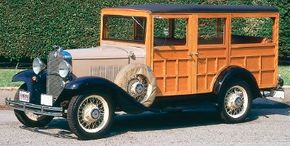
![]() By the time this 1931 Chevrolet station wagon was introduced, Chevy was GM's largest volume division. |
The Stovebolt was engineered by Ormond E. Hunt from an earlier design by Henry M. Crane that had evolved into the 1926 Pontiac engine. By 1930, it produced an even 50 brake horsepower from 194 cubic inches. With various improvements, this solid, overhead-valve engine would remain Chevrolet's only powerplant for nearly three decades.
For 1934, new combustion chambers prompted the name "Blue Flame," and two versions would be offered through 1935: 60-bhp, 181 cid and 80-bhp, 206.8 cid. The six was then redesigned for 1937 to be shorter and lighter. It also gained nearly "square" cylinder dimensions as well as four (versus three) main bearings. The result was 85 bhp from 216.5 cid.
It was with this engine in 1940 that a young Juan Manuel Fangio won the car-breaking 5900-mile round-trip road race between Buenos Aires, Argentina, and Lima, Peru, at an average speed of 53.6 mph. Fangio continued to race Chevrolets after World War II, but eventually switched to Grand Prix cars and became a legend as the first five-time world champion driver.
Chevrolets of the 1930s
Throughout most of its history, Chevrolet has made the right moves at the right time. To follow the Stovebolt, division general manager William "Big Bill" Knudsen and GM design director Harley Earl cooked up an elegant line of Cadillac-style cars for 1929-32. The 1930-31 line comprised a single series offering roadsters for two or four passengers, a phaeton, three coupes, and two sedans. Prices were attractively low: $495-$685.
The 1930-33
Chevys carried a different series name each year: in order, Universal,
Independence, Confederate, then Eagle (deluxe) and Mercury (standard). This
practice was ended for 1934, when models were grouped into Master and Standard
lines. Master tacked on the "DeLuxe" handle for '35, and Standards
became Masters for 1937-39.
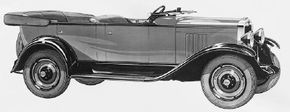
From 1930 to 1933, Chevys carried a different series name each year.
The 1930 Chevrolet Universal is shown here.
Chevy styling in these years evolved along the lines of costlier GM cars. The '33s, with their skirted fenders and graceful lines, were perhaps the most-attractive Chevrolets of the decade. Body styles proliferated, and by 1932 included such exotics as a $625 landau phaeton.
The 1933 Eagles offered many features designed to win buyers from Ford: a Fisher body with "No-Draft Ventilation" front-door ventwing windows, airplane-type instruments, Cadillac-style hood doors, a cowl vent, synchromesh transmission, selective free-wheeling, safety plate glass, adjustable driver's seat, even an octane selector.
Many of these also appeared on the standard Mercury models. Wheelbases gradually lengthened, going from 1930's 107 inches to 109 for 1931-32, then to 107/110 for the '33 Mercury/Eagle; the '34 Master/Standard split 112/107.
Chevy fared well in this period despite the prevailing Depression. Production outpaced Ford's each year in 1931-33, bottoming to 313,000 units for '32, but recovering to 486,000 for '33. Volume then soared to nearly a million by 1936, though Ford was nearer.
Along with more-streamlined styling, 1934 brought new "Knee-Action" independent front suspension (IFS) to Master models, Bill Knudsen's last major decision before leaving Chevy in October 1933. According to writer Karl Ludvigsen, engineer Maurice Olley tried to discourage Knudsen from using it, saying there weren't enough centerless grinding machines in America to produce all the coil springs.
Knudsen replied this was just what the machine-tool industry needed to get back on its feet. Still, he limited the new suspension to the one line. Knee-Action wasn't universally liked, so Standard/Master retained solid front axles through 1940, after which all Chevys had IFS.
The 1935s were the last Chevys with any styling kinship to the "classic" era. Master DeLuxe added an inch of wheelbase to suit sleeker new bodies with Vee'd windshield, streamlined fenders, and a raked-back radiator with cap concealed beneath the hood, then an innovation. Also new was the corporate all-steel "Turret Top" construction without the traditional fabric roof insert.
Modernization continued for 1936 as Chevrolet adopted still-rounder styling of the streamlined school, highlighted by die-cast "waterfall" grilles, steel-spoke wheels (wires remained optional), and sleeker fenders. As ever, Chevy relied on extra features to win sales from Ford.
A big plus for '36 was hydraulic brakes, which Ford wouldn't offer until 1939 (thanks mainly to old Henry's stubbornness). Chevy was also quicker than Ford to drop body styles without roll-up windows, abandoning both roadsters and phaetons for 1936. The two series became more alike, as both used the 80-bhp 206.8-cid Stovebolt.
The redesigned 85-bhp engine of 1937 made Chevrolet particularly well equipped for the sales battle. However, styling became rather dull, as it did for other GM cars, with skinny, uninteresting grilles and high, bulky bodies that looked clumsy next to the increasingly streamlined Fords. Despite that, Chevy regained production supremacy for model-year '38, and until the '90s, at least, rarely surrendered it to Dearborn.
For more on Chevrolet cars, old and new, see:
Chevrolet's Royal Clipper Styling
Renewed competitiveness was evident in an expanded 1940 line with what Chevy called "Royal Clipper" styling. Though not a drastic change from 1939, this facelift was sufficiently thorough to make the cars look much newer. Wheelbase was 113 inches, up from 1937-39's 112.3. Master 85 returned from '39 as the cheaper Chevy, with Master DeLuxe above it.
Each offered business coupe, two-door town sedan, and four-door sport sedan; the 85 also listed a woody wagon, the DeLuxe line a sport coupe. A new top-line Special DeLuxe series had all these plus Chevy's first true convertible coupe, which was quite successful (nearly 12,000 model-year sales).
Specials and Master DeLuxes came with
Knee-Action; Master 85s carried Chevy's last solid front axles. Model-year
production soared from some 577,000 to nearly 765,000 as Chevrolet bested Ford
by over 220,000 cars.
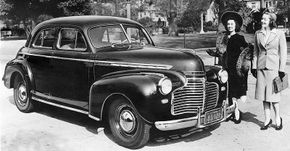
Chevy's first million-car model year was in 1941. The 1941 Chevrolet
Special Deluxe is shown here.
The gap widened to more than 300,000 for 1941 as Chevrolet scored its first million-car model year. Though no one knew it then, this year's substantial redesign would carry the make through 1948: 116-inch wheelbase, Knee-Action linewide, attractive new styling by Harley Earl's Art & Colour Section, and five extra horsepower achieved with higher compression (6.5:1); new pistons; and revised combustion chambers, valves, rocker arms, and water pump. Master 85s were dropped, but Special DeLuxe added a sleek Fleetline four-door sedan at midyear.
Distinguished by a more-formal roofline with closed-in rear quarters a la the Cadillac Sixty Special, the newcomer managed a creditable 34,000 sales for its shortened debut model year.
Styling refinements marked the war-shortened '42s. Fenders were extended back into the front doors, as on costlier GM makes, and a smart, clean grille replaced the somewhat busy '41 face.
Models stayed the same except for five-passenger coupes replacing business coupes, and series names continued as Master DeLuxe and Special DeLuxe. The latter now contained a Fleetline subseries with a new "torpedo-style" two-door Aerosedan that proved an instant hit and a conventional Sportmaster four-door, both bearing triple chrome bands on front and rear fenders.
By the time the government halted civilian car production in February 1942, Chevy's model-year total was over a quarter-million units, of which less than 50,000 were built in calendar '42. Convertibles and wagons numbered only about 1000 each. Like all 1942 Detroit cars, rarity has since rendered these Chevys coveted collector's items.
For more on Chevrolet cars, old and new, see:
Management Changes at Chevrolet
Strikes and material shortages hampered GM's postwar production startup, allowing Ford to outpace Chevy for '46. But Chevy was again "USA-1" for 1947-48 even though it followed most other makes (Ford included) by offering slightly modified '42s. The few differences involved grille treatments, medallions and other exterior trim. Models and specifications stood pat, but now Stylemaster and Fleetmaster names came in.
Meanwhile, Chevy contemplated a smaller companion model evolved under a program called "Cadet." Though different configurations were considered, the final prototype was an orthodox four-door sedan with smooth "bathtub" styling, 108-inch wheelbase, and a scaled-down Stovebolt Six.
But after spending a few million dollars, management decided there was no need for a compact in the booming postwar seller's market, especially as the Cadet would have cost as much to build as a standard Chevy. Ford reached the same conclusions at about the same time.
Still, the Cadet is significant as the first application of engineer Earle S. MacPherson's simple, effective strut-type front suspension, today almost universal among small cars. Ford would be the first to use it in production, however, as MacPherson went to Dearborn soon after the Cadet project was cancelled.
If production Chevys didn't change much in this period, management did, and new models were floated for the future: sports cars, hardtop-convertibles, all-steel station wagons.
These and other ideas gained impetus with the June 1946 arrival of Cadillac chief Nicholas Dreystadt to replace M.E. Coyle as Chevrolet general manager. Dreystadt also encouraged a forceful engineering program that would ultimately breathe new life into a make that had acquired a respectable but stodgy image.
Unfortunately, he died after just two years in
office, and his successor, W.E. Armstrong, resigned early because of illness.
Then came Thomas H. Keating, who continued Dreystadt's policies. Soon after he
took charge, Edward N. Cole came over from Cadillac to be Chevy chief engineer.
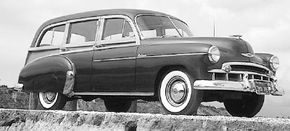
Chevy's 1949 models, like this 1949 Chevrolet Styleline,
were the best-handling Chevys to date.
Their first order of business was to make Chevys look more "with it." In a happy bit of timing, GM had scheduled most of its all-new postwar models for 1949, and Chevy's were among the best.
Though wheelbase was actually cut an inch, to 115, the cleanly styled '49s contrived to look much longer than the 1946-48 models. They were definitely lower, accented by a newly curved two-piece windshield trimmed two inches in height, fenders swept back smoothly through the cowl and doors, and rear fenders rolled gracefully forward.
Suspension revisions and a lower center of gravity made for the best-handling Chevys yet -- and probably better than that year's Plymouth and Ford. The '49s were also beautifully put together, testifying that engineers and production people had taken great care to make them "right."
Matching all this newness was an equally new four-series model line. It began with an "entry-level" Special series of two- and four-door Fleetline fastback sedans and notchback Styleline town and sport sedans, sport coupe, and business coupe. All but the last were offered with more-luxurious DeLuxe trim, as was a Styleline convertible and eight-passenger station wagon.
There were actually two wagons: an "early" '49 with vestigial wood in its body construction, and a midyear all-steel replacement. Fleetlines initially sold well, but the fastback fad soon faded, so offerings dwindled. The last was a lone 1952 DeLuxe two-door.
Having regained its production stride in 1947-48, Chevy rolled out a record 1,010,000 cars for 1949. Ford, however, managed about 108,000 more, thanks to a popular all-new design and an early introduction (in June '48).
For more on Chevrolet cars, old and new, see:
Chevrolet Bel Air
No make better reflected the exuberant '50s than Chevrolet, which evolved from family freighter to hot hauler in just a few short years. Again, in this decade the division mostly made the right moves at the right times. By 1960, Chevrolet was no longer just one of the "low-priced three" but an alternative to Dodge, Mercury, and Pontiac.
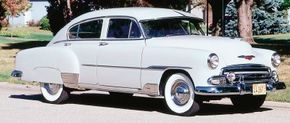
The 1950-52
models were the last of the traditional low-cost, low-suds Chevys, though
DeLuxes accounted for 80-85 percent of production. The hoary old 216.5
Stovebolt was coaxed up to 92 bhp for 1950, when a new 105-bhp 235.5-cid
version arrived for cars equipped with optional two-speed Powerglide.
The 1951 Chevrolet Fleetline was among the last of the
traditional, low-cost Chevys.
The last was Chevy's new fully automatic transmission, thus beating Ford, whose Ford-O-Matic was still a year off, and Plymouth, which wouldn't have a true self-shifter until '55. A torque-converter automatic similar to Buick's Dynaflow, Powerglide was a big reason why Chevy beat Ford in model-year car production by no less than 290,000, with a total of near 1.5 million.
Another factor was the new 1950 Bel Air, America's first low-priced hardtop coupe. Buyers couldn't get enough of it. Like the pioneering 1949 Buick, Cadillac, and Olds hardtops, this junior edition sported lush trim that included simulated convertible-top bows on the headliner. It debuted as a top-shelf Styleline DeLuxe priced at $1741, about $100 below the ragtop, but it outpaced the convertible by better than 2-to-1 with over 76,000 first-year sales.
Chevy took a breather the next two years, with no mechanical developments and only bulkier sheetmetal for '51, followed by detail trim revisions for '52. Yet Chevy remained "USA-1" for both years. The '51 total was 1.23 million to Ford's 1.01 million. Korean War restrictions forced industrywide cutbacks for '52, but Chevy's 800,000-plus still beat Ford's 671,000.
Though the Corvette sports car was Chevy's big news for '53, passenger models got a major facelift. The bottom-end Special series was retitled One-Fifty, DeLuxe became Two-Ten, and Bel Air was applied to a full range of models as the new top of the line. Higher compression brought the Blue Flame Six to 108 bhp with manual transmission or 115 bhp with Powerglide.
The figures were 115/125 for 1954, when styling became a bit flashier. Chevy continued to set the production pace. With war restrictions over, volume soared to over 1.3 million units for '53 and to near 1.17 million for '54. But though sound and reliable, Chevys still weren't very exciting. All-new styling and a landmark V-8 would take care of that.
For more on Chevrolet cars, old and new, see:
1955, 1956, 1957 Chevrolets
Without question, the new 265 V-8 of 1955 was one of Detroit's milestone engines. Though designed for efficiency and low unit cost, it was really one of those "blue sky" projects that comes along only once or twice in an engineer's career.
As principal designer Ed Cole later recalled: "I had worked on V-8 engines all my professional life. I had lived and breathed engines. [Engineer Harry F.] Barr and I were always saying how we would do it if we could ever design a new engine. You just know you want five main bearings -- there's no decision to make. We knew that a certain bore/stroke relationship was the most compact. We knew we'd like a displacement of 265 cubic inches...And we never changed any of this. We released our engine for tooling direct from the drawing boards. That's how wild and crazy we were."
They had reason to be enthusiastic. The 265 boasted low reciprocating mass allowing high rpm; die-cast heads with integral, interchangeable valve guides; aluminum "slipper" pistons; a crankshaft of forged pressed-steel instead of alloy iron -- and much more.
Best of all, it weighed less than the old six yet
was far more potent, initially pumping out 162/170 bhp (manual/Powerglide)
in standard tune or 180 bhp with optional Power-Pak (four-barrel carburetor and
dual exhausts).
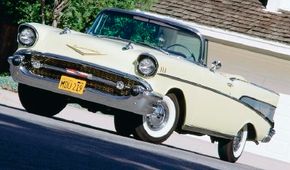
Exuberant 1950s styling is just one reason the 1957 Chevrolet Bel Air
is a collector's dream today.
Of course, it could give a lot more -- and did for '57 when bored to 283 cid and offered with optional fuel injection. Chevrolet developed a new 348-cid "big-block" for 1958 and beyond. It was a good one, but the small-block remains one of the best-known, best-loved engines of all time, earning Chevy a performance reputation the way sixes never could.
At just under $200, Powerglide became an increasingly popular option in the '50s -- a smooth operator well-suited to all but high-power models. Standard three-speed manual and extra-cost stick-overdrive were offered throughout the decade, and an all-synchromesh four-speed manual came on board in 1959.
Late '57 brought a second automatic option, three-speed Turboglide, but this was complex, costly, and short-lived. Powerglide would be the Chevy automatic until the mid-'60s.
The 1955-57 Chevys are coveted collectibles now, and styling has as much to do with this as engineering. Design principals Clare MacKichan (then Chevy studio chief), Carl Renner, Chuck Stebbins, Bob Veryzer, and others worked under Harley Earl's dictum of "Go all the way, then back off."
Though the '55 didn't reach showrooms looking like their fanciful renderings, it wasn't far off, wearing Earl's hallmark beltline "dip," wrapped windshield, and a simple eggcrate grille inspired by Ferrari. The last became broader, brighter, and more conventional for '56 in line with buyer tastes.
Other elements in Chevy's winning '55 package included a more-capable suspension, bigger brakes, better steering, more interior and trunk room, better visibility -- the list was almost endless. Even the old six was improved: boosted to 123/136 bhp (manual/Powerglide).
With all this, plus attractive prices that weren't changed much from '54 (mostly in the $1600-$2260 range), Chevy led the industry in a record Detroit year with over 1.7 million cars, a new make high and a quarter-million better than Ford.
An interesting '55 newcomer was the Bel Air Nomad, America's first "hardtop wagon." A Carl Renner idea adapted from his 1954 Motorama show Corvette, the Nomad didn't sell that well, mainly because two-door wagons were less popular than four-doors, though water leaks were also a problem. Then, too, it was relatively expensive ($2600-$2700). Had anybody else built it, the Nomad probably would have seen minuscule production, but a respectable 8386 were built for 1955, 7886 for '56, and 6103 for 1957.
Chevy called its '55 "The Hot One." Ads said the '56 was even hotter. It was. The old Stovebolt, now offered with manual shift only, was up to 140 bhp, while the V-8 delivered up to 225 bhp with Power-Pak. A $40-million restyle made all models look more like Cadillacs, and four-door hardtop sport sedans joined the Two-Ten and Bel Air lines.
Despite a broad industry retreat, Chevy managed record market penetration of close to 28 percent on just 88 percent of its '55 volume -- about 1.5 million units. Ford repeated at around 1.4 million.
Ford (and Plymouth) counterpunched with all-new styling for '57. Chevy had to make do with another substantial facelift, but it was deftly done and quite popular. In fact, this Chevy is still regarded by many as the definitive '50s car. There were now eight engine choices, up three from '56, including no fewer than six 283 V-8s with 185 up to 283 bhp.
The last was courtesy of "Ramjet" fuel injection, a new option that found few takers at $500, but enabled the division to claim "1 hp per cu. in." (though Chrysler had achieved that magic figure with its '56 300B). Yet even without the "fuelie," a '57 Chevy could be quite fast. For example, a Bel Air sport sedan with the four-barrel 270-bhp engine could do 0-60 mph in 9.9 seconds, the quarter-mile in 17.5, and over 110 mph flat out.
Properly equipped, the 1955-57 Chevy was a formidable track competitor. Before the Automobile Manufacturers Association voted to withdraw from organized racing in June 1957, Chevy did very well in NASCAR and other stock-car events. At that year's Daytona Speed Weeks, Chevy took the first three places in the two-way flying-mile for Class 4 (213-259 cid); in Class 5 (259-305 cid) it took 33 out of 37 places, the fastest car averaging 131.076 mph. Chevy also won the 1957 Pure Oil Manufacturers Trophy with 574 points against 309 for runner-up Ford.
For more on Chevrolet cars, old and new, see:
Chevrolet Impala
While the AMA racing "ban" didn't deter Chevy and others from providing under-the-table racing support, it seemed to be reflected in the softer, more-luxurious Chevys of 1958. Riding a new 117.5-inch-wheelbase X-member chassis, they were longer, lower, wider, and heavier, but not really slower than the lighter '57s.
Bodies were naturally all-new, too -- and shinier,
looking more "important" and Cadillac-like than ever. As it turned
out, they'd be one-year-only jobs. Not so the new 348 big-block V-8, a modified
truck engine (which Chevy was understandably loath to mention) offering 250 to
315 bhp. That year's base V-8 was a 185-bhp 283.
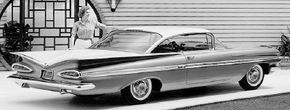
Chevy answered buyers' demands for bigger cars with the
longer, wider and heavier 1959 Chevrolet Impala.
Underscoring all this change was the new line-leading 1958 Impala (a name dreamed up by designer Robert Cadaret), a lush Bel Air subseries offering convertible and sport coupe hardtop with six or V-8 in the $2600-$2800 range.
Below was a rearranged model group. One-Fifty was renamed Delray (borrowed from a spiffy 1954-57 Two-Ten two-door sedan), Biscayne replaced Two-Ten, and "Station Wagon" was a separate line with no fewer than five models: two-door Yeoman and four-door Yeoman, Brookwood (in six- and nine-seat form), and Nomad. Unlike the 1955-57 Nomad, the '58 was conventionally styled.
Chevy was now clearly reaching for buyers it had never sought before: solid, substantial Pontiac types who cared more about size and comfort than performance or handling. The division's grasp did not exceed that reach. In a rough year for the economy in general and Detroit in particular, Chevy managed over 1.1 million cars. Impala was a big success, accounting for fully 15 percent of the total.
If Chevrolet showed restraint in bucking tailfins for '58, it more than made up for that the following year with another all-new body bearing huge "cat's-eye" taillamps and a "batwing" rear deck that tester Tom McCahill said was "big enough to land a Piper Cub." It could have been worse. Several 1959 proposals envisioned ugly, Edsel-like vertical grilles.
Ford had shaded Chevy in model-year '57 production and came within 12,000 units of doing it again for '59. Dearborn's more-conservative styling no doubt played a part. But future Chevys would be far more-tasteful under William L. Mitchell, who replaced Harley Earl as GM design chief on the latter's retirement in 1958.
Delray disappeared from the '59 line and a new full-range Impala series displaced Bel Air at the top, pushing other non-wagon series down a notch. All models rode a new 119-inch wheelbase, Chevy's longest yet. The growth between 1957 and 1959 was amazing: length up by nearly 11 inches, width by seven inches, weight by 300 pounds.
The '59s were the first of the overstuffed "standard" Chevys that would endure for the next 15 years, though they made sense at the time. Buyers demanded ever-bigger cars in the '50s, so even the low-priced three grew to about the size of late-'40s Cadillacs and Lincolns.
For more on Chevrolet cars, old and new, see:
Chevrolets of the 1960s
Though Chevrolet would mostly follow Ford's marketing initiatives in the '60s, it continued to lead in production, winning every model year except 1961 and 1966. Like its arch rival, Chevy expanded into compacts (Corvair and Chevy II), intermediates (Chevelle), "muscle cars" (Impala SS, Malibu SS) and "ponycars" (Camaro). Each was carefully conceived to fill a specific need, and all succeeded save the singular rear-engine Corvair, which is different enough to merit a separate entry.
Such
increasing specialization might imply increasing production, but though Chevy
did set some records, its 1969 volume was "only" some 500,000 cars
ahead of 1960's despite the introduction of four new model lines. This
proliferation reflected a market that had subdivided, generating more
"niche" competition than in the '50s. As a result, Chevy often
competed less against rivals than against itself or other GM makes.
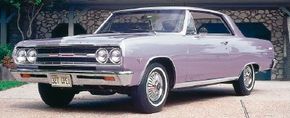
Chevy introduced the Chevelle in 1964 to compete with Ford's popular Fairlane.
Shown here is the 1965 Chevrolet Chevelle.
Its lineup certainly became quite broad by 1969, when it spanned no fewer than five wheelbases: 98 inches for Corvette, 108 for Corvair/Camaro, 111 for Chevy II/Nova, 116 for Chevelle, and 119 inches for full-size Chevrolets. An exception was the post-'67 Chevelle which, like other GM intermediates, went to a 112-inch wheelbase for two-door models and 116 for four-doors, an arrangement that would persist through 1977.
With no change in wheelbase, what became known as the "standard" (full-size) Chevrolet moved from overstyled outrageousness to clean, crisp elegance. The pattern was set immediately, the 1960 edition being a more-subdued version of the wild '59. A taut new package bereft of fins and wrapped windshields bowed for '61, reflecting the first direct influence of Bill Mitchell. For '63 came a more-sculptured look.
Another complete redesign brought more-flowing lines for '65, followed by even curvier '67s with semifastback hardtop coupes and more-pronounced "Coke bottle" fenders. The '69s had a fuller, squarer look, emphasized by bodyside bulges and elliptical wheel openings. The decade's prettiest big Chevy might well be the '62, with its straight, "correct" lines and, for Impala hardtop coupes, a rear roof sculptured to resemble a raised convertible top.
Nineteen sixty-two also saw Chevy enlarge the 283 small-block V-8 to 327 cid for an initial 250 or 300 bhp in full-size models. But 283s would continue to power a variety of Chevys through 1967, when a stroked 350 more amenable to emission controls began to be phased in.
Biscayne remained Chevy's full-size price leader in the '60s, but buyer interest quickly tapered off. The midpriced Bel Air also waned, but the top-line Impala rapidly became Detroit's single-most-popular model line. Its best sales year in this decade was 1964, when some 889,600 were built.
By far the most-collectible Impala is the performance-bred Super Sport, an option package for mid-1961 and 1968-69, an Impala subseries in other years. Body styles were always limited to convertible and hardtop coupe. The concept was simple: the smooth big Chevy with sporty styling touches and available performance and handling options. Sixes were available but not often ordered (only 3600 of the '65s, for instance).
Typical features ran to special SS emblems, vinyl bucket seats, central shift console, and optional tachometer. A variety of V-8s was offered, including big-blocks, beginning with the famous 409 of 1961, an enlarged 348 delivering 360 horsepower initially and up to 425 bhp by '63.
With options like stiffer springs and shocks, sintered metallic brake linings, four-speed manual gearbox, and ultra-quick power steering, the SS Impalas were the best-performing big Chevys in history. But they couldn't last forever. Government regulations and the advent of midsize muscle cars combined to do in sporty big cars of all kinds. Yet Impala SS remained exciting right to the end. Even the final 1967-69 models could be ordered with "Mark IV" 427 big-blocks packing 385-425 bhp.
A far-more-lucrative full-size Chevy was the Caprice, an Impala dolled up with the best grades of upholstery and trim. A mid-1965 reply to Ford's quiet-as-a Rolls LTD, Caprice garnered a healthy 181,000 sales for model-year '66, when it became a separate line and the initial hardtop sedan was joined by wagons and a hardtop coupe. Production through the rest of the decade ranged from 115,500 to nearly 167,000. Obviously, Cadillac luxury at a Chevy kind of price still appealed as much in the '60s as it had in the days of the first Impala.
One rung below the full-size Chevy was the intermediate Chevelle, introduced for 1964 in answer to Ford's popular Fairlane. Though conventional in design, Chevelle offered almost as much interior room as Impala within more-sensible exterior dimensions -- effectively a return to the ideally proportioned 1955-57 "classic" Chevy. Sales went nowhere but up -- from 328,400 in the first year to nearly 440,000 by 1969. Helping things along were numerous performance options and bucket-seat Malibu SS convertible and hardtop models.
Third down the size scale was the Chevy II, an orthodox compact rushed out for 1962 to answer Ford's Falcon, which had been handily trimming the radical Corvair. Initial engine choices were a 90-bhp, 153-cid four and a 120-bhp, 194-cid six. (Falcon had only sixes through mid-1963, then added a V-8 option.) It was a good move, but through 1966, Chevy IIs outnumbered Falcons only once: model-year '63.
Sales dropped nearly 50 percent for '64, due partly to intramural competition from Chevelle. A spate of Super Sport models didn't help. Nor did a heavy facelift for '66.
What did help was a 1968 Chevy II pumped up to near intermediate size via an all-new 111-inch-wheelbase GM X-body platform. Convertibles, wagons, and hardtop coupes were deleted, leaving four-door sedans and two-door pillared coupes. The latter were available with an SS package option. Backed by a strong ad campaign and competitive prices, Chevy's compact posted soaring sales of 201,000 for '68 and over a quarter-million for 1970, when the name was changed to Nova (originally, the premium Chevy II series).
For more on Chevrolet cars, old and new, see:
Chevrolet Camaro
Adding new
spice to Chevy's '67 line was Camaro, which would eventually succeed the ailing
Corvair as the division's sporty compact. Despite the beautiful styling and
impressive performance of the all-new '65 Corvair, the rear-engine Chevy was no
threat to Ford's incredibly successful Mustang in the burgeoning ponycar
market. Worse, it was costly to build -- entirely different in concept and
technology from other Chevys.
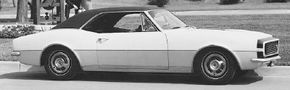
Chevy's new sporty compact, the 1967 Chevrolet Camaro,
was a huge success.
Six months after the '65s debuted, division managers decided Corvair would be allowed to fade away in favor of the conventional Camaro, which was deliberately designed as a direct Mustang-fighter.
Created under the omnipresent eye of GM design chief Bill Mitchell, Camaro styling was exactly right: long-hood/short-deck proportions; low, chiseled profile; flowing, slightly "hippy" lines.
Like Mustang, Camaro aimed at those who wanted a sporty four-seater that could be equipped as an economy run-about, vivid straight-line performer, or something in-between, so it offered a Mustang-style plethora of options: some 81 factory items and 41 dealer-installed accessories.
Camaro's 1967 prices started at $2466 for the basic hardtop coupe and $2704 for the convertible with standard 140-bhp, 230-cid six. A 155-bhp, 250-cid six cost $26 extra; a 210-bhp 327 V-8 was $106.
Next on the list was a 350 V-8 with 295 bhp, exclusive to Camaro in '67 but more-widely available beginning in '68. To get it you had to order a $211 Super Sports package comprising stiffer springs and shocks, D70-14 Firestone Wide-Oval tires, performance hood with extra sound insulation, SS emblems, and "bumblebee" nose stripes. A 396 big-block V-8 became available during the year at nearly $400.
Also tempting '67 Camaro customers were custom carpeting; bucket seats; fold-down rear seat; luxury interior; full instrumentation; and console shifters for the optional Turbo Hydra-Matic, heavy-duty three-speed manual, and four-speed manual. For $105, a Rally Sport package added a hidden-headlight grille, "RS" badges, and other touches. Additional extras ran to tinted glass, radio, air conditioning, clock, cruise control, and a vinyl roof covering for hardtops.
Mechanical options included sintered metallic brake linings, ventilated front disc brakes, vacuum brake booster, power steering, fast-ratio manual steering, stiff suspension, Positraction limited-slip differential, and a dozen different axle ratios. With all this, a Camaro could easily be optioned to $5000.
Though two years behind Mustang, Camaro was a big hit. Production topped 220,000 the first year, 235,000 for '68, and 240,000 for '69. There were no major changes through mid-1970. The '68s carried a horizontal grille treatment, ventless side glass, Chevy's new "Astro Ventilation" system, and restyled taillights; the '69s were more-thoroughly face-lifted via a recontoured lower body with front and rear creaselines atop the wheel openings, plus a Vee'd grille and new rear styling.
Available for the street but aimed squarely at the track was Camaro RPO (Regular Production Option) Z-28, a tailor-made competition package for hardtops announced during 1967. With it, Camaro won 18 of 25 events in the Sports Car Club of America's new Trans-American road-racing series for production "sedans." Camaro then claimed the class championship in 1968 and '69.
Veteran Chevy engineer Vincent W. Piggins had designed the Z-28 expressly for the Trans-Am -- then convinced management to sell it to the public. To meet the prevailing displacement limit, he combined the 327 block with the 283 crankshaft to produce a high-winding 302.4-cid small-block with a nominal 290 bhp -- it was more like 350 -- and 290 pound-feet of torque.
Completing the Z-28 package were heavy-duty suspension, 11-inch-diameter clutch, quick steering, hood air ducts feeding big carburetors, close-ratio four-speed gearbox, front disc brakes, metallic rear-brake linings, a "ducktail" rear spoiler, broad dorsal racing stripes, and Rally wheels with wide-tread tires.
All this listed for about $400, but actual price was more like $800 because the four-speed, power front discs, special headers, and metallic rear-drum linings were all "mandatory" extras.
Nevertheless, the Z-28 was a whale of high-performance buy. It wasn't for everyone, of course, but production climbed quickly, going from 602 for '67 to 7199 for '68 and then to 20,302 for '69. All are now coveted collectibles, not only as the first of a great breed, but because, unfortunately, the Z would become less-special in future years.
For more on Chevrolet cars, old and new, see:
Chevrolet Monte Carlo
Chevrolet entered the personal-luxury market with the Monte Carlo. A 65-day strike kept the division from outproducing Ford, but its 12-month total of nearly 1.5 million cars was hardly bad. For the model year, Chevy built 1.46 million cars to its arch rival's two million-plus.
A kissin' cousin of Pontiac's all-new '69 Grand Prix, the cleanly styled Monte Carlo rode the Chevelle's 116-inch four-door chassis but came only as a hardtop coupe with the longest hood in Chevy history. A 250-bhp 350 V-8 teamed with Turbo-Hydra-Matic as standard, and all sorts of luxury options were offered. Alternative engines ran to a 300-bhp 350 and a new 400 V-8 with 330 bhp.
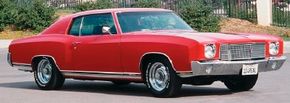
![]() The sharp 1970 Chevrolet Monte Carlo sold well in the personal-luxury market. |
Base-priced just below $3000, the Monte Carlo sold well: over 145,000 for 1970 (against only 50,000 for Ford's considerably costlier Thunderbird). Among them were a mere 3823 equipped with the optional SS 454 package -- an iron fist in a velvet glove if ever there was one.
Listed as RPO Z20, the Monte SS package delivered the division's huge new 454 big-block engine, a stroked 427 tuned for 360 bhp in this application, plus square-tip dual exhausts and a chassis fortified with auto-leveling rear shocks, stiffer front shocks, and power front disc brakes. Discreet badges and black rocker-panel trim were the only clues as to what lay beneath that long hood.
Acceleration was vivid: just 7.5 seconds for 0-60 mph. But luxury was this car's forte -- after 1919 more in '71, the Monte Carlo wouldn't take another run at performance until years later.
Corvair's demise after 1969 left Nova as Chevy's only compact. The 1970 edition was mildly face-lifted, but saw no substantive change. That year's Chevelle, still on the split-wheel-base 1968 A-body platform, was restyled to look more like full-size Chevys, gaining a divided grille, bulges around each wheel opening, and a more-rounded, massive look.
Super Sport packages were again offered for both Nova and Chevelle, the former built around a 350 V-8, the latter around the big-block 454 and 396 (which was actually a 402 now). None saw very high sales, what with rising fuel prices and insurance rates putting a big damper on muscle-car demand throughout Detroit.
The big-car sales emphasis was still on the luxurious Impala and Caprice; Biscayne and Bel Air were now reduced to just one four-door sedan each.
For more on Chevrolet cars, old and new, see:
Chevrolet Vega and Chevrolet Chevette
Chevrolet would remain "USA-1" throughout the '70s despite a few product blunders and the vexing problems that plagued all Detroit in that turbulent decade. In model-year production, it ran second to Ford only in 1970 and '71.
After that, Chevy was the consistent industry leader with at least 2 million cars a year except for troubled '75, when depressed big-car demand after the 1973-74 energy crisis dropped the tally to about 1.75 million.
Such strength enabled Chevrolet to endure mistakes that would have crippled most any other brand save Ford. Even the subcompact Vega, long viewed as the division's biggest folly of the period, hung on for seven model years and sold respectably in every one.

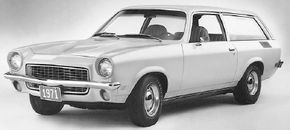
The 1971 Chevrolet Vega was available in three body styles;
the two-door "Kammback" wagon shown here. See more pictures of Chevrolet cars.
Vega certainly seemed a good idea when it bowed for 1971. Riding a 97-inch wheelbase, the shortest in Chevy history, it carried an all-new, 140-cid four with 90 or 110 bhp. Pert styling marked by a Camaro-like front was offered in three practical body styles: two-door notchback sedan, hatchback coupe, and a nifty little two-door "Kammback" wagon.
Chevrolet spent vast sums designing, launching, and promoting this latest attempt at beating back small imports -- not to mention Ford's new Pinto -- and on a special factory to build it.
But like the Corvair, Vega missed its intended target: bought not as basic transport but as a small sporty car, abetted by a GT coupe and wagon. Worse, it quickly became notorious for early, severe body rust, and its alloy-block engine (which made do without cylinder liners) suffered persistent oil leaks and head warping.
By 1976, when the even smaller Chevette was ready, Vega was being trounced by a number of domestic and foreign rivals. Though the name was dropped after '77, the basic car -- minus the problematic engine -- continued through 1979 in the Monza line.
An intriguing Vega offshoot was the Cosworth-Vega of 1975-76, quite "foreign" for a U.S. car and thus something of a collector's item now. Its main attraction was a destroked, 122-cid Vega engine wearing a special 16-valve twincam aluminum cylinder head designed by England's Cosworth Engineering. Fuel was fed by Bendix electronic injection actuated by a glovebox-mounted computer.
Available only as a hatchback coupe, the "CosVeg" initially came only in black with special gold striping and cast-aluminum wheels. Completing the package were wide radial tires, full instrumentation in an engine-turned panel, front/rear anti-roll bars, four-speed gearbox, quick steering, and discreet badges.
Unfortunately, the engine yielded only 111 bhp, so this wasn't the BMW-beater Chevy had planned. The '76 version offered any Vega body color and an optional five-speed gear-box, but many were unsold at year's end. Respective production was just 2061 and 1447.
Monza proved a far-more-successful Vega variant. New for '75, it rode the same chassis, but carried a handsome 2+2 coupe body with lift-up rear hatch and a fastback roofline reminiscent of certain Ferraris. A notchback "Towne Coupe" was added during the year.
The Vega four was base power, but a new 262-cid small-block V-8 was optional, mildly tuned for 110 bhp. Enthusiasts could opt for several interesting RPOs such as a Z01 performance and handling package and, for 2+2s, a "Spyder" appearance group.
After 1977, the Vega wagon became a Monza, and all three models got a new standard engine: the 151-cid Pontiac "Iron Duke" four (so named to reassure buyers stung by the Vega unit). That same year, the blunt-front Towne Coupe was optionally available with the 2+2's "droop snoot." Monza then saw only minor changes through early 1981, when it departed to make way for an even better small Chevy.
Picking up where Vega left off was Chevette, the smallest Chevrolet ever, announced for bicentennial 1976. Derived from the 1974 German Opel Kadett, the first of GM's "world car"
T-body
models, it rode a modest 94.3-inch wheelbase, measured 17 inches shorter than
Vega, and weighed in at just under a ton. Its mission, of course, was economy,
which it delivered: 35 mpg or so on the highway. Engines were small: initially
a 1.4-liter/85-cid overhead-cam four with 52 bhp and a 60-bhp 1.6-liter/98-cid
version. The former was gone by '78, when the 1.6 was tuned to deliver a
slightly more-respectable 63-68 bhp.
Chevette
bowed as a single two-door hatchback sedan, but a four-door on a
three-inch-longer wheelbase was added for '78. Options were numerous, as the
car had been built "down" to a low price. Yet, like so many Chevys
before it, Chevette was exactly right for its time, and quite competitive in
the increasingly hard-fought subcompact market.
For more on Chevrolet cars, old and new, see:
Chevrolets of the 1970s
After a mostly stand-pat 1970, the full-size Chevys ballooned to as big as they'd ever get, thanks to 1971's new "fuselage-style" GM B-body and a longer 121.5-inch wheelbase. As ever, promotion focused on Impala and Caprice. The Biscayne and Bel Air sedans were now relegated to the fleet market, and would be discontinued after 1972 and '75, respectively.
Mid-price Impala Customs, new for '68, continued finding favor among those who liked, but couldn't quite afford, a Caprice. The Caprice itself was similarly upgraded as more Classic models were added year by year.
Big-Chevy engine choices through 1976 revolved around 350, 400, and 454 V-8s, though a 145-bhp 305 was rushed out as standard for '76 (except on wagons), a post-oil-embargo economy move. Emissions tuning rendered all decreasingly potent, as did the added weight of "crash" bumpers after 1972, plus other federally required measures.
Styling became progressively more ornate and "formal," and threatened rollover standards prompted hardtop coupes to be replaced by "pillared" 1974 models with huge rear side windows.
For the same reason, the Caprice convertible (an Impala through '72) disappeared
after 1975. Despite their limitations, these big Chevys always sold in large
numbers -- as ever, the epitome of middle-class American motoring.
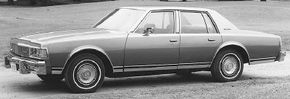
The downsizing of the 1977 Chevrolet Caprice made it
more agile and more fuel-efficient.
Then, a revolution: the first wave of GM's corporatewide downsizing program, which saw the 1977 Caprice/Impala trimmed by 51/2 inches in wheelbase and 600-800 pounds in gas-wasting bulk. It seemed like a huge gamble then, and Ford tried to take advantage by extolling the "road-hugging weight" of its still-enormous full-sizers.
But Chevrolet, as usual, knew exactly what it was doing, and Caprice/Impala sales actually improved (despite the departure of hardtop sedans). And why not? The new models were not only lighter but more-agile, easier on gas and, to some, better-looking.
In the intermediate ranks, Chevelle and Monte Carlo were switched to GM's new "Colonnade" A-body for 1973, which meant fresh styling and no more convertibles or closed pillar-less models.
The Monte divided into S and plusher Landau offerings, both with rather baroque, "French curve" styling. The blockier Chevelles included base, Malibu and ritzy Malibu Classic coupes and sedans, plus a plethora of wagons in base, Classic, and Classic Estate trim.
An interesting 1974-76 concoction was the Laguna S-3 coupe. A cross between a luxury tourer and the now-departed Malibu SS, it sported body-color grille surround and bumpers, plus a posh vinyl interior available for a time with optional swiveling front seats -- a revival of a '50s Chrysler idea.
When the big Chevys shrank to intermediate stature, it was obvious that the midsizers would get smaller, too. They did, for 1978. Chevelles became Malibus, and shared a new 108.1-inch-wheelbase platform with Monte Carlo. The latter retained generally florid looks, but the Malibus were crisp and clean. Again, sales didn't suffer -- to Chevy's undoubted relief.
A consistently high seller since its '68 overhaul, the compact Nova saw little change through 1973, when a minor facelift occurred and hatchback two-door sedans arrived in the usual base and Custom trim.
An extensive 1975 reskin ushered in new rooflines and more glass, fancy LN ("Luxury Nova") models (renamed Concours for '76), and steering and front suspension borrowed from Camaro. Nova captured 15 percent of Chevy's total 1975 sales to become the year's most-popular American compact.
Engine offerings simplified for '76. The "performance" option was now a 305 V-8, a debored 350 replacing both that engine and the little 262. Standard power through 1979 remained the workhorse 250-cid inline six, after which both engine and car were scrubbed in favor of fours and V-6s in a new compact called Citation, "the first Chevy of the '80s."
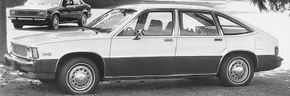
Unveiled in April 1979, Citation was a runaway success its first year, helped by another fuel crisis. Body styles comprised two- and four-door hatchback sedans and a pillared "slantback" two-door unique among the four versions of this corporate design. On a 104.9-inch wheelbase, Citation's new X-body platform afforded excellent space at moderate weight, which averaged around 2500 pounds.
Pontiac's well-proven "Iron Duke" four was standard; the only power option was a new Chevy-built 60-degree V-6 displacing 2.8 liters (173 cid). Both engines were mounted transversely to take advantage of the space-saving front-drive mechanicals. A four-speed manual transaxle was standard, three-speed automatic optional.
For a sporty Citation, you ordered a two-door with an X-11 package comprising uprated suspension and other chassis modifications, plus brash exterior graphics. The lightweight X-11 was a capable performer with the V-6.
Like most new designs, however, Citation had a hefty helping of engineering and quality-control problems, and would be recalled many times. But overall balance and livability made it a hot number for awhile, and Chevrolet was hard pressed to meet demand.
Camaro almost expired after 1974 as sales sagged in the wake of the first energy crisis. But a determined effort by enthusiastic GMers saved the striking second generation from a premature end.
For more on Chevrolet cars, old and new, see:
Chevrolet Camaro Second Generation
Arriving in the spring of 1970 was a brilliant new second-generation Camaro ('69s were sold as '70s through the previous December). With dramatic, European-inspired GT styling, it sold nearly 125,000 copies despite the abbreviated 1970 run.
The ragtop was no more, another victim of fading demand, but a smooth new coupe offered the usual arm-long list of extras, including two SS packages, like Chevelle's, plus a separate Rally Sport trim group and the still-potent Z28 option.
Wheelbase was unchanged, but most everything else was. If the result was heavier and less-efficient, it was also a smoother-riding and better-handling Chevy ponycar.
The 1971-72 Camaros were much like the inaugural "19701/2" models save minor changes dictated by federal regulations. For '73, the macho SS was replaced by a less-pretentious LT (Luxury Touring) model with standard 145-bhp V-8, variable-ratio power steering, and appearance touches like hidden wipers, black rockers, Rally wheels, and woodgrain dash trim.
Prices started to gallop with the '74s, which were face-lifted at each end to accommodate required five-mph impact bumpers. A wraparound rear window marked the '75s, which began Camaro's sales revival after a four-year dry spell.
Capitalizing on renewed interest in ponycars, Chevy reinstated the Rally Sport package as a midseason option. This included matte-black hood and front fender tops, special paint, and the further option of color-matched Z28 wheels. The '74 facelift kept going for 1976-77 as Camaro reached, then exceeded, its '60s sales record.
The big Camaro event in 1977 was a revived Z28, only with the emphasis now on refined road manners rather than raw power. Chassis engineer Jack Turner took a straightforward approach: tighter springs, thicker front antiroll bar, a more-flexible rear bar, larger wheels and tires. New exterior graphics and colors were well suited to the smooth lines. A midyear introduction limited '77 sales, but the reborn Z then zoomed in popularity.
Effectively face-lifted for 1978, the durable second generation Camaro ran three final years in four models: base, Rally Sport, Z28 and new-for-'79 luxury Berlinetta (replacing LT).
For more on Chevrolet cars, old and new, see:
Chevrolets of the 1980s
The entire market would be hard-fought in the 1980s. Detroit found itself battling not only a deep national recession early in the decade, but also a horde of Japanese competitors, which had already captured lots of U.S. sales territory with low prices, top-notch workmanship, and superior reliability.
Though the economy began recovering after 1982, import penetration reached record levels by mid-decade -- some 35-40 percent of the total U.S. car market -- despite price increases prompted by a weakening dollar.
Much of the Japanese gains came at the expense of AMC, Chrysler, and Ford, but GM had problems of its own and suffered lower volume, too. Chevrolet's withered to about 1.6 million units for 1981, when the market was still relatively good, then to a bit under 1.4 million for 1985-87.
Meantime,
the division had decided to switch rather than fight, and began selling a pair
of small Japanese models with bowtie badges. But in domestic production,
Chevrolet maintained its traditional number-one rank only through 1987. It was
then overhauled by an increasingly aggressive Ford Division. Dearborn as a
whole out-earned the General for the first time in 40 years -- and on only half
the volume.
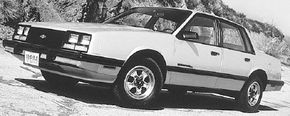
The 1980 Chevrolet Citation was one of the
smaller, more-efficient Chevys introduced in the 1980s.
Chevy's mixed fortunes in the '80s certainly weren't for lack of product or canny marketing. GM's long-term downsizing program ushered in a spate of smaller, more-efficient new Chevys, yet old standbys were allowed to carry on so long as sales were decent.
Continuing modernization saw fuel injection (both single- and multi-point) replace carburetors on many engines, which increasingly became V-6s and inline-fours. Yet V-8s were still part of the picture, as were performance cars -- once demand for them returned around 1984.
Reflecting these trends were those three division staples of the '80s, the Monte Carlo, Chevette, and Caprice/Impala. The last saw little change following a mild 1980 "aero" reskin that freshened the basic '77 styling even if it did little for mileage as claimed. Hoods were lower, rear decks higher, and coupes exchanged their sharply creased wraparound backlights for flat panes.
Sedans used V-6s, either 229-cid Chevy or 231-cid Buick, as base power though 1984, then a 4.3-liter (262-cid) Chevy V-6. There was also a diesel V-8 option, the trouble-prone 350 Olds engine, canceled after '85 as Americans bathed again in a sea of cheap gasoline. Most of these big Chevys carried the reliable 305 small-block V8 (usually standard on wagons).
Coupes were dropped for '83, revived for '84, then dropped again four years later. The venerable Impala name was gone by '86, as Caprices had proliferated into base, Classic, Classic Brougham, and Classic LS Brougham models.
Chevy was wise to retain big rear-drive cars once Buick, Olds, and for a time, Pontiac dropped them, for they were strong sellers even in the worst of times. And when times got better, so did Caprice/Impala sales, rising from a decade low of about 185,000 units for 1982 to nearly a quarter-million a year for 1983-87. Production then dropped below 200,000, though that was still far from shabby.
The humble Chevette was similarly little changed through the '80s, an increasing sales handicap in the fast-moving small-car sector. Model-year '81 was the production peak -- nearly 434,000 units -- after which assemblies tapered off steadily each year. Yet even the swan-song '86s managed over 100,000 sales, and the lack of change enabled Chevy to keep the lid on prices.
Appearance updates were confined to a full-width grille and square headlamps for '79, bigger taillights for '80. Major mechanical changes were limited to a five-speed manual option from 1983 and an extra-cost four-cylinder diesel (from Isuzu) that was rarely ordered, probably because it made a slow car even slower. Though few mourned its passing, the Chevette had done an able job. It was simply time for better things.
The same could be said of the 1978-vintage Monte Carlo, which departed during 1988. Here, though, there was reason to mourn. A handsome '81 facelift, similar to the big Chevys', was followed at mid-1983 by a revived SS bearing a smoothly raked new nose and a 305 V-8 tuned for 175 bhp (later upped to 180). You also got a beefy suspension with fat raised-white-letter tires, plus bold exterior graphics and trunklid spoiler. Things were pretty plain inside, but luxury options weren't long in coming.
If far removed from late-'60s muscle, this new SS was hardly your typical mid-'80s Monte. In fact, it was the starting point for Chevy's latest racing stockers, which began cleaning up in NASCAR and elsewhere.
To help its teams do even better, Chevy released an SS "Aerocoupe" at mid-1986 bearing a huge, compound-curve backlight that allegedly added a few more mph on the long supertracks. It only lasted through 1987, and only some 6200 were built -- which only makes this a gilt-edged future collectible.
As ever, the most-popular Montes were the luxury sort; they were even called Luxury Sport from 1986. All sold well: more than 187,000 for '81, over 90,000 for 1982 and '83, an average 120,000 a year thereafter. Chevy might well have kept the decade-old coupe going a little longer but, again, it was time to move on.
For more on Chevrolet cars, old and new, see:
Chevrolet Celebrity, Chevrolet Citation, and Chevrolet Cavalier
For Chevy, "moving on" at the bottom of the line meant moving to smaller, more-efficient front-drive models. The compact Citation had been the first. Cavalier and Celebrity would follow for the subcompact and midsize segments, respectively.
Celebrity
was one of four GM A-body lines announced for '83 in early 1982. All were
essentially X-cars in tailored suits. Inner structure, chassis, even
drivetrains were all the same, but squarer, more-formal notchback styling
contrived to make Celebrity look more expensive than the slopeback Citation --
which it was, by some $1500-$2000. Two- and four-door sedans were the only body
styles at first, but an attractive wagon arrived for '84. All could be dressed
up with trim packages variously called Custom, CL, and Classic.
The 1984 Chevrolet Celebrity sported square, notchback styling.
Also new for '84 was a Eurosport option group, available for any model. A gesture to enthusiasts, this delivered Chevy's firmer F41 handling suspension, plus special emblems, less exterior chrome, and sporty accents inside. It gilded a very middle-class lily, but the result was good enough to beg comparison with much costlier European sports sedans.
Planned to replace Malibu, Celebrity ran alongside the old rear-drive line through 1983, then soldiered on alone. Not that Chevy needed to worry, for the Celebrity handily surpassed Malibu's peak sales in this decade (278,000 for '80) by averaging 350,000 a year for 1984-87 peaking at nearly 405,000 for '86.
Sales dwindled thereafter as the two-door was killed after '88 and the mainstay four-door departed after '89. But this was only because a replacement was at hand. Overall, Celebrity was a winner.
The same could not be said for the Citation that spawned it. Buyers spurned the first front-drive Chevy in rapidly growing numbers amidst a welter of safety recalls, drivability problems, and damaging publicity about weak brakes that locked up too early in panic stops.
The division tried to stem the tide for '84 with detail changes and "Citation II" badges, but fooled no one. A high-output, 135-bhp V-6 arrived for the 1982 X-11 package, then became optional for any model, but that didn't help either.
In unit volume, debut 1980 would be Citation's best year: over 811,000. The tally plunged nearly 50 percent for '81, dropped under 166,000 for '82, then fell well below 100,000 through the last-of-the-line '85s. It only seemed to prove what some critics had been saying -- that GM left final "shakedown" testing to its unwitting customers.
Far fewer complaints attended the front-drive Cavalier subcompact. Replacing Monza for '82, it rode the new 101.2-inch-wheelbase J-body platform, the first ever offered by all five GM divisions.
Cavalier was basically "right" from the start. Nobody much liked the original engine -- a new Chevy-built 2.0-liter four with old-fashioned overhead-valve head (some called it the "junkyard engine") -- and the four-speed manual transaxle wasn't the slickest around, but that was about it.
And there were some tangible strengths: decent room for four, neat styling, initial choice of four body styles -- two- and four-door sedans, four-door wagon, and two-door "fasthatch" coupe -- and competitive prices, initially less than $6000 base.
Customers responded strongly to Cavalier, snapping up better than 195,000 for the extra-long '82 model year, over 462,000 of the '84s and some 432,000 of the '86s. Steady improvement helped: a five-speed manual option, throttle-body fuel injection, more power, a neat convertible for '83, new frontal styling for '84, "mini-muscle" V-6 Z24 coupes for '85, a major facelift and a Z24 convertible for '88, and detail changes most every year.
Sales continued strong through 1994, last year for the original J-body. Demand throttled back some in the face of fresh competition, yet Cavalier did no worse than 225,000 for 1992. Even the '94s managed almost 274,000, not bad for a basic design in its 13th season.
Evolutionary changes helped. Budget-priced VL ("Value Leader") models bowed for 1988. A larger 3.1-liter V-6 making 135 bhp was added in '90. For '91, the pushrod four grew to 2.2 liters and 95 bhp; by '94 it was up to 120 bhp thanks to multipoint fuel injection and other improvements. The '91 Cavs also sported a minor facelift, a more-ergonomic dash, and better-equipped base models tagged RS.
Later years brought more cosmetic touchups and extra standard features like larger wheels and tires for some models, plus cupholders, extra instruments, automatic door locks, and GM's ABS VI antilock brake system. Still, starting prices remained comfortably below $10,000, though the natty Z24 convertible was pushing $20,000 by mid-decade.
For more on Chevrolet cars, old and new, see:
Chevrolet Corsica, Chevrolet Berretta, and Chevrolet Lumina
Succeeding Citation as Chevy's compact were the Corsica sedan and Beretta coupe, introduced in March '87 as early '88 models. Both used a new 103.4-inch-wheelbase L-body platform exclusive to Chevrolet, though with engineering that owed much to the J-car and the front-drive N-body models at Buick, Olds and Pontiac.
Among other things, that meant coil-spring suspension
with front struts and a twist beam rear axle on trailing arms, rack-and-pinion
steering, and front-disc/rear-drum brakes. Standard power at first was the
latest Cavalier four, with the division's 130-bhp 2.8 V-6 optional.
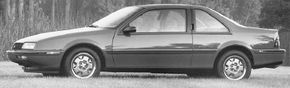
The 1988 Chevrolet Berreta used Chevy's exclusive L-body platform.
Styling was also unique to Chevy -- and a welcome change from GM's earlier "cloning:" smooth, rounded, aerodynamically efficient. Best of all, these cars reflected Chevy's strongest efforts yet to ensure tight, thorough fit and finish. Corsica/Beretta got off to a strong sales start, with 225,000 built in calendar '87 alone. The "true" '88s saw only running changes. So would most later models.
A Euro-style Corsica called LTZ arrived for 1989, along with a four-door hatchback that was hard to tell from the normal notchback. That same year, Beretta's sporty GT option became a separate model and gained many appearance features of the racy GTU package from mid-'88.
The GTU (named for the under-2.0-liter Grand Touring class in the International Motor Sports Association) was distinguished by 16-inch aluminum wheels, "ground effects" lower-body skirting, a five-speed manual gear-box designed by Getrag in Germany, and a tinted upper-wind-shield band with "Beretta" in big, bold letters.
Beretta GT, GTU, and the Corsica LTZ all came with a V-6. A firm Z51 handling option made Berettas corner as slick as they looked. A similar Z52 setup did the same for '91 Corsicas, though it killed the LTZ.
The GTU bids fair as a minor collector's item, being a low-volume short-timer with only 3814 built for '88 and 9813 for '89. Its 1990 replacement was the Beretta GTZ, identified by a neat grilleless face instead of a broad eggcrate. Under the hood sat the High-Output version of Oldsmobile's vaunted new 2.3-liter "Quad-4," a genuine Euro-style twincam engine with four valves per cylinder and an excellent 180 bhp.
But though faster than a GTU, the GTZ was far noisier and stiffer-riding. As if to acknowledge its shortcomings, Chevy offered a credit-option V-6 for '91 GTZs, a 140-bhp 3.1-liter unit.
Chevy made an odd bit history by announcing a 1990 Beretta convertible that never made it to showrooms. A handful were built for Indy 500 pace-car duty, but all were prototypes.
Like Oldsmobile's new 1990 Cutlass Supreme ragtop, which did see series production, the open Beretta was basically a roofless coupe with a structural metal "hoop" bridging the B-posts. The hoop helped restore some lost torsional rigidity and preserved the coupe's pillar-mounted outside door handles.
Chevy dropped Cavalier convertibles to make way for the soft-top Beretta, only to revive them when quality-control problems proved insurmountable on the Beretta. It was a minor but embarrassing episode symbolic of larger troubles.
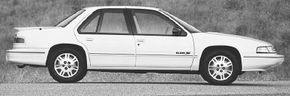
Spring 1989 ushered in the belated 1990 replacement for Celebrity. Named Lumina, it rode the front-drive GM10 platform first used for 1988 coupes at Buick, Olds, and Pontiac. This time, though, there was no delaying the planned sedan. Base Luminas carried a humble 2.5-liter four -- the old "Iron Duke" still hanging on -- and offered the 3.1 V-6 at extra cost. The latter was standard for a sporty Euro coupe and sedan with black exterior trim, sport suspension, and wider 16-inch wheels and tires (versus 14s or 15s).
All Luminas naturally boasted the GM10's laudable all-independent suspension and four-wheel disc brakes. But the Euro, as Car and Driver observed, was really quite "Amero" in ride, handling, performance, and interior treatment.
That wasn't necessarily bad, of course, but Ford's Taurus remained a much more-popular midsize. Even into the '90s, Lumina was handily outsold by Taurus and Japanese rivals Honda Accord and Toyota Camry. Styling was a likely factor. Even Charles M. Jordan, then GM design chief, admitted that Lumina sales suffered because the design sat on a shelf for some seven years before the public saw it, by which time it was no longer "clear" or "up to date."
For more on Chevrolet cars, old and new, see:
Chevrolet Camaro Third Generation
V-6s ousted straight sixes as standard power for the 1980 Camaro, when an interim 267-cid V-8 option joined the 305 and 350 engines. Sales held up well, all things considered: 152,000 for 1980, a bit more than 126,000 for '81.
A smaller Camaro was a foregone conclusion by then, and it duly arrived for 1982 on a trim 101-inch wheelbase. Though retaining the traditional format, the third generation was nearly 10 inches shorter, three inches narrower, and almost 300 pounds lighter, yet looked terrific.
Chevy design chief Jerry Palmer precisely tailored styling to the smaller package: chiseled yet obviously aerodynamic. A new liftup rear hatch provided luggage access, and its compound-curve backlight was said to be the largest, most-complex piece of car glasswork ever. Beneath the swoopy new body was a more-modern all-coil suspension with front struts, and rear disc brakes were optionally available to complement the standard front discs.
The Rally Sport temporarily departed as the base '82 sport coupe became the first Camaro with a standard four, the aged 90-bhp "Iron Duke." A 2.8 V-6 was standard for Berlinetta.
As ever, the hunky Z28 got the most attention. It packed only 305 V-8s: a four-barrel 150-bhp unit or a 165-bhp version with "Cross Fire" twin-throttle-body electronic fuel injection, as on that year's Corvette. Four-speed manual gearbox was standard except on the 165-bhp 228, where it was three-speed automatic only (optional elsewhere). The base Camaro could be ordered with V-6, Berlinetta with the carbureted 305.
Once again, Chevy scored big with a smaller car, the new Camaro garnering 50,000 more model-year sales than its '81 predecessor. By 1984, it was up past a quarter-million.
But
1985-86 production plunged to some 185,000, the '87 tally was 50,000 units
below that, and 1988 volume was under 100,000. New competition from all
quarters contributed to the decline, but so did indifferent assembly and
persistent mechanical troubles.
A five-speed manual transmission was standard for the
1985 Chevrolet Camaro.
Nonetheless, the third-generation Camaro -- Z28 especially -- was very much in the ponycar spirit of the '60s. Changes through 1992 were evolutionary but well timed. For example, a T-bar roof option appeared for '83, when the Z28 switched to a fuel-saving four-speed automatic and other engines became available with a five-speed manual option.
The Cross-Fire V-8 disappointed, so a high-output 190-bhp carbureted engine replaced it for '84. That year's Berlinetta acquired a gimmicky dash with hard-to-read electronic digital/graphic instruments and spacey minor controls; thankfully, these didn't last long.
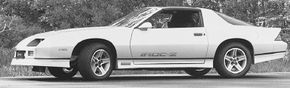
Providing genuine excitement for 1985 was a hot new IROC-Z performance package for Z28, honoring the Camaros used in the revived International Race of Champions "top gun" driver's contests. The H.O. V-8 was exclusive to the IROC and available with a five-speed manual transmission, now standard for all Camaros. More-efficient "Tuned Port Injection" (TPI) yielded a new 215-bhp option for Z28s.
IROC hunkered down on 16X8 five-spoke aluminum wheels wearing meaty Goodyear Eagle performance tires, came with its own handling suspension and high-effort power steering, and looked ready to race with its full-perimeter lower-body "skirts."
Chevy again turned up the wick for '87. The IROC got the TPI V-8 and could be ordered with the 350 Corvette engine packing 225 bhp (delayed from a promised mid-'86 debut). Z28 returned with standard four-barrel 305. The underpowered four was gone and Berlinetta reverted to being an LT.
But the real treat was the first Camaro convertible in 18 years. A mid-'87 arrival, it was quite a head-turner in IROC trim, but could be had in other lines, too. They were crafted "out of house" to Chevy specs, making these "semi-factory" models, but hardly anyone cared when blasting top-down on a winding two-lane.
Then suddenly, the Z28 vanished -- a big surprise -- though the 1988 sport coupe was much the same thing save a standard V-6. The LT disappeared too. Minor tweaking added five horses to all three V-8s, though you lost 25 on the injected 305 when teamed with automatic. Base prices had risen some $2000-$3000 in five years, a rather modest increase, really. The ragtop IROC was the costliest '88 Camaro with a starting tariff around 18-grand.
The hallowed RS designation returned for 1989 on a V-6 coupe marketed the previous season only in California. It looked a lot like the IROC, but had its own suspension tuning and equipment mix. The RS also came as a convertible with a standard V-8. The IROC itself could now be had with 16-inch wheels and new Z-rated tires certified safe for sustained speeds above 149 mph. Production hit nearly 111,000 for the model year in a modest sales recovery, though there was no particular reason for it.
For more on Chevrolet cars, old and new, see:
Chevrolet Camaro Fourth Generation
The 1990 Camaros comprised RS and IROC coupes and convertibles with some extra standard features. Among the goodies: 16-inch wheel/tire package for IROCs, a torquier 3.1-liter V-6 with 140 bhp for RS, and a tilt steering wheel, driver-side airbag and GM "PASS-Key" antitheft ignition for all models. A deliberately shortened model year held production to just under 35,000.
Camaro's 1991
began in the spring of 1990. Z28s took over for IROCs. The reason? Dodge now
sponsored the IROC series and owned rights to that name. At least Z coupes
could be quicker now with a new 245-bhp 350 option, the extra power reflecting
a switch to more-sophisticated sequential multipoint injection. The 305 also
got that and rose to 230 bhp. Reworked front and back ends freshened all
models, and Z28s wore a higher-flying rear spoiler that looked faintly
ludicrous.
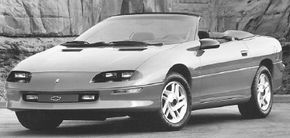
The 1990s Camaros were regarded as the most solid-feeling
Camaros in history. Shown here is a 1994 Chevrolet Camaro.
For all the recent additions to standard equipment, Camaro was still a bargain performance buy, ranging from $12,000 for the RS V-6 coupe to just under $21,000 for ragtop Z28. To Chevrolet's delight, sales more than tripled, '91 production soaring beyond 100,000. Volume then faded to 70,000, likely because a new Camaro was known to be coming for 1993.
The third generation thus closed out after '92 with only one further change: a $175 "Heritage Appearance" package to mark Camaro's 25th birthday. Available in white, red, or black, it involved only badges and some hood and decklid stripes. It was a feeble gesture, but at least Chevy didn't forget its ponycar's anniversary.
A ground-up fresh Camaro promised some new glory days. Arriving for '93 in base and Z28 coupe models, it was about the same size as its well-liked predecessor (wheelbase was unchanged) but more-sculptured and futuristically swoopy, patterned on the recent "California Camaro" show car -- and not that much more-subdued.
Yet the new fourth-generation design was unmistakably Camaro, carefully preserving hallowed appearance "cues" like tunneled headlamps, broad taillights, a low Vee'd nose, even optional T-tops for the coupe.
Despite added standard features, the '93 was only some 150 pounds heavier than previous Camaros. One reason was a lighter, yet stronger, unit body/chassis with steel-reinforced composite panels over a steel framework as on GM200 minivans and the small Saturn.
The nominal weight gain bode well for performance, especially on the Z28, which now packed a 350 LT1 V-8 with 275 bhp, 30 more than before. The base Camaro also muscled up via a new overhead-valve 3.4-liter V-6 with a creditable 160 horses. Transmission choices comprised standard five-speed manual for the base model, a new six-speed for Z28 (again borrowed from Corvette), and optional four-speed automatic for both.
Front suspension reverted to Detroit-traditional twin A-arms, though with unique geometry and premium gas-pressure, coil-over deCarbon shocks. The latter were also featured in back, where the live axle was now located by a torque rod and trailing arms.
Each end had a hefty stabilizer bar. Antilock brakes were standard, with rear discs on Z28. A tantalizing new option was RPO 1LE, an ultrastiff performance suspension package for Z28. It was "not recommended for street use" but worked wonders on the track.
With 70 more horses than a Mustang GT and a starting price on the right side of $17-grand, the '93 Z28 was immediately hailed as the new best buy in Detroit performance. That came from "buff books," who typically reported 0-60 at just over five seconds with manual.
For buyers of all stripes, Camaro appealed with standards like dual airbags, full instrumentation, and a good sound system (with even better ones available). Options were still fairly numerous but easier to comprehend, being grouped into sensible packages.
A deliberately slow "ramp-up" limited '93 Camaros to just 40,224, all coupes, but they were the tightest, most solid-feeling Camaros in history. Production then hit full stride to pass 125,000 for '94, when promised base and Z28 convertibles went on sale with standard power top; glass backlight; and a low, tidy "top stack."
Six-speed Z28s became a bit quicker that year thanks to shorter final gearing (3.42:1 vs. 2.73/3.23). Unhappily, their shifter acquired CAGS, the Computer Aided Gear Selection feature first used on Corvettes.
Electronic watchdogs "forced" a short-shift from 1st to 4th at certain speeds and throttle openings, a bit of nonsense prompted by government fuel-economy standards. But enthusiasts found that CAGS could be defeated by pulling a little wire, and many did pull it.
As ever, the torquey Z28 was a prodigious tire-smoker off-the-line, and a standard limited-slip differential was no substitute for modern traction control. Chevy finally obliged for '95 by offering the Corvette's ASR (Acceleration Slip Reduction) as a Z28 option.
ASR would restore lost grip by braking a spinning wheel and/or throttling back on engine power as needed -- a boon for wet-road control. And when the road was dry, you could switch it off if you wanted. Street racers loved that.
Though a new Mustang had galloped away with the ponycar market, Camaro mostly held its own for 1995, slipping to 110,595. Arriving late that year was a stronger "3800" V-6 option for base models sold in California. This became standard for all '96s, bringing a useful 40 extra horsepower and 25 more pound-feet of torque over the displaced 3.4. With that, a base Camaro could at least keep up with a Z28 on winding roads, though not on a dragstrip, of course.
For more on Chevrolet cars, old and new, see:
Chevrolets of the Early 1990s
Any chance to celebrate was doubtless welcome by now, for the '80s had not been kind to Chevrolet. True, the division had more models than ever, but it wasn't selling that many more cars. Worse, Ford was entrenched as number one, and seemed destined to remain so.
Nevertheless,
Chevrolet was a strong "USA-2" through the mid-'90s, with yearly
domestic car sales of around one million units. As with the '80s Nova, the
California-built Geo Prizm was counted in those results, but not other Geo
cars, which were classed as imports on the basis of "domestic
content" even though some came from Canada instead of Japan.
Although Chevy had fallen below Ford, it still had annual sales
of around one million units. Pictured here is the 1992 Chevrolet Lumina.
Chevy had launched the Geo nameplate for 1989 as a marketing umbrella for Japanese-designed models like Prizm. The idea was to distinguish these products from "real" Chevrolets in the minds of those most likely to buy them -- what marketing types called "import intenders."
But the ploy worked only in the beginning, and Geo sales dropped steadily. A big blow was losing the popular Isuzu-built Storm sporty coupe after model-year '93. By '98 the remaining Geos were badged Chevrolets. The Toyota Corolla-based Prizm was redesigned that year and continued through 2002.
Though Chevy had been "The Heartbeat of America" since 1987 (an ad slogan adopted for the make's 75th anniversary), its mainstream cars of the early '90s offered little to raise anyone's pulse.
Indeed, motor-noters began chiding GM for building mostly "rental cars": dependable but dull underachievers compared to class rivals. Nevertheless, the Chevys most-popular with buyers were the least inter