The Lotus story started more than forty years ago and it is still going strong in the new millennium.
Anthony Colin Bruce Chapman set up Lotus in order to build limited numbers of sports-racing cars, and quickly moved to road cars, as well. In this article, you’ll learn about Lotus cars, from Chapman’s low-weight philosophy to the Lotus Elan’s role in a popular television series.
Starting with 1959’s Lotus Elite, Chapman built the world’s first car with unit fiberglass construction, in an effort to keep body weight as low as possible. This principle (if not the specific implementation) reappeared in each Lotus, from the popular and collectible Lotus Elan through the aggressive, mid-engine Lotus Esprit.
Advertisement
Lotus began small, and remains so to this day, producing small numbers of vehicles, and providing consulting to other manufacturers, particularly in the finer points of engine design and fiberglass construction.
Come explore the history of Lotus, beginning on the next page with the Lotus Elite.
To learn more about Lotus and other sports cars, see:
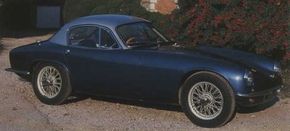
The world’s first -- and so far only -- car with unit fiberglass construction, the Lotus Elite proved as delicate as it looked.
The Lotus Elite was Anthony Colin Bruce Chapman's first road design following the production of several sports-racing cars. Chapman earned fame in his native England with a series of early-50s racing “specials,” then set up a small company called Lotus to produce small numbers of sports-racing cars to his design. Before long, however, his ambitions turned to road cars, and in 1957 he announced the sleek Elite coupe as his first. Though displayed at that year’s London Motor Show, it wasn’t fully developed, so customer deliveries didn’t begin until 1959.
The Elite was not only the first practical roadgoing Lotus but the world’s first production car with unitized fiberglass construction, with no more than a tiny amount of steel stiffening. (This compares with the Chevrolet Corvette, which uses a fiberglass body on a separate steel frame.) Chapman, who liked his cars as light as possible, thought this the ideal way to save weight without compromising structural rigidity. It also seemed the most affordable approach. A separate chassis was old hat, he felt, while a monocoque would have been too costly if built in steel.
Advertisement
Though beautiful and a real image-booster, the Elite was not a corporate success. It was unrefined and unreliable in many ways, which hindered sales, while production costs proved higher than expected, so it never made any money. Worse, the fiberglass monocoque proved such a difficult construction job that Lotus had to switch suppliers in midstream, the later, higher-quality shells coming from a subsidiary of Bristol Aeroplane Company. Nevertheless, this was valuable production experience that would stand Lotus in good stead when it turned to the altogether more practical Elan in the early Sixties.
And despite its problems, the Elite was a technical marvel. The monocoque was extremely light, as was the engine, an all-aluminum overhead-cam four supplied by Coventry-Climax. Chapman had persuaded C-C to productionize its FWA racing engine, which it enlarged into the torquier FWE unit for the Elite (hence the different end initial).
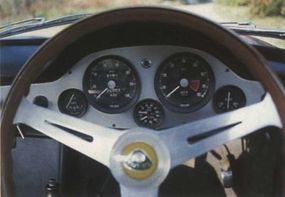
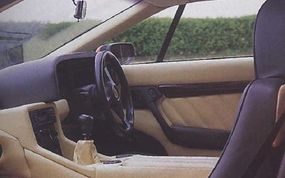
The Lotus Elite was a joy to drive when things were working right, though that was seldom. The small cockpit featured a no-nonsense dash.
Independent front suspension and all-disc brakes were expected, but ACBC had devised a simple and effective irs that he cheekily called “Chapman strut” suspension. It was simply a modified MacPherson-strut layout transplanted to the rear, but it fit perfectly with the layout and concept of this lean and lovely coupe. Like sports-racing Lotuses, the Elite had soft springs and relatively firm shock absorbers for a comfortable ride with truly excellent grip and handling balance.
The result of all this was a car that weighed half as much as a Jaguar XK140 but was almost as fast and far more economical, thus further confirming Chapman’s weight-saving design philosophy. Low aerodynamic drag further aided both performance and fuel efficiency, while road manners were responsive -- quite feline, in fact.
But refinement -- that is, the lack thereof -- was the Elite’s downfall. With all running gear bolted directly to the main structure, and given the superior noise-transmission properties of fiberglass versus steel, too much mechanical and road ruckus found their way into the cockpit, making the Elite tiring as an everyday car. Also, the barrel-section doors precluded drop-down windows, so occupants either had to swelter in warm weather or remove the windows completely. And with a wheelbase of just 88.2 inches, cockpit room was limited for larger folks, a literal shortcoming that would characterize future Lotuses.
Finally, there was poor workmanship, another failing that would persist far into Lotus’s future. The Elite was designed, and largely built, as a kit to take advantage of British tax laws that levied a heavier surcharge on assembled cars. Yet even factory-built Elites were rather fragile, especially in America’s more demanding driving conditions. This and the U.S. importer’s financial problems and subsequent upheaval did nothing for sales or Lotus’s reputation here, especially since the Stateside price was a lofty $4780 POE.
Yet when all was in order, the Elite was a magnificent driving machine: quick, smooth-riding, amazingly obedient. And it became even better. Series II cars, produced beginning in 1960, had revised rear suspension and a ZF gearbox, while a few later examples were built as “Super 95” and “Super 105” models with more powerful C-C engines. Still, the last Elite was essentially the same as the first.
Alas, demand evaporated once the Elan was revealed in 1962, and a tentative proposal to continue the Elite with the new Lotus-Ford twincam engine was abandoned.
But the Elite was certainly an auspicious beginning for a small company entering the production-car lists. More than that, it was a modern milestone that was even recognized as such in its own time. Colin Chapman had done well indeed.
To learn more about Lotus and other sports cars, see:
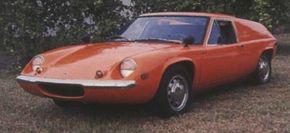
Early Europas had high “breadvan” rear quarters -- cut-down sail panels greatly improved driver vision in later Europas.
Lotus’s mid-engine racing cars achieved worldwide fame before Colin Chapman got around to a midships road car. Not that he hadn’t wanted to offer a car like the Lotus Europa, but until the mid-60s, he couldn’t find a suitable proprietary powertrain available in quantity. Besides, his facilities were already full building Elans. Then Renault introduced its first front-drive car, the 16 sedan, in 1965, and Chapman was intrigued -- enough to acquire a more spacious factory at the wartime U.S. Air Force bomber field at Hethel, near Norwich.
Chapman duly arranged to buy modified 16 drivetrains from Renault for a new mid-engine model to be designed and built by Lotus. As part of the deal, sales would be limited to the Continent for the first couple of years, reflecting Chapman’s desire to establish a presence in the recently formed European Common Market, another reason for the Renault mechanicals. Chapman diplomatically suggested the name “Europe,” which was soon changed to Europa, and the first roadgoing mid-engine Lotus was born.
Advertisement
What Chapman bought was the 16’s front-drive transaxle and a tuned, 78-horsepower version of its 1470-cc overhead-valve all-alloy four. Because the powertrain would sit “north-south” behind the cockpit and ahead of the back wheels in the rear-drive Europa, the final drive was modified and the engine turned back-to-front, with the inline gearbox trailing behind. Like other roadgoing Lotuses, a fiberglass body sat atop a steel backbone frame with all-independent coil-spring suspension.
Styling was neat if slightly strange. The low nose with exposed headlamps was no problem (rather like the Elite’s, in fact) but the rear quarters were funny, with broad, high sail panels aft of the doors that earned the Europa its “breadvan” nickname. A flat detachable engine cover lived between the sails, just below a slit-like rear window. Bodies and chassis were initially bonded together, which helped structural stiffness but complicated accident repairs.
The Twin-Cam Europa belatedly received the capable Lotus-Ford four originally ruled out for the mid-engine Lotus.
Retrospectively called “Series 1,” the first Europas were delivered in early 1967 after a late-’66 launch, and were sold factory-built or in kit form like other roadgoing Lotuses. Lightweight construction again paid off in surprising performance with great fuel economy, while the midships layout meant little body roll, high grip, and the kind of handling the world had come to expect of Lotus -- all this plus the usual fine ride and a very attractive price.
But all was not bliss. Performance disappointed many, as did the cramped interior, fixed door windows, odd styling, and typically patchy Lotus workmanship. The Series 2 Europa, announced in 1968, answered some of these problems. Bodywork was bolted on rather than bonded to ease accident repairs, windows now moved electrically to reduce claustrophobia, the engine cover was newly hinged, and a bit more space was found for luggage (behind the engine) and around the pedals. For the U.S. market, the larger 1565-cc 16TS engine countered power-sapping emissions controls.
British Europa sales commenced in mid-1969, and Chapman hired a new project engineer named Mike Kimberley (Lotus’s chief executive at this writing) away from Jaguar. One of his first jobs was to develop an even less quirky, more powerful Europa.
The result appeared in October 1971 as the Series 3 Twin-Cam, with the 105-bhp Lotus-Ford dohc four as used in the front-engine Elan Sprint and Elan + 2S 130 -- and originally ruled out for the Europa! The Renault transaxle was retained. Styling was altered via cut-down rear quarters for improved driver vision, plus new cast-alloy road wheels. In this form, the Europa was good for up to 120 mph flat out (versus the previous 110).
Late 1972 brought the even better Europa Special, with the 126-bhp “Big-Valve” engine and a new 5-speed Renault transaxle, the latter optional at first but made standard in 1974. Top speed improved to 125 mph plus, and there were corresponding gains in standing-start acceleration.
But Lotus was working on a more grown-up middie, the chiseled Giugiaro-designed Esprit, revealed in 1975. Thus, the Europa passed into history much loved, if not overly mourned in light of its stunning successor.
At least U.S. enthusiasts got the best of the breed. Though imports were sporadic through late 1969, the Europa was officially certified for American sale after that, which means most examples on today’s market will be the desirable S3 and Special models.
To learn more about Lotus and other sports cars, see:
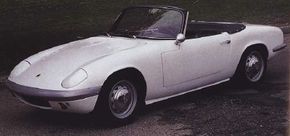
The Lotus Elan was the road car that successfully translated Colin Chapman’s race-bred philosophy that lighter is better. It used a steel backbone chassis and a fiberglass body with then-novel hidden headlamps.
Colin Chapman was a canny Brit whose credo was that simplicity, lightness, and streamlining wins the race. After a modest start in the late 1940s souping-up tiny Austin Sevens, he formed Lotus Cars in 1952 and won fame with aluminum-bodied sports-racers that proved giant-killers despite small engines and somewhat fragile natures. Lotus soon expanded into road cars with the stark, speedy Seven roadster, followed in 1959 by the elegant Elite coupe, the world’s first production car with fully unitized fiberglass construction. But the Elan would showcase Chapman's philosophy that lighter is better.
In 1962, Chapman changed the shape of racing with rear-engine Formula 1 and Indianapolis cars. They made Lotus the decade’s dominant power in international open-wheel competition. That same year brought an equally revolutionary roadgoing Lotus, the Elan. Like the Elite, it was a petite fiberglass-bodied two-seater with a front four-cylinder engine, all-disc brakes, rack-and-pinion steering, and all-coil independent suspension with rear MacPherson struts. Also per Lotus tradition, the Elan was sold in both assembled and kit form (the latter avoiding high taxes in Britain).
Advertisement
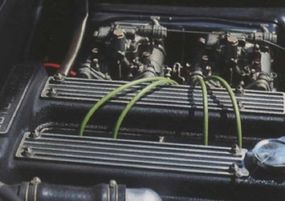
But the Elan was a far more practical -- and saleable -- Lotus than the Elite. A neatly styled roadster with hidden headlamps, it eschewed its predecessor’s nervous Coventry-Climax engine for a larger, more reliable British Ford-based unit with a new Lotus-designed twincam cylinder head that gave all kinds of revvy performance in concert with Chapman’s weight-conscious engineering. The Elan also pioneered a new Lotus hallmark: a sturdy sheet-steel “backbone” chassis with forked ends for carrying the drivetrain and final drive. Though the design dictated a high center tunnel, it made for flat cornering and super-responsive handling that were state-of-the-sports-car art.
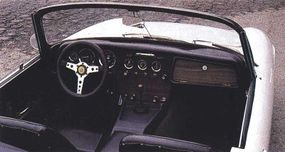
The communicative Lotus Elan cornered like a go-cart and accelerated well for its modest power, but assembly quality was spotty. (The steering wheel on this example is not original.)
The Elan evolved steadily over a dozen years, gaining a bit more power, a companion coupe, and nicer appointments, even siring a stretched “+2” coupe series. The final version, the 1971-74 Sprint, was arguably the best, thanks to its 126-hp “Big Valve” engine. Yet every Elan was what Road & Track once called “a gutty little car, highly refined in some areas and crude in others. [It calls] for a lot of concentration and skill if the driver is to handle it smoothly -- [but] the rewards of great cornering powers and a marvelously intimate connection between driver and road are worth the trouble.” Colin Chapman wouldn’t have it any other way.
The Elan evolved steadily over a dozen years, gaining a bit more power, a companion coupe, and nicer appointments, even siring a stretched “+2” coupe series. The final version, the 1971-74 Sprint, was arguably the best, thanks to its 126-hp “Big Valve” engine. Yet every Elan was what Road & Track once called “a gutty little car, highly refined in some areas and crude in others. [It calls] for a lot of concentration and skill if the driver is to handle it smoothly -- [but] the rewards of great cornering powers and a marvelously intimate connection between driver and road are worth the trouble.” Colin Chapman wouldn’t have it any other way.
To learn more about Lotus and other sports cars, see:
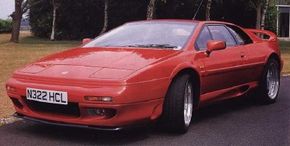
The Lotus Esprit is a mid-engine exotic that dates from 1975. Lotus has refined and fortified the Esprit over the decades.
Some cars get better with age. Take the Lotus Esprit. The 1996 V-8 model isn’t just the newest sports car from “Britain’s Porsche,” it’s the ultimate version of a contemporary classic, a car that’s seen Lotus through good times and bad.
Entering production in 1975, the Esprit was the second roadgoing mid-engine Lotus, after the 1967-vintage Europa. In addition to the established marque hallmarks of two-seat fiberglass bodywork, steel backbone chassis, and race-proved independent suspension, the Esprit had trendy “doorstop” styling by Italy’s Giorgetto Giugiaro and Lotus’s new 2.0-liter twincam four. It was mounted longitudinally and delivered 160 hp (140 in U.S. tune) through a five-speed transaxle for 0-60 mph in nine seconds or less.
Advertisement
The 1982 death of founder Colin Chapman began a troubled era for Lotus, but the Esprit hung on as sister models died. The first major improvements came with 1980’s “S2.2,” named for its enlarged 2.2-liter engine. More exciting was a 150-mph Turbo Esprit with 210 hp, a stiffer chassis, larger wheels and brakes, and revised suspension that also benefitted 1981’s non-turbo Series 3. SE models debuted in 1987 with 228 hp in the Turbo, then 264 from ’89, and a smooth-contour restyle by Britisher Peter Stevens. The replacement S4s of ’93 were the most luxurious Esprits ever and sired the strongest of the four-cylinder breed, the turbo Sport 300 and similar S4S, both with 300 hp and sub-five-second 0-60 ability.
by Britisher Peter Stevens and features the line’s first V-8 engine.
Despite such performance, turbo Esprits were always high-strung mounts demanding an expert driver (preferably of jockey build) and a rich man’s means. Today, thanks to Lotus’s new 350-hp aluminum twin-cam twin-turbo V-8, the Esprit fulfills Chapman’s original vision of a smooth, refined, mid-engine supercar -- though it’s only about as quick as an S45. Still, wrote Paul Frere for Road & Track, it “puts you in charge of a wonderful engine, performance in the Porsche Turbo class, superb handling and a surprisingly good ride.” What’s more, 20 years of careful honing finally produced a Lotus “that is beautifully made, down to the smallest details.”
To learn more about Lotus and other sports cars, see: