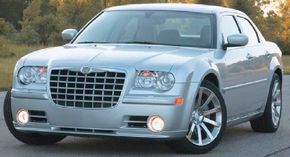
Chrysler Origins
Walter Percy Chrysler honed his native mechanical skills on the great Midwestern railroads, then learned about cars by tinkering with a $5000 Locomobile he bought in 1908. Within a few years he became plant manager at Buick under Charles W. Nash, then took over for him as Buick president. But Chrysler didn't get along with GM's Billy Durant, so he left to run his own car company (as did Nash).
That first Chrysler was the foundation of the company's early success. It was designed with instrumental assistance from three superb engineers: Fred Zeder, Carl Breer, and Owen Skelton, the "Three Musketeers" who would dominate the design of Chrysler Corporation products throughout the '30s.
Power came from a high-compression 202-cubic-inch L-head six with seven main bearings and 68 brake horsepower -- 0.3 bhp per cubic inch, outstanding for the day. Also featured were four-wheel hydraulic brakes (well ahead of most rivals), full-pressure lubrication, attractive styling, and competitive prices around $1500. It couldn't miss, and it didn't. By 1927, production was up from 32,000 to some 182,000.
Sixes
remained Chrysler's mainstay through 1930, when the make offered four
different engines ranging from 195.6 to 309.3 cid. The smallest was the
four-main-bearing job in the cheap CJ-Series; the others were derived
from the original 1924 design. That year's lineup comprised no fewer
than 38 models priced from $795 for the least-costly CJ to $3000-plus
for the imposing Imperial.
The Chrysler line then moved
rapidly upmarket in price, prestige, and power. The reason was the
company's 1928 expansion via the acquisition of Dodge and introduction
of DeSoto and Plymouth. Given his GM experience, it's no surprise that
Walter Chrysler wanted a similar make "ladder" running from low-priced
Plymouths to premium Chryslers to keep customers in his corporate camp.
At first, DeSoto, not Dodge, was the step up from Plymouth; their price
positions wouldn't be reversed until the mid-'30s. 
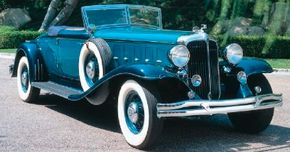
The 1932 Chrysler Imperial was a response to Cadillac, wisely avoiding the
costly V-12 and V-16 engines that were popular for the day.
Imperial had arrived in 1926 to answer Cadillac, though this would always be more of a prestige leader than high money-earner. Also unlike GM's luxury make, Imperials built through 1954 weren't the products of a separate division, just the finest Chryslers, though they usually rivaled Cadillac in most every way. A notable exception is that Imperial didn't try to match Cadillac's costly V-12 and V-16 engines of the '30s -- wise, considering how poorly those sold in the devastated Depression market.
Imperial reached a pinnacle in 1931, when Chrysler introduced its first eights. The largest was naturally reserved for Imperial: a smooth, low-revving 385-cid L-head with nine main bearings and 125 bhp. Despite weighing nearly 5000 pounds, these majestic cars could reach 96 mph and do 0-60 mph in 20 seconds. Styling (heavily influenced by the Cord L-29), was distinctive: long and low, with gracefully curved fenders and a rakish grille.
Hard times made sales scarce, but these Imperials provided glorious motoring at relatively modest prices. They remain among the most beautiful Chryslers ever built -- particularly the custom-bodied examples from the likes of Locke, Derham, Murphy, Waterhouse, and especially LeBaron. Though most coachbuilders perished in the Depression, Chrysler hired Ray Dietrich, one of the partners in LeBaron, to head its styling department (such as it was) in the late '30s.
Chrysler also offered an eight-cylinder 1931 CD-Series priced about half as much as Imperials, with engines of 240.3 cid and 82 bhp or 260.8 cid and 90 bhp. There was also a DeLuxe Eight with 95 bhp from 282.1 cid. But sixes still anchored the line, as they would through 1954. In the '30s these became progressively larger and more potent, reaching 241.5 cid and 93 bhp by 1934.
Meantime, Chrysler cemented its reputation for advanced engineering with the 1931 debut of "Floating Power" rubber engine mounts. They were standard on all models, as were automatic spark control, free-wheeling, and rustproofed bodies. Welded steel bodies were an innovation from the previous year. To prove their strength, Chrysler persuaded a five-ton elephant to climb atop a sedan at Coney Island in one of the firm's many famous period publicity stunts. Fortunately, the body held.
Chrysler also offered an optional four-speed manual transmission, basically a three-speed unit with an extra-low first gear. But hardly anyone used "emergency low," so this was dropped after 1933. Interiors were lavish during these years, especially on Imperials and Chrysler Eights, which came with full instrumentation in a polished walnut panel.
The Chrysler Airflow
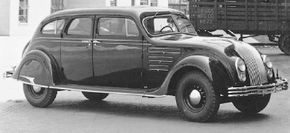
After making few changes through 1933, Chrysler made a major one, summoning the future with the most-radical production car yet attempted by a U.S. maker. Widely recognized as the first truly modern automobile, the 1934 Airflow was an "engineer's" car, which was hardly surprising. What was curious is that normally canny Walter Chrysler approved its daring concept without much regard for whether the public would like it.As the story goes, Carl Breer spotted a squadron of Army Air Corps planes flying overhead in 1927, which inspired him to push with Zeder and Skelton for a streamlined automobile employing aircraft-type design principles. Wind-tunnel tests suggested a modified teardrop shape (and ultimately the Airflow name).
![]() The 1934 Chrysler Airflow was designed with aircraft principles in mind. Unfortunately, bad press limited the Airflow’s success. |
But there was no denying Airflow performance. At the Bonneville Salt Flats a '34 Imperial coupe ran the flying-mile at 95.7 mph, clocked 90 mph for 500 miles, and set 72 new national speed records. Airflows were strong, too. In Pennsylvania, one was hurled off a 110-foot cliff (another publicity stunt); it landed wheels down and was driven away.
Unfortunately, the massive cost and effort of retooling delayed Airflow sales until January 1934 (June for Custom Imperials). Then, jealous competitors -- mainly GM -- began running "smear" advertising that claimed the cars were unsafe. All this blunted public interest that was initially quite favorable despite the newfangled styling, and prompted rumors that the Airflow was flawed. Save for a group of traditional Series CA and CB Sixes, the 1934 Chrysler line was all Airflow, and sales were underwhelming. While most makes boosted volume by up to 60 percent from rock-bottom '33, Chrysler rose only 10 percent. It could have been worse -- and was for DeSoto, which banked entirely on Airflows that year (all sixes).
Yet the Airflow wasn't nearly the disaster it's long been portrayed to be. Though Chrysler dropped from eighth to tenth in model-year output for 1932, it went no lower through '37, the Airflow's final year, when it rose to ninth. And though the cars did lose money, the losses were far from crippling. The Airflow's most-lasting impact was to discourage Chrysler from fielding anything so adventurous for a very long time. Not until 1955 would the firm again reach for industry design leadership.
There were also two immediate results of the 1934 sales experience. First, planned Airflow-style Plymouths and Dodges were abruptly canceled. Second, Chrysler Division regrouped around more-orthodox "Airstream" Sixes and Eights for 1935 and '36. Though not pure Airflow, this design's "pontoon" fenders, raked-backed radiators, and teardrop-shape headlamp pods provided a strong family resemblance, yet wasn't so wild that it discouraged customers. Airstreams literally carried Chrysler in those years.
Most 1937 Chryslers and all '38s had transitional styling of the period "potato school," carrying barrel grilles, rounded fenders, and pod-type headlamps. Ornate dashboards grouped gauges in front of the driver on '37s, in a central panel for '38. Offered in both years were revamped non-Airflow models comprising six-cylinder Royals and eight-cylinder standard and Custom Imperials.
An interesting 1938 hybrid was the New York Special combining the year's new 119-inch-wheelbase Royal chassis with Imperial's 298.7-cid eight. Distinguished by a color-keyed interior, it came only as a four-door sedan (a business coupe was planned, but it's doubtful any were produced). All eights were now five-main-bearing side-valve engines (the nine-main unit was dropped after '34). Volume recovered from the 1934 low of some 36,000 to over 106,000 by 1937, only to drop by half for recession '38; still Chrysler remained ninth.
The division fell back to 11th place for 1939 despite improved volume of near 72,500 -- and handsome new Ray Dietrich styling. Headlamps moved stylishly into the fenders above a lower grille composed of vertical bars, and all fenders were lengthened. Adding to the list of Chrysler engineering firsts was "Superfinish," a new process of mirror-finishing engine and chassis components to minimize friction.
Several familiar model names bowed for 1939: Windsor (as a Royal subseries), New Yorker, and Saratoga. The C-22 Royal/Royal Windsor line carried the 241.5-cid six from 1938 and rode an unchanged wheelbase,though a long sedan and limousine were added on a 136-inch platform. The 125-inch C-23 Imperial included New Yorker coupes and sedans and a brace of Saratogas.
Topping the line was the C-24 Custom Imperial: two long sedans and one limo on a 144-inch-wheelbase. All eight-cylinder offerings used the same 323.5-cid powerplant, with 130-138 bhp depending on the model. Dating from 1934, it would remain in production until the breakthrough hemispherical-head V-8 of 1951.
For more on the amazing Chrysler, old and new, see:
1940, 1941, 1942, 1943, 1944, 1945, 1946 Chryslers
Walter Chrysler died in August 1940 after turning over the presidency to his chosen successor, K.T. Keller, in 1935. But engineers continued running Chrysler with Keller's wholehearted support. Styling remained conservative, construction sound, value good.Chrysler Division fared well in the immediate prewar years, rising to 10th place on over 92,000 units for 1940, then to 8th for '41 with nearly 162,000. Much of this was owed to a now very broad range of models and prices. The 1940 line, for instance, ranged from an $895 Royal Six coupe to a $2445 eight-passenger Crown Imperial limo.
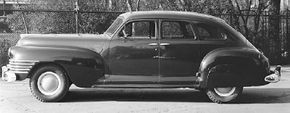
![]() The 1942 Chrysler New Yorker was one of the last cars produced that year, before Chrysler shifted all its production to the war effort. |
Eights began with the new Traveler, New Yorker, and Saratoga on a 128.5-inch span (the last two also offered formal sedans). A 145.5-inch chassis carried Crown Imperial sedans and limousine. The eight now delivered 135-143 bhp, the six produced 108 or 112 bhp.
Two striking show cars from LeBaron (by then owned by Briggs Manufacturing, Chrysler's longtime body supplier) appeared during 1940; six of each were built. The Newport, designed by Ralph Roberts, was an Imperial-based dual-cowl phaeton with "melted-butter" streamlining. It paced the 1941 Indianapolis 500. The Thunderbolt, penned by Briggs' Alex Tremulis and built on the New Yorker chassis, had even sleeker flush-fender styling, plus a three-person bench seat and a novel, fully retracting hard top. Both cars hid their headlamps behind metal doors, a preview of 1942 DeSotos.
The most-interesting 1941 Chrysler was Dave Wallace's unique Town & Country, the make's first station wagon. Unlike other period "woodies," this one was fairly graceful -- and functional, with "clamshell" center-opening rear doors. Riding the Royal chassis, the T&C offered six- or nine-passenger seating for a remarkably low $1412/$1492. Still, only 997 were built for the model year, mostly the nine-seat type. A new variation on the familiar four-door was the attractive 1941 Town Sedan. Available in each series, it bore rear-roof quarters sans side windows, plus front- instead of rear-hinged back doors.
Wheelbases were trimmed an inch for all '41 Chryslers save Crown Imperials. Grilles became simpler, taillamps more ornate. The Traveler departed, but Saratogas expanded to include club and business coupes, two- and four-door sedans, and Town Sedan.
Several interesting new upholstery choices arrived: Highlander, a striking combination of Scots plaid and leatherette; Saran, a woven plastic and leatherette created for certain open models; and Navajo, a pattern resembling the blankets of those Southwest Indians. The year's main new technical gimmick was optional "Vacamatic" transmission, a semiautomatic with two Low and two High gears; you shifted only to go between the ranges. Vacamatic was combined with Fluid Drive (introduced in '39), which allowed the driver to start and stop without using the clutch.
A major facelift achieved a smoother look for '42 by wrapping the horizontal grille bars right around to the front fenders. A sleeker hood opened from the front instead of the sides, and running boards were newly hidden beneath flared door bottoms. Highlander Plaid returned along with a new upholstery option called Thunderbird, also inspired by Indian motifs. Town & Country was upgraded to the Windsor chassis. Increased bore brought the six to 250.6 cid and 120 bhp; the eight cylinder was offered only in a 140-bhp version.
Like other Detroit cars, Chryslers built after January 1, 1942 used painted metal instead of chrome trim per government order. For the same reason, Chrysler ended civilian production in early February 1942 for the duration of World War II. The division built only 5292 cars that calendar year and close to 36,000 for the model year. It then turned out anti-aircraft guns, Wright Cyclone aero engines, land-mine detectors, radar units, marine engines, and "Sea Mule" harbor tugs; tanks were its most famous wartime product.
When they could during the war, small teams of designers and engineers would work on ideas for postwar Chryslers -- largely smoother versions of the 1940-42 models with fully wrapped bumpers and grilles, thinner A- and B-pillars, and skirted rear fenders. But like most every other Detroit producer, Chrysler needed only warmed-over '42s to satisfy the huge seller's market that developed postwar, and that's what it offered through early 1949.
These cars wore less fender brightwork but a new eggcrate grille -- one of Detroit's shiniest faces. All prewar offerings returned save Crown Imperial sedans, and engines were slightly detuned.
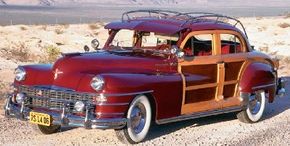
A more significant change involved the Town & Country, which was no longer a wagon but a separate series of six- and eight-cylinder sedans and convertibles. Chrysler had promised a full line of nonwagon T&Cs, including a two-door brougham sedan and even a true roadster and a hardtop coupe. But only a handful of each were built, all basically prototypes. Hardtops, numbering just seven, were created by grafting an elongated coupe roof onto the T&C convertible. All were built in 1946, a good three years before General Motors began making sales hay with "hardtop convertibles." The eight-cylinder T&C sedan was dropped after '46 and just 100 copies.
For more on the amazing Chrysler, old and new, see:
1947, 1948, 1949 Chryslers
Postwar inflation pushed prices up dramatically. For example, a Royal business coupe that had cost a little more than $1000 in 1942 was over $1400 in '46. Prices would continue rising through decade's end, when a Crown Imperial went for nearly double its 1940 figure. Even so, Chrysler ranked among the top-10 in industry production for 1947-48.Only detail alterations occurred for 1947: fender trim, wheels/hubcaps, colors, carburetion, instruments, plus low-pressure Goodyear "Super Cushion" tires. The Traveler name returned for a luxurious Windsor utility sedan with special paint and interior and an attractive wood luggage rack. Unlike DeSoto's similar Suburban, it had a separate trunk instead of fold-down triple seats and wood rear floorboards. Also making a belated comeback was the eight-passenger Crown Imperial sedan.
![]() The 1947 Chrysler Town & Country was one of Chrysler’s best sellers in the years following World War II. |
Chrysler planned a redesigned Silver Anniversary line for late '48, but ran into delays. Thus, existing models -- save the ragtop T&C -- were sold through March 1949 at unchanged prices, though none of these "first-series" '49s were built in that calendar year. Though streamlined styling with integral, skirted fenders had been considered for the all-postwar "second-series" '49s, Keller insisted on bolt-upright bodies with vast interior space. He got them, but with some loss in sales appeal. Output fell to some 124,200 for model-year '49, and Chrysler slipped back to 12th in the industry race.
Overall, the '49 Chryslers were ornate, with massive chrome-laden grilles, prominent brightwork elsewhere, and curious vertical taillights except on Crown Imperials (which were spared the gaudy devices). Gimmicky names were used for certain desirable features: "Safety-Level Ride," "Hydra-Lizer" shock absorbers, "Safety-Rim" wheels, "Full-Flow" oil filter, "Cycle-Bonded" brake linings.
Wheelbases were generally longer. Royals and Windsors now spanned 125.5 inches, though a 139.5-inch chassis continued for long models. Saratogas, New Yorkers, convertible T&C, and an Imperial sedan got a 131.5-inch chassis; Crowns remained at 145.5. Engines were largely unchanged.
Chrysler-based customs were still around in the late '40s, many built by Derham of Rosemont, Pennsylvania. In 1946-48 Derham offered a Crown Imperial town limousine, as well as numerous one-offs such as a dual-cowl Imperial phaeton and a New Yorker coupe that resembled a Lincoln Continental with a Chrysler front end. Derham also tried the padded-top treatment on a handful of '49 New Yorker sedans. Chrysler itself built custom formal sedans, and A.J. Miller of Ohio did a long-wheelbase limousine/hearse. Wildest of all was a promotional 1946-48 New Yorker parade car done up as a giant Zippo lighter.
Chrysler entered the '50s as a lower-medium-price make with seven series and 24 models. By 1959 it was an upper-medium line with 15 models spanning four series. Styling and engineering improved rapidly, and the dowdy L-head cars of 1950 gave way to exciting high-performance machines by mid-decade. Chrysler also had some of the best-looking tailfins of the age.
Those fins, which premiered as tack-ons for '55, were the work of Virgil M. Exner, who came from Studebaker to head corporate styling in 1949. Exner favored "classic" design elements: upright grilles, circular wheel openings, rakish silhouettes. But the practical, boring boxes of K.T. Keller (then preparing for retirement) weren't selling, and before Exner could get out anything completely new, Chrysler Division's yearly volume had dropped from 180,000 to barely 100,000.
For more on the amazing Chrysler, old and new, see:
The Chrysler Hemi Engine
Predictably, the 1950 Chryslers were repeats of the all-new postwar '49 models save the usual trim shuffles and a broader chrome eggcrate smile. A Deluxe Imperial sedan with custom interior was added, but the big news was Chrysler's first volume hardtop coupe. Called Newport, it was offered as a Windsor, New Yorker, and wood-trimmed Town & Country (the last replacing the convertible).Six-cylinder Royals were in their last year for 1950, selling for $2100-$3100. The T&C was no longer needed to glamorize an unglamorous group of cars as it had done in the early postwar period. After '50, T&C would apply only to station wagons. Before leaving, the Town & Country hardtop would pioneer a form of four-wheel disc brakes. Unlike later systems, this one employed two discs expanding inside a drum.
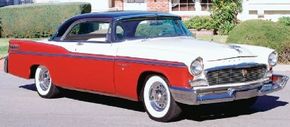
![]() The 1956 Chrysler New Yorker was powered by the now-legendary Hemi engine, offering unprecedented performance and boosting Chrysler’s image. |
With one singular exception, Chryslers didn't change much from 1951 through '54. Wheelbases stayed the same throughout, as did basic styling, though a more conservative grille marked the '51s. The '52s were all but identical; the firm didn't even keep separate production figures. Taillights are the only way to tell them apart: the '52s had built-in backup lamps. The '53s gained slightly bulkier lower-body sheetmetal, more chrome, and one-piece windshields. The '54s were a little "brighter" still. Body and series assignments also stood pat, though 1953-54 brought a revived Custom Imperial line with sedan and limousine on a 133.5-inch wheelbase, plus a standard-length Newport.
The above-mentioned exception was 1951's new hemispherical-head V-8, Chrysler's greatest achievement of the decade. Highland Park's early-'50s styling may have been bland, but its engineering was still anything but. The brilliant "Hemi" was simply the latest example.
Still, the Chrysler six had long dominated division sales, so its complete disappearance after 1954 surprised some. But it was part of a plan instigated by Keller's successor, Lester Lum "Tex" Colbert. Then, too, the Hemi left fewer buyers for the six: well over 100,000 in 1950, but only some 45,000 by '54.
Colbert took over as company president in 1950 with several goals. The main ones were decentralized division management, a total redesign for all makes as soon as possible, and an ambitious program of plant expansion and financing. Giving the divisions freer reign meant that people close to retail sales would have more say in mapping policy.
The Hemi polished Chrysler's image in a big way, and quickly spread to other company nameplates. First offered on the '51 Saratoga, New Yorker, and Imperial, it wasn't really a new idea, but it did have exceptional volumetric efficiency and delivered truly thrilling performance. Despite lower compression that allowed using lower-octane fuel than most other postwar overhead-valve V-8s, the Hemi produced far more power for a given displacement.
And it had plenty of power even in initial 331-cid form. An early prototype recorded 352 bhp on the dynamometer after minor modifications to camshaft, carburetors, and exhaust. Drag racers would later extract up to 1000 bhp.
But the Hemi was complex and costly to build, requiring twice as many rocker shafts, pushrods, and rockers; heads were heavy, too. All versions were thus phased out by 1959 in favor of more-conventional "wedge-head" V-8s. But the Hemi was too good to lose, and it would return in Highland Park's great midsize muscle cars of the '60s.
Of course, the Hemi made for some very hot Chryslers in the '50s. By dint of its lighter Windsor chassis, the Hemi Saratoga was the fastest in the line up to 1955, able to scale 0-60 mph in as little as 10 seconds and reach nearly 110 mph flat-out -- straight from the showroom. Bill Sterling's Saratoga won the Stock Class and finished third overall -- behind a Ferrari -- in the 1951 Mexican Road Race.
Chryslers also did well as NASCAR stockers, but were eclipsed by Hudson's "fabulous" Hornets in 1952-54. However, millionaire Briggs Cunningham began building rakish Hemi-powered sports cars for European road races, and his C-5R ran third overall at Le Mans '53 at an average of 104.14 mph (against 105.85 mph for the winning Jaguar C-Type).
Then came Chrysler's own mighty 1955 C-300 packing a stock Hemi tuned for 300 bhp -- the most ever offered in a regular-production U.S. car. The 300 dominated NASCAR in 1955-56, and might have continued to do so had the Automobile Manufacturers Association not agreed to de-emphasize racing after 1957.
For more on the amazing Chrysler, old and new, see:
1955, 1956, 1957, 1958, 1959 Chryslers
The Chrysler 300 was part of the all-new Exner-styled '55 line that cost $100 million to develop, hence the "Hundred Million Dollar Look" advertising hype. But it was worth the expense, boosting model-year volume to over 150,000 units and bringing appearance up to par with performance at last. Evolved from an early-'50s series of Exner-designed, Ghia-built Chrysler "idea cars," the '55s were clean and aggressive-looking on a slightly longer 126-inch wheelbase. Windsor DeLuxe was treated to a new 301-cid Hemi with 188 bhp. New Yorker retained a 331 rated at 250 bhp.![]() The 1957 Chrysler New Yorker carried the first Detroit-built V-8 engine to achieve 1 horsepower per cubic inch. |
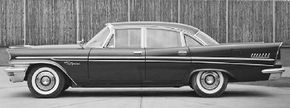
Exner's work was never better than on the '57 Chryslers: longer, much lower, wider, and sleeker, with modest grilles and graceful fins. They still look good today. That year's 300C was breathtaking: big and powerful yet safe and controllable -- and offered as a convertible for the first time. A unique trapezoidal grille set it apart from other models.
Supplementing Newport hardtops for 1955-56 were the Windsor Nassau and New Yorker St. Regis, conservatively two-toned and boasting slightly ritzier interiors than standard Newports. Neither returned for '57, but the previous year's Newport hardtop sedans, a hasty answer to GM, would carry on well into the '70s. The '57 Town & Country wagons, Windsor and New Yorker, seated six, but could hold nine from 1958 on via a novel, optional rear-facing third seat.
Saratoga returned as Chrysler's midrange '57 series and promptly sold more than 37,000 copies. It again offered a performance premium in its 295-bhp, 354-cid Hemi. Windsors boasted 285 horses. New Yorkers moved up to an enlarged 392 with 325 bhp; in the 300C this engine delivered an incredible 375 or 390 bhp. Nobody ran the period "horsepower race" better than Chrysler.
The division had merely caught up in the "transmission race" with fully automatic two-speed PowerFlite, which bowed in late 1953 to replace semiautomatic "Fluid Drive." But Chrysler pulled ahead in mid-'56 by adding three-speed TorqueFlite, one of the finest automatics ever built. Also that year, both transmissions switched to the now-famous -- or infamous -- pushbutton controls, mounted in a handy pod to the left of the steering wheel. PowerFlite-equipped '55s used a slender wand to the right of the helm. Though this looked stiletto-lethal, it crumpled harmlessly on impact.
Chrysler's '57 styling was superb, but offering a second all-new design in three years led to hasty, sub-standard workmanship and a tendency to early body rust -- one reason relatively few of these cars survive today. A series of plant strikes didn't help. Even so, Chrysler moved close to 125,000 cars for the model year, down from the 128,000 of '56 but still good for 10th in industry production.
No discussion of Chrysler in the '50s is complete without mentioning "Torsion-Aire Ride," a corporate staple from 1957 until the early '80s. Packard had its excellent four-wheel "Torsion Level" system for 1955-56, so the idea wasn't really new. But Torsion-Aire was in far more driveways, and proved once and for all that American cars could be made to handle. Instead of sending road shock into the chassis or body like coil or leaf springs, torsion bars absorbed most of it by twisting against their mounts. Chrysler used them only at the front, likely more for engine-compartment space than improved geometry, but it complemented them with a conventional rear end specially calibrated to maximize the bars' effectiveness.
A deep national recession and continuing subpar quality made 1958 a terrible year for Chrysler Division. Volume plunged to less than 64,000, and the make dropped to 11th, still trailing Cadillac (as it had since '56). A mild facelift was generally not for the better except on the 300D, which was all but identical to the '57 C-model. Windsor gained a convertible, but was demoted to the 122-inch Dodge/DeSoto platform. Horsepower kept climbing. Windsors were up to 290 and Saratogas to 310, courtesy of 354-cid Hemis; New Yorkers packed 345 bhp and the 300D a rousing 380/390, all from 392s.
A more substantial restyle marked the "lion-hearted" '59s. Though arguably less graceful in appearance, they scored close to 70,000 sales in a mild Detroit recovery. The switch to wedge-head V-8s introduced a 383 with 305 bhp for Windsor and 325 for Saratoga; a bigger-bore 413 gave 350 in New Yorker and 380 bhp in the 300E. Though not as efficient as the Hemi, the wedge was much simpler and cheaper to build.
For more on the amazing Chrysler, old and new, see:
1960, 1961 Chryslers
The Chrysler 300E has been long chided as a weakling next to its Hemi-powered predecessors, but road tests said the 300E was just as quick as a 300D. With 10.1:1 compression, TorqueFlite, and 3.31:1 axle, the E could run 0-60 mph in under 8.5 seconds and reach 90 mph in 17.5. Even so, production was just 550 hardtops and a mere 140 convertibles, a record low that would stand until '63.![]() The 1961 Chrysler Newport retired its extravagant fins after this model year, leaving behind the styling cues of Virgil Exner. |
The 1960-61 models were the last of the outlandishly finned Exner-styled Chryslers and the first to employ full unit construction instead of traditional body-on-frame (even the old Airflow had body panels welded to a separate cage frame). Since "unibodies" were held together more by welds than nuts and bolts, they didn't suffer so much from looseness or rattles. But they were definitely more prone to rust -- as many a sad owner found out.
Stylewise, the 1960 Chrysler models were highly sculptured but as clean as the deft '57s. Chrome was tastefully handled, superstructures were glassy (especially windshields), and inverted trapezoid grilles conferred an aggressive 300-like appearance. Returning from '59 were optional swiveling front seats that pivoted outward through an automatic latch release when a door was opened.
Wheelbases and engines stood pat for 1960. The Saratoga was in its last year. Windsor would also depart for good, after '61. Top-liners were confined to six varieties of luxury New Yorker and the 300F. By decade's end, New Yorker regularly scored over 30,000 annual sales. Prices were just below Imperial's but about equal to those of the larger Buicks.
By far the most-exciting 1960 Chrysler was the sixth-edition "letter-series" 300 with a racy yet simple new "cross-hair" grille, four-place bucket-seat interior, road-hugging suspension, and newly optional French-made Pont-a-Mousson four-speed gear-box. The F rode hard, but cornered better than any other car of its size. And it was a flyer. New "ram-induction" manifolding lifted its 413 V-8 to 375 or 400 bhp, good for standing quarter-miles of 16 seconds at 85 mph. A half-dozen different axle ratios were available for even greater speed. With the 3.03 cog plus a tuned engine and some body streamlining, Andy Granatelli came close to 190 mph in one flying-mile run. The 300F wasn't cheap at $5411 for the hardtop and $5841 for the convertible, but it had a lot of style and sizzle.
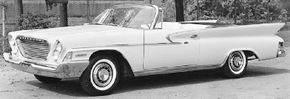
The '61 line was mostly a repeat of 1960 save somewhat more contrived styling. Windsor moved up to replace Saratoga; taking its place was a downpriced base series called Newport. The latter fast became the make's bread-and-butter, thanks to very competitive pricing of just under $3000 through 1964, a point repeatedly emphasized in Chrysler ads. By 1965, Newport's annual sales were exceeding 125,000. The '61 carried a 265-bhp 361 V-8; Windsor and New Yorker retained their previous engines. That year's 300G didn't offer the four-speed option, but returned to 15-inch wheels (versus 14s) for the first time since 1956.
Though Highland Park's fortunes were shaky in these years, Chrysler Division actually improved its volume and industry rank. After sinking to 12th with over 77,000 cars for 1960, it finished 11th on better than 96,000 units for '61.
Nevertheless, the company's general sales difficulties hastened a management shakeup that had an immediate effect on products. At the end of July 1961, a beleaguered "Tex" Colbert retired as president, a role he had resumed in 1960 when William Newberg quit the post after two months amid allegations of having financial interests in several Chrysler suppliers.
This ushered in former administrative vice-president Lynn A. Townsend, who then became chairman in January 1967, with Virgil Boyd as president through early 1970. These changes also prompted Exner, who was often blamed for the sales woes, to leave in late 1961 after shaping the '63 corporate line. His replacement was Elwood Engel, recruited from Ford and part of the design team on the elegant '61 Lincoln Continental.
For more on the amazing Chrysler, old and new, see:
1962, 1963, 1964, 1965, 1966, 1967, 1968, 1969 Chryslers
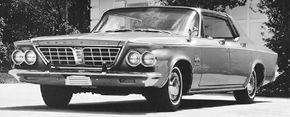
In 1962, Chrysler fielded what Exner called the "plucked chickens": basically '61s shorn of fins. The 1963-64s had "the crisp, clean custom look" -- chiseled but chunky. For 1965 came Engel's smooth, squarish bodies with fenders edged in bright metal, one of his signatures.Among the finless '62s was a new four-model group of "non-letter" 300s: convertible, hardtop coupe, and four-doors with and without B-pillars. All carried the same engine as the now-departed Windsor and could be optioned with sporty features like center console and front bucket seats. Save the pillared sedan (only 1801 built, all for export), these Chrysler 300s were quite popular at prices in the $3300-$3800 range. But they hurt that year's 300H, which cost $1600-$1800 more yet looked almost the same. As a result, letter-series volume dropped from about 1600 for '61 to just 558.
![]() The Chrysler New Yorker underwent a wheelbase reductionfor model year 1963, down to 122 inches. See more pictures of Chrysler cars. |
The Salon came with such standard luxuries as air conditioning; AM/FM radio; "Auto Pilot" speed control; power brakes, steering, seats, and windows; TorqueFlite; and color-keyed wheel covers and vinyl roof. Minus the Pace Setters, this lineup repeated for '64 with largely untouched engines and styling.
The 1963-64 300J/300K (the letter "I" was skipped to avoid confusion with the number "1") were big, solid performance cars in the letter-series tradition. The J came only as a hardtop; the convertible was reinstated with the K. Just 400 Js were built in all, a record low for Chrysler's limited edition, but the K saw a healthy 3600-plus. All ran 413s with 360/390 bhp, down slightly from 300H ratings. The last of the true letter-series cars was the 300L of 1965. It saw 2845 copies, including a mere 440 convertibles. None of these were quite the stormers that previous 300s were, but they remained the most roadable Chryslers and among the best handling of all big Detroiters. Sales lost to the non-letter 300s is what killed them, of course.
Chrysler did very well for 1965, selling over 125,000 Newports, nearly 30,000 non-letter 300s and almost 50,000 New Yorkers. Things were even better for '66: the 300 nearly doubled and Newport climbed by 42,000 units.
The post-1964 Engel Chryslers were shorter than their Exner forebears but just as spacious inside. Wheelbase was 124 inches for all models except wagons (121 through '66, then 122 inches). Expanding the '67 line were the Newport Custom two- and four-door hardtops and four-door sedan. Tagged some $200 above comparable standard Newports, Customs were trumpeted as "a giant step in luxury, a tiny step in price."
Deluxe interiors were the big attraction: jacquard cloth and textured vinyl, plus pull-down center armrests. Like other '67 Chryslers, the Custom dash sprouted no fewer than eight toggle switches, three thumbwheels, 16 pushbuttons, three sliding levers, and 12 other assorted controls. Vinyl-covered lift handles appeared on Custom trunklids, and there were "over 1000 chrome accents along the sides, plus 15 gold crown medallions."
Meanwhile, the luxurious New Yorker Town & Country wagon disappeared after 1965 (sales had been slow for years), but six- and nine-passenger Newport wagons continued through '68, after which T&C became a separate wagon series. All typically came with vinyl upholstery instead of the cloth-and-vinyl of Newport sedans.
Spring 1968 brought the interesting $126 "Sportsgrain" option: wagon-type simulated-wood side paneling for the Newport convertible and hardtop coupe. It didn't catch on and thus was dropped after '69. Sportsgrain convertibles must be rare indeed, as Chrysler built only 2847 total ragtop Newports for '68. More popular that year were the added Newport Special two- and four-door hardtops with a turquoise color scheme, later extended to 300s.
Engine choices for '65 involved 270- and 315-bhp 383s for Newport and 300, a 413 with 340 or 360 bhp for New Yorker and 300L. The more-potent 383 gained 10 horses for '66, when a huge 440 big-block arrived as standard New Yorker fare, rated at 350 bhp. The 300s adopted it for 1967, when a 375-hp version was added. The 440s stood pat for 1968-69, but the 383s were retuned to 290 and 330 bhp, this despite the advent of federal emissions standards.
These moves and the conservative Engel styling paid off in vastly higher volume: 206,000-plus for '65, nearly 265,000 the following year. Though sales dipped to some 219,000 for '67, Chrysler ran 10th in industry output in each of these years, then claimed ninth with 1968 production that just topped the '66 record.
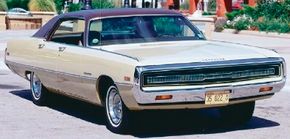
The all-new "fuselage-styled" '69s did almost as well. If not the most beautiful Chryslers of the decade, they were at least handsome with their great looping bumper/grille combinations, fulsome bodysides, and low rooflines. Despite remaining on the 124-inch wheelbase, all models were bigger than ever: almost 225 inches long and nearly 80 inches wide -- about as big as American cars would ever get.
For more on the amazing Chrysler, old and new, see:
The Chrysler Corporation Restructures
Chrysler models in the 1970s changed only in detail, but midyear, Chrysler introduced the first Cordobas: a Newport hardtop coupe and sedan with paint, vinyl roof, bodyside moldings, wheels, and grille all colored gold, plus unique "Aztec Eagle" upholstery. A well-equipped Newport 440 hardtop also arrived with TorqueFlite, vinyl roof, and other extras as standard.![]() The Chrysler 300 made a brief return in the early 70s, with the 300-H. The “H” stood for Hurst, who was responsible for the shifter used on the car’s TorqueFlight automatic transmission. |
Vast changes in corporate administration were evident by 1969-70. Quality control had become an end in itself as engineers struggled to correct Chrysler Corporation's poor reputation in that area. On the administrative side, Townsend had consolidated Colbert's old decentralized structure and moved to strengthen divisional identities between Dodge and Chrysler-Plymouth. Still, the firm would travel a very rocky road in the '70s.
The Chrysler brand stayed with its basic 1969-70 formula through 1973. Style variations through '72 came via easy-change items that became a bit tackier with time. The '73s gained blockier lower-body sheet metal and a more-conventional front, with bigger bumpers per federal requirement.
New for '71 was a low-priced Newport Royal subseries with standard 255-bhp 360 V-8, an enlarged version of the corporate small-block engine introduced in the mid-'60s. A stroked 400-cid version of the 383, more adaptable to emissions tuning, replaced it for '72, then disappeared with the 360 and all Royal models.
Other Chryslers relied on the 440 with added emission controls that sapped power, which was down to 215 bhp by '73 -- though that was in more-realistic SAE net measure, not the old gross rating. A popular new addition for '72 was the New Yorker Brougham: two hardtops and a sedan with lusher interiors and a $300-$400 price premium over the standard issue.
Overall, Chrysler did fairly well in this period. Sales fell to around 177,000 for 1970-71, but recovered to nearly 205,000 for '72, then to 234,000-plus. Nevertheless, Chrysler still couldn't seem to beat Cadillac, trailing GM's flagship every year in 11th place.
Sales sank mightily in the wake of the first energy crisis despite a completely redesigned crop of 1974 models, still on a 124-inch wheelbase but about five inches shorter than the "fuselage" generation. Styling was crisper but more slab-sided, announced by pseudo-classic square grilles, a period fad that Chrysler had studiously avoided before.
Engine options and horsepower were down: 185/205-bhp 400 V-8s for Newport and Newport Custom, 230/275-bhp 440s for T&C wagons, New Yorker, and New Yorker Brougham. The last was now quite like the Imperial, which was again being marketed as a Chrysler but was still registered as a separate make. After '75, Imperial actually became a Brougham via the badge-engineering so long practiced by Chrysler -- to the confusion of customers up and down the corporate line.
Few in Highland Park had foreseen the energy crisis, which only accelerated the buyer resistance to big cars that had been building as a result of galloping sticker prices. Sales of the record-priced 1974s dropped to 1970 levels, and a two-month backlog quickly piled up, yet chairman Townsend refused to slash prices. Instead, he slashed production.
By early November 1974, corporate sales were down 34 percent -- not as bad as GM's 43 percent loss, but more serious, as Chrysler's fixed costs were spread over much smaller volume. The results were employee layoffs and an unsold inventory of 300,000 units by early 1975.
Finally, Chrysler offered something no one in Detroit ever had: cash rebates -- essentially paying people to buy. Other automakers had little choice but to follow. It amounted to throwing money away in an attempt to lose less on the balance sheets, but it was a necessary, if drastic, step. That big backlog cost Chrysler $300,000 a week.
For more on the amazing Chrysler, old and new, see:
Lee Iacocca Arrives at Chrysler
Sharp reversals in the car industry prompted a complete rethink that must have seemed quite alien for Chrysler, a company that had solemnly promised never to build a smaller car. But a new philosophy was emerging that echoed some 1958 remarks of then-outgoing president K.T. Keller, who suggested Chrysler should "get back to design for function, with more stress on utility."![]() The 1975 Chrysler Cordoba reflected a new direction for Chrysler: the small car. On a 115-inch wheelbase, it was smaller than any other current Chrysler. |
Cordoba was billed as "the new small Chrysler," which it was, and something of a road car, which it wasn't despite standard antiroll bars and steel-belted radial tires. Reflecting its true character were interiors upholstered in crushed velour or vinyl with brocade cloth. "Fine Corinthian leather," extolled on TV by actor Ricardo Montalban, cost extra.
Save higher prices, the rest of the line was little changed for 1975-76. The accent was now strictly on luxury with a modicum of "efficiency" thrown in. The opulent New Yorker Brougham boasted standard leather, velour, or brocade upholstery, plus shag carpeting, "test-tube" walnut appliques, and filigree moldings. Economy, such as it was, got a little help from numerically lower axle ratios and a new "Fuel Pacer" option -- an intake manifold-pressure sensor hooked to a warning light that glowed during heavy-footed moments.
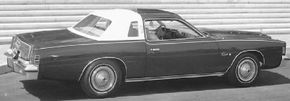
Chrysler fielded something even smaller for 1977: the mid-size, 3500-pound, M-body LeBaron. Cleanly styled in the boxy Mercedes idiom on a 112.7-inch wheelbase, it came in standard and upmarket Medallion trim as either a coupe or four-door sedan. Despite its origins in the workaday A-body Dodge Aspen/Plymouth Volare compacts, it sold quite well, providing timely sales assistance in a market again clamoring for smaller cars. The full-size line was mildly facelifted, and Newport Custom departed. Cordoba soldiered on in two little-changed models.
LeBaron got greater emphasis for 1978 with the addition of downpriced S versions and a brace of Town & Countrys, the latter replacing full-size Chrysler wagons. All offered 90- and 110-bhp versions of the hoary 225-cid "Slant Six" as alternatives to optional 140- and 155-bhp 318-cid V-8s. The slow-selling full-sizers were further reduced by dropping pillared four-doors. The 440 V-8 was still available for them, but most were ordered with the standard 400. LeBaron had bowed with square headlamps newly approved by Washington. Cordoba now got them, too.
For 1979, Chrysler issued downsized big sedans on a 118.5-inch wheelbase: six and V-8 Newport and V-8-only New Yorker and New Yorker Fifth Avenue. Built on the firm's 1971-vintage intermediate platform, these ostensibly "new" R-body models were considerably smaller and lighter than the old mastodons, but still looked big and heavy -- which they were.
Sales were underwhelming: about 133,000 in a record Detroit year. The LeBaron line now listed base, Medallion, and new midrange Salon models plus woody-look T&C wagons, none substantially altered. Reviving the spirit of the great letter-series 300 was a midyear option group for Cordoba comprising unique trim, bucket seats, cross-hair grille, and a 195-bhp 360-cid V-8.
By this point, a gathering financial crisis was threatening Chrysler Corporation's very existence. But help was already onboard in the person of newly named chairman Lee A. Iacocca, the recently ousted president of Ford who'd arrived in late 1978. He arrived none too soon. Not only was Chrysler near bankruptcy, it was in "a state of anarchy," as laccoca wrote later in his best-selling autobiography. "There was no real committee setup, no cement in the organizational chart, no system of meetings to get people talking to each other…I took one look at the system and almost threw up. That's when I knew I was in really deep trouble."
"Chrysler had no overall system of financial controls," he said. "Nobody in the whole place seemed to fully understand what was going on when it came to financial planning and projecting. I couldn't find out anything. I already knew about the lousy cars, the bad morale, and the deteriorating factories. But I simply had no idea that I wouldn't even be able to get hold of the right numbers so that we could begin to attack some basic problems."
For more on the amazing Chrysler, old and new, see:
Lee Iacocca Reverses Chrysler's Poor Sales
New products to answer some of Chrysler's problems were nearing completion when Iacocca came in; others were further away. None would have appeared without the federal loan guarantees Iacocca managed to coax from a reluctant United States Congress in mid-1980.For the Chrysler line, this situation dictated a holding action for 1980-81, though with a few game attempts at something different. Prime among the latter was a second-generation Cordoba, a crisply reskinned LeBaron coupe on the same 112.7-inch wheelbase. It was a fair success its first year at some 54,000 units, but annual volume then fell to less than half of that through '83, after which Cordoba said adios.
![]() The 1985 Chrysler Executive Limousine lasted only a few short years, with most of its sales going to hotel and airport limousine services. |
The big R-body Newport/New Yorker provided little sales help in this period, and was dropped after much-reduced 1981 volume of fewer than 11,000 (including a high proportion of taxi and police sales). A much happier fate awaited the M-body LeBaron, which also looked terminal but would run a good deal longer. It was facelifted for 1980 with bolder grilles, more-sharply creased fenders and, save wagons, blockier rooflines. Making room for the downsized Cordoba, LeBaron coupes moved to the 108.7-inch Aspen/Volare wheelbase and gained a more close-coupled look.
What ultimately prolonged this design appeared as a mid-1980 special called LeBaron Fifth Avenue Edition, a loaded four-door with throwback styling in the image of the like-named R-body New Yorker. When the latter was canceled and a new front-drive LeBaron instituted for '82, this one model, kept on as a "downsized" New Yorker, showed increasing sales strength as the market recovered from its early-decade doldrums. By 1984, it was simply Fifth Avenue and up to over 79,000 produced -- a figure that neared 110,000 the next year. Remarkably, the Fifth Avenue was still bringing in over 70,000 orders per year as late as 1987.
There was no mystery in this. A lot of folks still craved traditional rear-drive American luxury. This one offered plenty of standard amenities at attractive prices that began around $13,000 and finished the decade only some $5000 higher. Yes, the Fifth Avenue was terribly outmoded by 1989, but as tooling costs had long been amortized, Chrysler could keep prices reasonable (despite pressures to the contrary), which hardly dampened demand. In all, this car was a pleasant surprise success for Chrysler.
Meanwhile, Iacocca presided over a remarkable resurgence that put Chrysler Corporation solidly back in the black by 1983. The company even paid all its creditors ahead of time, without ever resorting to federal backup. The return to prosperity came almost entirely on clever -- and seemingly endless -- permutations of the front-wheel-drive K-car compact, introduced for 1981 as the Dodge Aries/Plymouth Reliant. Chrysler versions followed for '82; by decade's end they'd constitute virtually the entire line.
First up were smaller LeBarons: base and Medallion coupes and sedans on the 99.9-inch K-car wheelbase. Power came from Chrysler's own newly designed 2.2-liter (135-cid) single-overhead-cam four or an optional 2.6-liter "balancer" four supplied by longtime Japanese partner Mitsubishi. A turbocharged 2.2 spinning out 142-146 bhp arrived for '84 and was relatively popular.
Replacing the old M-body LeBarons, these "CV" models were joined at mid-1982 by a woody-look Town & Country wagon and America's first factory convertibles since the mid-'70s. The latter can be fairly credited to Iacocca and were a brilliant stroke, offered in plain and nostalgic T&C trim.
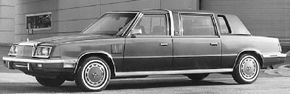
Iacocca also issued CV-based long models recalling the 1940s and '50s. These comprised a five-passenger Executive Sedan on a 124-inch wheelbase and a seven-seat limousine on a 131-inch chassis -- the first "carriage trade" Chryslers since the last Stageway Imperial limousines of 1970. They sold in modest numbers through 1986, mainly to fancy hotels and airport limo services. Chrysler then gave up on them as just so much bother.
The CV LeBarons continued through 1986 with only minor styling and mechanical changes. A stroked 2.5-liter (153-cid) engine with 100 bhp became available that season, a year after TorqueFlite automatic was made standard and the five-speed manual transmission was dropped. The line quickly established itself as Chrysler's top period seller, garnering around 100,000 orders annually. The notchback four-door and T&C wagon lasted through 1988.
Next in the line of K-based Chryslers was a stretched four-door, originally named "Gran LeBaron" but announced for 1983 under the prosaic title of E-Class, a reference to its E-body platform. Though riding a three-inch longer wheelbase, the E-Class was much like the CV LeBaron save revised rear-quarter styling, a roomier back seat, and slightly higher prices. But it failed to catch on -- at least as a Chrysler product. After 1984 and some 80,000 examples, it was badge-engineered into Plymouth and Dodge models that sold somewhat better as "new-age" family cars.
For more on the amazing Chrysler, old and new, see:
The Chrysler New Yorker and Chrysler LeBaron
A more-successful spinoff was the first front-drive New Yorker. Bowing at mid-1983, this was an E-Class with more class -- or what passed for it at the time. Taking a cue from Fifth Avenue sales, stylists gave the E-body a blind-quarter padded vinyl roof, a more-upright vertical-bar grille, extra chrome accents, even "opera lamps" (a '70s throwback).There was also a more-uptown interior with Mark Cross leather upholstery (introduced with the LeBaron convertible) and high-tech tricks like an irritating Electronic Voice Alert, a "back-seat driver" with a synthesized voice that nagged you from within the instrument panel when your "key is in the ignition" or "a door is ajar." New Yorker wasn't the only Chrysler afflicted by this ill-conceived device, which was soon dropped anyway. The car itself lasted longer, generating some 60,000 sales through 1987, after which it departed for a more-impressive New Yorker.
![]() The 1985 Chrysler LeBaron GTS appealed to the baby-boomer generation, capitalizing on a preference for European-style sedans. |
But it may have been a little much for most Chrysler types, because the Daytona always outsold it. As Dodge was reasserting its claim as the corporation's "performance" division, Chrysler-Plymouth dealers lost the Laser after 1986, though they got something more salable to replace it.
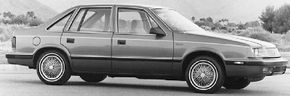
GTS, a 1985 addition, was a very different LeBaron: a smooth hatchback four-door aimed at America's increasingly affluent baby-boomers and their growing preference for premium European sedans. As usual, there was a duplicate Dodge, the Lancer. Both shared the same new H-body and the usual K-car underpinnings on a 103.1-inch wheelbase. Available engines were the now-familiar assortment of Chrysler-built four-cylinder units teamed with five-speed overdrive manual and TorqueFlite automatic transaxles.
Though no threat to the likes of BMW and Mercedes, the LeBaron GTS was a competent all-around tourer, surprisingly roomy and quite versatile (like Laser, its back seat folded down for extra cargo space). Over 135,000 found buyers in the first two years at base prices running $9000-$11,000. Unfortunately, volume dropped by almost 50 percent for '87, reflecting tough competition from the popular new Ford Taurus/Mercury Sable. For 1989, GTS referred only to a top-spec 2.2 turbo model, the base and midrange offerings becoming just plain LeBarons.
As if buyers weren't already bewildered by so many LeBarons, Chrysler introduced two more for 1987: a new J-body coupe and convertible to replace the previous CV styles. Chrysler's design staff, under new chief Tom Gale, gave them rounded, GTS-type contours, a clean yet dignified hidden-headlamp nose, and a shapely tail with full-width light panel. From the rear, the coupe was nicely reminiscent of Studebaker's Avanti. The convertible looked great from any angle, especially with the top down.
Though the CV wheelbase was retained, the J-model's inner structure related more to Daytona than K-car. By now, corporate planners were seeking to reestablish Chrysler as their premium make, so there were no divisional doubles of these LeBarons. Instead, Chrysler gave up the Laser, and the Daytona continued as a Dodge exclusive. This strategy helped the Daytona less than the LeBaron Js, which got off to a strong sales start at nearly 83,500 units.
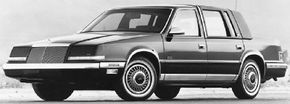
New Yorker figured in another name game for 1988: fully revised on the new 104.3-inch-wheelbase C-body platform shared with Dodge's Dynasty. There were no major chassis innovations at first, but there was a new engine: a smooth 136-bhp 3.0-liter (181-cid) Mitsubishi V-6 with electronic-port fuel injection (by now almost universal at Highland Park). Styling was clean but archly conservative -- really a cautious update of the Fifth Avenue and, again, reportedly dictated by chairman Iacocca himself.
Base and better-equipped Landau sedans (the latter with vinyl rear quarter-roof) were listed from around $17,500. A first for Chrysler was availability of antilock brakes, a $1000 option but worth every penny in peace of mind. Handling and performance were nothing special, but these were merely traditional luxury cars of a trimmer, more-efficient sort -- really, no bad thing to be.
And Chrysler made them better for 1989 with standard all-disc brakes and a new four-speed automatic transaxle that gave Highland Park another industry first with its fully adaptive electronic shift control. Other new features for the New Yorker nameplate's 50th year included options such as antitheft alarm system, power front seatback recliners, and two-position "memory" power driver's seat, plus a revised electronic instrument cluster.
For more on the amazing Chrysler, old and new, see:
Chrysler's TC by Maserati
Plymouth's new 1989 Acclaim compact implied an upscale Chrysler version. Sure enough, it arrived in January 1990 to take over for the departed LeBaron hatchback. A blocky "trunked" four-door with smoothed-off edges, it was essentially a gussied-up Acclaim that could pass as a pint-size New Yorker with optional bright trim, vinyl-roof toppings, and a standard 141-bhp V-6.The K-car's 2.2-liter four had grown to 2.5 liters and 100 bhp, and it was now standard for all '89 two-door LeBarons. The only option was a 150-bhp turbo version for LeBaron coupes and convertibles. Those J-body cars received a modernized dash for 1990. Designed by Trevor Creed, lately of Citroën, it was flashy, but less than ideal for ergonomics.
Also new for the Js was a 2.2-liter "Turbo IV" option with Chrysler's new Variable Nozzle Technology. Power was unchanged from the previous "Turbo II" (174 bhp), but VNT reduced throttle lag by optimizing exhaust-gas flow to the turbocharger with a set of radial vanes that could be angled by computer control according to throttle position and engine speed.
Symbolic of Chrysler's 1980s fortunes was its first-ever production two-seater. Awkwardly named Chrysler's TC by Maserati, it was first shown in mid-1986 (as the "Q-coupe") but was delayed by numerous problems to a late-1988 debut as an '89 model. Maserati, of course, is the well-known Italian sports-car maker in which Chrysler had lately acquired a minority interest, but its main role in this joint venture was simply to build Chrysler's design.
Almost too predictably, the TC was yet another K-clone: a shortened 93.3-inch-wheelbase version of that ubiquitous platform topped by a wedgy convertible body looking much like the open LeBaron J (though the TC was actually created first). Powerteams involved a special 200-bhp turbocharged 2.2 with intercooler, port injection, and a new Maserati-design 16-valve twincam cylinder head, available only with five-speed manual; and a single-cam 160-bhp "Turbo II" engine for buyers preferring three-speed automatic.
The customer's only other choice was paint color, since the TC was conceived as a fully equipped "one-price" model. Included were the expected leather upholstery and full power assists, but also all-disc antilock brakes, manual soft top with heated-glass rear window, and a removable hardtop (made of sheet-molding compound). The last had a nostalgic styling touch: rear-quarter portholes, recalling the '56 Thunderbird and the earliest days of Iacocca's career at Ford.
Despite all this, the TC bombed. Its similarity to the much cheaper LeBaron convertible was too obvious; and handling, refinement, and performance were undistinguished for a car of its price. Adding injury to insult, the announced $30,000 base sticker was hiked $3000 within three months. Thus did trade weekly Automotive News name the TC its 1988 "Flop of the Year," the same "honor" it accorded Cadillac's Allanté the previous year.
The 1990 edition was unchanged except for adding a wood-rimmed steering wheel with airbag and a 3.0-liter Mitsubishi V-6 to replace the Turbo II engine with automatic. Production soon ended at some 7300 total units. A few 1990s were retailed into '91, again at fire-sale prices.
Meanwhile, the old rear-drive M-body Fifth Avenue was finally retired for a new Y-body 1990 model, essentially the latest front-drive New Yorker stretched to a 109.3-inch wheelbase. Styling displayed the usual "formal" cues, though hidden headlamps were a nice change and there were gadgets galore. Under the hood sat a new Chrysler V-6: a 3.3-liter overhead-valve design with port injection and 147 bhp.
But the real surprise was yet another reborn Imperial, this one a more-deluxe Fifth Avenue measuring four inches longer (203 overall). An upright grille announced it, and the familiar Imperial eagle badges appeared on the tail and roof. But prices were stiff for what amounted to luxury K-cars: $21,395 for Fifth Avenue, $25-grand for Imperial.
Worse, both were narrower and less roomy than Cadillac's recently enlarged DeVille. And Chrysler charged extra for antilock brakes that Lincoln included on its Continental sedan. With all this, the Y-body twins were not huge sellers. The Fifth Avenue claimed a respectable 44,400 model-year sales, but Imperial managed fewer than 15,000.
There was a new Town & Country for 1990, the first in two years. To no one's surprise, it was a minivan. Chrysler had pioneered this concept with its '84 Dodge Caravan/Plymouth Voyager, and had kept sales roaring with useful yearly updates, especially the '87 introduction of extended "Grand" models on a spacious 119.1-inch wheelbase. With every minivan an easy sale -- and often loaded with profitable extras -- a luxury version was a logical addition to the Chrysler lineup.
The minivan T&C bowed as a single long-chassis model with numerous comfort and convenience features including leather interior. Base price was a bit startling at $25,000, but the only extras were whitewall tires and a front license-plate bracket. A vertical-bar grille and pseudo-wood bodysides distinguished T&C from less-costly Dodge/Plymouth minivans. The sole powertrain was a 150-bhp 3.3 pushrod V-6 and four-speed automatic, the latter a new option for Caravan/Voyager. Though model-year sales were modest at under 3500 units, Chrysler hoped for better T&C results in the future.
For more on the amazing Chrysler, old and new, see:
Robert Lutz Joins Chrysler
Chrysler's future was in doubt in 1990. Incredibly, Chrysler was again flirting with disaster in a market turned sour once more, but this time there was no question of a government rescue. Chrysler's latest woes were clearly of its own doing.They stemmed from a mid-'80s spending spree amid windfall earnings, mainly from minivans. Optimistically, Iacocca decided that if GM could acquire Hughes Electronics, Chrysler should buy its own aerospace company -- say, Gulfstream Aviation. Trouble was, Chrysler's purchase cost far more than GM's in relation to total assets, and Gulfstream ultimately proved of little direct benefit.
![]() The 1991 Chrysler Imperial’s sales figures stagnated, due in part to the recession that struck in 1990. |
As part of its 1980s "diversification," Chrysler split off its vehicle business as a separate Chrysler Motors unit in 1985. But this was an organizational indulgence, and it lasted only five years. In the meantime, the firm began losing the key executives who'd helped engineer its early-'80s comeback, the former Iacocca colleagues from Ford who'd been serving as presidents and chairmen of Chrysler Motors.
First to go was minivan "father" Harold Sperlich in 1988; financial whiz Gerald Greenwald and Bennett Bidwell resigned two years later. These departures ushered in Robert Lutz as president of Chrysler Motors in 1988. Three years later, he became overall president of a reunified Chrysler Corporation.
Lutz arrived in the nick of time. A knowledgeable "car guy" with top-level executive experience at Opel, BMW, and Ford Europe, he knew even better than Iacocca that consumer tastes had changed greatly and that Chrysler had to change with them -- fast. That not only meant more-contemporary, "international" vehicles but a whole new way of designing, building, and selling them.
With Iacocca's endorsement, Chrysler began shedding noncore businesses like Gulfstream while forming "cross-functional platform teams" charged with creating superior cars and trucks -- and getting them to market in three years or less instead of the usual four or five.
Under the "team concept," designers, engineers, production experts, and marketing talent would work together from day one to ensure their products were on target with buyers for features, cost, and quality. The idea was to minimize the delays, mistakes, confusion, and "turf battles" that often arise when people work on separate pieces of the same project.
The decision to produce the hot Dodge Viper sports car provided a timely opportunity to test the new approach on a manageably small scale. It worked beautifully, and the team concept was quickly adopted for all future-product programs. Chrysler also began forging closer alliances with its many suppliers by including them as members of the various teams.
With these and other departures from Detroit tradition, the company liked to say it was "reinventing" itself, hoping to become a "New New Chrysler Corporation" able to make timely, right moves to survive and even thrive in a now vastly changed automotive world. Toward that end, chairman Iacocca was finally persuaded to step down, something he'd resisted for years.
Though Lutz was the obvious heir apparent, Iacocca got in one last surprise by handing the job to Robert Eaton in early 1993. Eaton was a shrewd choice. He came directly from GM Europe, which had recently come back strong under his command, and his low-key manner made a nice contrast with the often outspoken Lutz. To his credit, Lutz agreed to stay on and give his all for the new chairman. They made a formidable team.
Of course, massive change doesn't happen overnight, so the early '90s were transition years for the Chrysler line. Existing models were kept on only until replacements were ready, which would be remarkably soon.
For more on the amazing Chrysler, old and new, check these out:
The Chrysler Concorde
Some of the old stuff was treated with "benign neglect." The Y-body, for example, vanished after 1993 and only two interim changes of note: a 3.8-liter V-6 for '91 (standard for Imperial, optional on Fifth Avenue) and a mild Fifth Avenue facelift for '92. Sales faded in both cases. Imperial dropped under 12,000 for '91, then to 7600 and a final 7000 or so.Fifth Avenue held up better, scoring no worse than just under 30,000 in its last model year. Still, against Cadillac and Lincoln, these cars were only a token luxury presence for the Chrysler brand, and in looks and driving feel they were about as modern as a leisure suit.
![]() The 1993 Chrysler Concorde introduced “cab forward” styling and ushered in the next generation of Chrysler vehicles. |
LeBarons were fiddled with during this period, but not drastically changed. The J-body line was rearranged for '91, then added optional antilock brakes for '92, when the A-body sedan expanded to base, LX, and Landau models. Two-doors got a nice facelift for '93, showing new grilles and exposed headlamps. Turbo engines were dropped, but the Mitsubishi V-6 was now standard for midline LX and sporty GTC coupes and convertibles.
At the same time, the LX sedan departed and the base model was renamed LE. Coupes and four-cylinder power disappeared for '94, leaving the two sedans and one GTC convertible with standard V-6. Only the ragtop returned for '95, after which the LeBaron name was finally put to rest (at least so far). Though sales declined with all models, the J-body two-doors fared a little better.
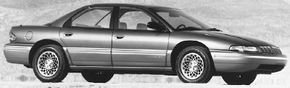
Heralding Chrysler's next generation was the front-drive Concorde sedan, the 1993 replacement for the C-body New Yorker. Though billed as an intermediate car, it was really a full-size, standing nearly 17 feet long on a rangy 113-inch wheelbase. All-independent suspension and no-cost antilock brakes recalled Chrysler's glory days. So did appearance.
With its new "LH" platform (still a "unibody," of course), Concorde introduced "cab forward" styling that made for vast interior space and a sleek, even daring, new look -- a refreshing break from boxiness. For the first time in nearly 40 years, Chrysler could claim industry design leadership. Though Concorde's form was shared by divisional sisters Dodge Intrepid and Eagle Vision, Chrysler wisely made sure there were enough differences among the three to avoid the possibility of buyer confusion.
Essentially, cab-forward lengthened the greenhouse and pushed the wheels out closer to the car's corners, resulting in a stubby deck, foreshortened nose, and purposeful wide-track stance (though a longitudinal engine dictated lengthy front overhang). General design thinking had been moving in this direction, so cab-forward was not entirely new or unique to Chrysler. But nobody would it use more. In fact, cabforward was the company's new design signature.
Concorde bowed in a single, well-equipped model base-priced at $18,341. Included were front bucket seats, shift console, tachometer, dual airbags, full power assists, and other amenities. Power came from one of two V-6s. The pushrod 3.3 was standard, tuned for 153 bhp. Optional was a new 3.5-liter unit with dual-overhead camshafts, four valves per cylinder and 214 bhp. Both were mated with four-speed automatic transaxle. Key options included electronic traction control, a firmer "touring" suspension with performance tires, leather interior, and an innovative built-in child safety seat that flipped out from the rear backrest.
Though advertised as "the renaissance of the American car," Concorde was assembled in Canada, as Chrysler was obliged to note in fine print. It was just another sign that the auto world had become a small one after all.
The LH cars had been branded by some as the "Last Hope" for Chrysler's survival. Fortunately, they were the solid success the company needed. Concorde alone scored debut model-year production of 56,218, and its 1994 volume was nearly 86,000. The sophomore edition creeped up to $19,500, but gained the touring suspension as standard, revised transmission controls, eight more horses for the 3.3 engine, power steering that increased effort with road speed, and a power moonroof option. No big changes occurred for '95, though trim levels expanded to LX and posher LXi.
For more on the amazing Chrysler, old and new, see:
The Chrysler LHS and Chrysler Cirrus
Next on Chrysler's new-model menu were an LH-based New Yorker and a premium companion called LHS, arriving in spring '93 as the 1994 successors to the starchy Y-body Imperial/Fifth Avenue. Both rode the Concorde wheelbase but stretched nearly five inches longer overall, hence their internal designation "207."Styling was naturally in the wedgy cab-forward mold, but a more-orthodox face and upright rear roofline imparted formality without stuffiness. Graceful reverse-curve C-posts, allegedly inspired by late-'30s Bugattis, combined with a setback rear seat for near-limousine legroom.
LHS was the sporty version, aiming at affluent "boomers" with front buckets, shift console, leather interior, firmer touring suspension and less exterior flash. New Yorker was for more-conservative folks, delivering a front bench seat, column shift, cloth trim, relatively soft damping, and a little more outside chrome. Both models carried the twincam 3.5-liter V-6.
At just over $30-grand, the LHS was some $5000 above the new New Yorker, yet outsold it from day one. Combined volume was excellent at nearly 83,000 for debut '94, far above anything the Y-body had managed. Ads playfully admitted that some past Chryslers had been "barges" -- but not these two. Like Concorde, the LHS/New Yorker was taut and responsive on twisty roads, peppy enough, smooth and refined (save rather excessive tire noise) and, of course, eminently spacious. Not since the '50s had Chryslers changed so much in just one year -- or so much for the better.
The 207s carried into 1995 essentially unchanged. LHS added an optional power moonroof during the '94 run. New Yorker got a standard premium audio system and touring suspension for '95. But with sales still greatly favoring LHS, Chrysler decided to drop the New Yorker after a short 1996-model run, thus ending a veteran American nameplate after 57 eventful years.
A new link with Chrysler's past appeared on 1995 models, as the corporate pentastar gave way to the make's original "rose" emblems, revived after a 41-year absence. It was a pleasant surprise, but no less so than that year's new Cirrus, the cab-forward replacement for the A-body LeBaron sedan. Once again, Chrysler played fast and loose with semantics, labeling Cirrus a compact even though dimensions were close to intermediate and even full-size. A 108-inch wheelbase, for example, put Cirrus just 2.8 inches shy of a Buick Park Avenue or Oldsmobile Ninety-Eight. Its overall length of 186 inches wasn't that "compact," either.
All this made Cirrus relatively vast inside, and it looked even bolder than bigger cab-forwards, though not everyone liked the low, jutting, vertical-bar grille. What people did approve was the taut, assured handling of its new wide-stance "JA" platform, again with all-independent suspension, standard antilock brakes and speed-variable power steering. The powerteam sat transversely here, and four-speed automatic was again mandatory. The only engine for '95 was a Mitsubishi-based 2.5-liter (152-cid) V-6, another twincam multivalve unit, good for 164 bhp.
This continued on the posh LXi but was optional for the '96 LX, which switched to a standard twincam four, a new Chrysler-designed 2.4-liter with 150 bhp. Both Cirruses were fully equipped with standard air conditioning, tilt steering wheel, good-quality sound system and power windows/mirrors/door locks. The LXi added power driver's seat in a leather-trimmed interior, remote keyless entry, and antitheft alarm, plus touring suspension with performance tires on alloy wheels. In all, Cirrus was another impressive new Chrysler -- and appealing value with base prices in the mid-to-high teens.
A rather different '95 newcomer was the Sebring coupe, a luxury edition of the year-old Dodge Avenger. Replacing the J-body LeBaron coupe, it wasn't technically an American car, as its foundation was the Japanese-designed 1994-98 Mitsubishi Galant sedan platform with 103.7-inch wheelbase.
But the snazzy two-door body was styled with Chrysler input, and the base LX model came with a Chrysler's own 2.0-liter four as used in the small 1994-95 Dodge/Plymouth Neon. (Mitsubishi's 2.5-liter V-6 featured in the uplevel LXi.) The Sebring coupe was also American-made, built exclusively for the U.S. market at the Illinois factory that Chrysler set up with Mitsubishi in 1989 as Diamond-Star Motors.
But sales were never impressive, even though Sebring coupes offered a good many standard features at affordable mid-teens to low-$20,000s prices. A shrinking coupe market didn't help, but neither did the few changes that occurred over five model years, the most visible being a modest 1997 facelift. As a result, calendar-year sales ran 25,000-35,000 through 1999, then plunged below 13,000.
For more on the amazing Chrysler, old and new, see:
Chrysler Sebring and Chrysler Town & Country
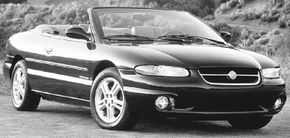
More successful was the Chrysler Sebring convertible that bowed in early 1996 to replace the drop-top LeBaron. Unlike the coupe, this Sebring was pure Chrysler, sharing powertrains and a basic platform with the Cirrus sedan. Here, too, cab-forward styling contributed to uncommon interior space, with genuinely comfortable rear seating for two adults, the best of most any affordable ragtop around.![]() The 1997 Chrysler Sebring added the “AutoStick” feature to its V-6 engines, allowing drivers to select gears manually, even with an automatic transmission. |
Though changed little more year-to-year than Sebring coupes, the convertibles sold better and more consistently, pulling in around 50,000 orders each calendar year through 2000. Like its LeBaron predecessor, a good many went to rental companies in sunbelt areas like Florida, Southern California, and Arizona, so Chrysler retained title to America's most-popular "rent-a-vertible." Among the few noteworthy changes in this period were the addition of a posh LXi Limited version for 1998 with leather-and-wood interior, chrome wheels, V-6, and AutoStick, and Sebring's first traction-control system.
Cirrus, too, seemed stuck in a time warp, its six-year run marked by annual equipment shuffles -- including a here today, gone tomorrow four-cylinder engine. An exception was the '99 edition, which sported a larger grille adorned with a broad winged badge in bright chrome, a new Chrysler-brand signature being phased-in throughout the line. Calendar-year sales see-sawed from the low to high 30,000s, a fairly lackluster showing for a mainstream sedan. The related Dodge Stratus did much better business, helped by lower prices and more-aggressive marketing.
We shouldn't forget Town & Country, if only because Chrysler Corporation had become the "minivan company" in more ways than one. Like sister Dodge/Plymouth models, the T&C got a smoother exterior and redesigned dash for '91, plus a standard driver's airbag and exclusive digi-graphic instrumentation (dubious at best). Optional all-wheel drive arrived for 1992, a boon for "snowbelt" mobility that attracted few orders. Only new-design wheels marked the '93s.
For '94, the optional 3.8 V-6 became standard and the dash was again modified to accommodate a no-cost passenger airbag. Chrysler also installed door guard beams per new federal rules for side-impact protection, and offered the industry's first integrated child safety seat at extra cost. T&C then carried into '95 with few other changes pending release of redesigned 1996 models. Though base price was then nearing $30,000, T&C sales had also climbed steadily: from just 6400 of the '91s to over 40,000 by middecade, more than respectable for a gilded people-mover.
Adding safety features, especially airbags, were a big sales help to all Chrysler minivans in these years. The government may have mandated front "passive restraints," but there were several ways to meet the requirement, and the public showed a marked preference for airbags over motorized front shoulder belts or "passive" three-point harnesses.
Chrysler recognized this sooner than Ford or GM, and was quicker to offer airbags throughout its corporate fleet without waiting until model replacement time. It was a particularly shrewd thing to do for minivans, many of which were purchased by parents who naturally wanted the safest possible vehicle for their children. Other makers had no choice but to follow Chrysler's lead, something that hadn't occurred in decades.
Chrysler kept up its product offensive in the late '90s, starting with fully redesigned 1996 T&Cs, Dodge Caravans, and Plymouth Voyagers. Though not a breakthrough like the 1984 originals, the new "NS" models preserved all their winning attributes and added some of their own, including sleeker styling, more available power, and thoughtful family-oriented features like "Easy-Out" second- and third-row seats with built-in rollers and the industry's first driver's-side sliding rear door.
The latter proved so popular that the company eventually built all its minivans that way. T&C sales remained steady and fairly strong, running 70,000-76,000 each calendar year through 2000. As ever, minivans remained vital to the health of the Chrysler marque, amounting to 22-40 percent of the brand's total car sales in this period.
For more on the amazing Chrysler, old and new, see:
The Chrysler 300M
Demand for nonminivan Chryslers jumped 25 percent in calendar 1998, and a dramatically redesigned Concorde was one reason. Wheelbase was not changed, but most everything else was. A wide, Ferrari-like eggcrate grille announced handsome new cab-forward styling that added 7.5 inches to overall length, making a roomy trunk even more so.Yet despite that and a much stiffer structure, the new Concorde weighed about the same as the old, thanks to the use of aluminum for the hood, some rear suspension components, and two new Chrysler-bred V-6s. The base LX model used a 2.7-liter with dual overhead camshafts and 200 bhp, the uplevel LXi a related single-cam 3.2 with 225. Engineers worked hard to reduce the noise, vibration, and harshness criticized in previous LH models, but didn't entirely succeed. And workmanship, though visibly improved, still wasn't up to snuff.
Prices held steady, but only with skimping on the quality of some materials, especially inside. Overall, though, the '98 Concorde was an impressive effort -- enough that Consumer Guide® named it a Best Buy each year through 2003. But though sales jumped more than 67 percent for calendar '98 to nearly 65,000, buyers seemed to lose interest after that, and volume steadily declined, skidding to under 26,000 by calendar 2003. An increasingly rough market was partly to blame, but so were some new public-relations gaffes described further on.
A new Concorde implied a redesigned LHS, and it arrived as an early-1999 entry. But the big surprise was a sportier sister audaciously reviving the famed letter-series 300 line after nearly 35 years. Called 300M, it wore specific front and rear styling that made it 10 inches shorter overall than the LHS. And instead of being a luxury cruiser, the M presented itself a serious "driver's car" of the European sports sedan school. It was even designed for sale in Europe, where regulations dictated the trimmer size.
Both models came with front bucket seats and an automatic transmission married to a new single-cam 3.5-liter V-6 with 253 bhp (basically a big-bore version of the Concorde's 3.2), but the 300M added the AutoStick manual-shift feature and was even more athletic than the LHS off the straight and narrow. An optional $255 Performance and Handling Package made it even more so, providing higher-effort power steering, firmer damping, uprated all-disc antilock brakes, and stiffer 16-inch tires vs. comfort-oriented 17s (also standard for LHS).
Despite all this, the 300M was nothing like the "beautiful brutes" of old. Not only was it slower -- a so-so 7.7 seconds 0-60 mph in Road & Track's test -- it was a sedan, not a glamour-puss convertible or pillarless coupe. But the M could "out-stop" any of its forebears and leave them gasping on a twisty road. It was also built miles better, if nowhere near as well as the Eurosedans it sought to challenge. Then again, it didn't cost like they did, delivering for a reasonable $30,000 or so, about the same as a like-equipped LHS.
The 300M immediately outsold the LHS, by more than 2-to-1 in calendar '99 and 2000 with some 107,000 units combined. Heeding the market, Chrysler dropped the LHS after 2001, though it gave '02 Concordes a similar nose treatment, plus a top-line Limited model offering most LHS features at a lower price. The 300M maintained its sales pace into calendar 2000, then fell nearly 28 percent in '01.
That suggested buyers might like something even sportier, so 2002 ushered in a 300M Special with slightly more power, a few extra frills, the Performance/Handling option as standard, and high-speed tires on chunky 18-inch wheels. But that was no help, and calendar-year sales showed double-digit losses through 2004. The cab-forward Ms then stepped aside for very different 300s that we'll come to in due course.
For more on the amazing Chrysler, old and new, see: