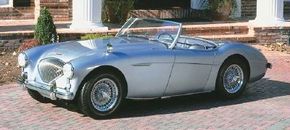
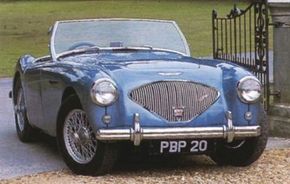
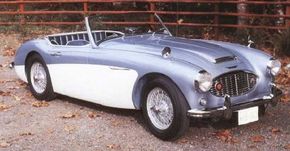
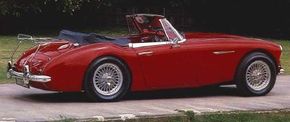
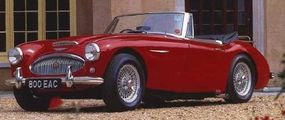
The attractive looks and affordable price of the Austin-Healey sports cars made them popular on both sides of the Atlantic. See more pictures of sports cars.
In 1952, just as Donald Healey began looking for ways to expand his business, Leonard Lord of the British Motor Corporation’s Austin division was searching for a way to spruce up his line. So when Lord saw that Healey’s prototype car at the London Motor Show was based off the Austin A90 design, history -- and the Austin-Healey name -- was born.
In the pages of this article, you’ll learn about the timeless Austin-Healey cars, from the Austin-Healey 100/4 that started it all to the decade-spanning Austin-Healey 3000.
Advertisement
That original A90 prototype eventually became the Austin-Healey 100/4, a clean, sporty car that remained affordable. American enthusiasts were quick to support this lively, attractive machine, firmly establishing Austin-Healey’s reputation.
The natural evolution of the 100/4 -- the Austin-Healey 100 Six -- traded its four-cylinder engine for -- you guessed it -- a powerful straight six. The body was updated without losing any of its character, although it was significantly heavier than the 100/4, and performance suffered for it.
Sports Cars Image Gallery
A few years later, Austin-Healey made up for the 100 Six’s sometimes-sluggish handling with the zippy, frog-eyed Austin-Healey Sprite. A last-minute change in headlight design forced Austin-Healey to apply protruding, bug-like headlamps which, combined with the car’s tiny dimensions, gave it a completely unique look. People loved it. That it was also an agile, responsive, and unbelievably inexpensive car didn’t hurt matters, either, and the Sprite retains a fond place in collectors’ hearts to this day.
Finally, the Austin-Healey 3000 rounded out the line, going through several incarnations in its nine-year run, ending with the Mk III. While all good things must come to an end, you can find out all about these beloved Austin-Healey cars in the following pages. Let's get started on the next page with the Austin-Healey 100/4.
To learn more about Austin-Healeys and other sports cars, see:
The Austin-Healey 100/4 had a standard lay-back windshield, and the sports car's appearance was virtually unchanged through the model run.
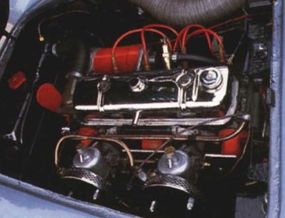
Despite the Austin-Healey 100's performance and handling, the sports car suffered from excess engine heat and limited ground clearance -- two problems caused mostly by a low-riding exhaust system.
Though the four-cylinder Austin-Healey was built for only 3½ years, there were four distinct variations. The original car, built until the autumn of 1955, was coded (and is now colloquially known as) BN1. The following year, it gained a new 4-speed gearbox (still with overdrive) to become the BN2.
Meantime, the Healey company (not BMC) developed and further refined a racing BN1 in 1954-55. Called 100S (S for Sebring), it featured a stripped all-aluminum body sans bumpers and had a much-modified 132-bhp engine. Only 50 were built, all intended (and mostly used) in competition. There were also 1159 examples of the 100M, a BN2 conversion with 110 bhp, duo-tone paint, and assorted body and chassis modifications.
Advertisement
The Healey 100 succeeded in establishing a fine reputation very quickly indeed, especially in the U.S., where enthusiasts found it offered everything a contemporary MG didn’t. In fact, most of the more than 14,000 BN1s and BN2s built were sold in America, making the name Austin-Healey a permanent part of sports-car love and lore.
To learn more about Austin-Healeys and other sports cars, see:
A two-inch wheelbase stretch made room for a tiny seat in the Austin Healey 100 Six.
BMC saw the Austin-Healey as an integral part of their lineup, so when the firm’s engine strategy changed, it was clear that the big sports car would too. It was thus no surprise that the 100/4 became the Austin-Healey 100 Six in 1956. The old A90 four was considered obsolete. In its place was a new straight six of about the same size. But there was much more to the new model than just two extra cylinders and more low-rpm torque, for the Healey family, at BMC’s behest, took the opportunity to freshen up the car end to end.
U.S. market feedback suggested buyers wanted more cabin space than the 100/4 had, so the redesign included a two-inch wheelbase stretch and the repositioning of some components in the tail to make room for the addition of tiny “ + 2” rear bucket seats. These may have been virtually useless for anything except parcels, but they met the demands of the sales force. Styling for the Austin-Healey 100 Six was much the same aside from a new oval grille, fixed windscreen, choice of wire-spoke or steel-disc wheels, and a bulged hood with a small functional air intake at the front.
Advertisement
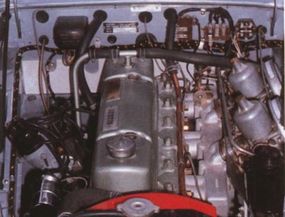
The big difference, of course, was the new six-cylinder engine. This was BMC’s corporate C-Series large-car unit, which had some design similarities -- but few common components -- with the B-Series four used in the MGA sports car. A big, heavy 2.64-liter cast-iron job with overhead valvegear, it was, according to the claimed figures, more powerful than the old big four (102 vs. 90 horsepower). A 4-speed gearbox was standard, as on the ousted BN2, but on the Austin-Healey 100 Six, designated BN4, overdrive was an optional extra.
Alas, the Austin-Healey 100 Six was a disappointment in its first year or so of production. Considerably heavier than the 100/4 (2435 pounds vs. 2150), it not only felt but was less lively. It didn’t seem to handle as well either, and somehow came off as less of a sports car than its predecessors.
Two extra cylinders didn't help the Austin-Healey 100 Six's performance much, as the sports car was heavier than the Austin-Healey 100/4 and felt less lively.
But autumn 1957 brought two important developments. First came a major strategic move as BMC decided to centralize assembly of all its sports cars; this meant that Austin-Healey production moved 50 miles south, from Longbridge to the MG factory at Abingdon. At about the same time (the phase-in point was neither tidy nor exact) there appeared a much-improved engine, with a revised cylinder head and more efficient manifolding that boosted peak power to 117 bhp and afforded a more sporting torque delivery. The difference was perhaps more marked than the figures suggest, for road tests pointed to an 8-mph gain in top speed and acceleration restored to something like BN2 levels.
Then, the two-seater returned as an addition to the line. Designated BN6, it reflected the sort of “second thoughts” backpedalling that would increasingly come to characterize BMC marketing. Moreover, BN4 assembly was suspended for a time, then resumed once existing inventory was cleared (most in the U.S., presumably).
Still, these were exciting years for Austin-Healey, especially once the little “frogeye” Sprite arrived in 1958 to take the marque into high-volume territory for the first time. With two different models in the showrooms, enthusiasts began to refer to the 100 Six (and its successors) as the “Big Healey.”
By that point, the disappointing BN4 had been forgotten, and the reputation and sales of the latest six-cylinder Healeys continued to mount. As in 1953, these were sports cars with great character and style that not only performed well but made all the right noises. They would be a tough act to follow, but BMC thought it could do just that. It did. The Austin-Healey 3000 was at hand.
To learn more about Austin-Healeys and other sports cars, see:
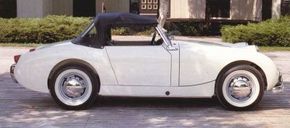
The Austin-Healey Sprite was a tiny two-seat roadster that BMC built to complement the popular MGA.
Few cars have been more adroitly timed -- or more right for their time -- than the original Austin-Healey Sprite, the beloved “Bugeye.” It was conceived to fill an obvious market gap that existed by the time the genuinely small sporting MGs, the Midgets of the 1930s and 1940s, had evolved into the larger, costlier, more modern and “mature” MGA of the 1950s.
BMC chairman Sir Leonard Lord rarely missed a commercial trick, and invited the Healey family to design a small, back-to-basics sports car that would complement, rather than compete with, the popular MGA. As this collaboration had already led to the Austin-Healey 100, which was selling very well in the U.S., Lord was convinced that the new small Healey would have similar success. As it turned out, he was right.
Advertisement
Donald Healey and sons went to work at Warwick, though their creation was finalized by MG at Abingdon and put into production there beginning in mid-1958. The “olde worlde” Berkshire works thus found itself building three different sports cars: the MGA, the Austin-Healey 100 Six, and the new Sprite. BMC delved into its big box of registered trademarks for the model name, which had graced a Riley sports car of the 1930s. (The Nuffield Organisation had acquired Riley in 1938, then joined Austin in 1952 to form BMC.)
Riding an 80-inch wheelbase, the Austin-Healey Sprite was tiny by the standards of its day (and ours, come to that) though larger and heavier than 1930s Midgets. Alfa Romeo and Fiat had already produced unit-construction sports cars (both on shortened mass-market sedan platforms) but the Sprite was the first unitized British sports car. It was, of course, a spare two-seat roadster but, with a 1460-pound curb weight, wasn’t all that light for its size.
The Austin-Healey Sprite did not have an external trunklid; instead, the seats were to be folded down in order to load luggage through the cockpit.
To keep the Austin-Healey Sprite structure as simple and rigid as possible, the Healeys omitted an external trunklid; you loaded luggage through the cockpit by folding down the seats. Front sheetmetal -- hood, fenders, and surrounding panels -- was hinged at the firewall to lift up as a unit, thus providing almost unrestricted access to engine and front suspension. Doors were mere shells (scooped out for storage) to which sliding side curtains could be attached. Per British tradition, the soft top was of the “build-it-yourself” variety, though an optional bolt-on hardtop was offered soon after introduction.
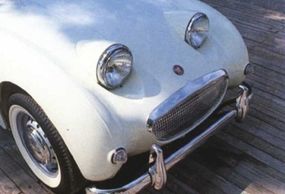
What everybody noticed, of course, was the protruding headlamps that gave the Sprite a “bugeye” or “frogeye” look, hence the nicknames that persist to this day. This appearance distinction was quite accidental. Retractable lights had been contemplated (prototypes had them) but were cancelled at the last minute as too costly (so was a fold-down windshield), by which time it was too late to change the styling.
Cost considerations also dictated off-the-shelf running gear and chassis components, a mixture of items from two small BMC family sedans. The Morris Minor 1000 donated its rack-and-pinion steering, while the Sprite’s 4-speed gearbox, firmed-up front suspension, and venerable BMC A-series four-cylinder engine came from the Austin A35. The last also contributed its rear suspension, with a live axle located by upper radius arms and cantilevered quarter-elliptic leaf springs.
Last-minute cancellation of planned hidden headlamps gave early Austin-Healey Sprites their distinctive "bugeye" or "frogeye" look, nicknames that persist even today.
The result was a cheeky little car with enormous character and joie de vivre. With its rudimentary rear end, the Bugeye could be darty and prone to oversteer, but since the steering was so responsive -- and top speed only 80 mph -- it rarely got away from you.
And because it could be flung about with abandon, the Sprite was perfect for slaloms, gymkhanas, and other competition, and demand from weekend warriors soon prompted all sorts of hop-up and handling goodies from aftermarket sources. Much-modified Sprites, with front disc brakes, heated engines, and smoothed-out bodywork competed gamely but with distinction against far larger and more powerful machines at places like Sebring and Daytona.
Inherent mechanical sturdiness and race-and-ride versatility helped sales, but price was the big factor. At about $1500 new, the Sprite was cheap -- $1000 or so less than an MGA and Triumph TR3 -- and a whale of a buy. Alas, it wouldn’t last long: just three years and near 49,000 units. Its successor, the Sprite Mark II of 1961 (also cloned for a new MG Midget), was much the same car with extra amenities and more conventional, square-rigged styling.
But Len Lord’s bargain-basement roadster had done its job, reestablishing a popular market class while teaching an entire generation what real sports-car motoring was all about. While it’s likely that fewer than half the original Bugeyes survive today, it’s almost possible to build a new one from scratch, so numerous are the reproductions of virtually everything -- mechanical parts, body panels, trim, the works. That “cheap wheels” can inspire such long-lived affection may be surprising, but then, the Bugeye was much more than the sum of its humble parts.
To learn more about Austin-Healeys and other sports cars, see:
The Austin-Healey 3000 was similar to the Austin-Healey 100 Six, though the 3000 had a bigger engine and better brakes.
Though we list the Austin-Healey 3000 as a separate family, it was little more than a 100 Six with a bigger engine and better brakes. It was only in the 1960s that more significant changes came along. Thus, the “Big Healey” formula established in 1956 wasn’t altered conceptually in its 12 years.
From the first 100 Six to the last 3000, these were rugged sports cars with a 92-inch wheelbase and a heavy but reliable engine -- not to mention a hairy-chested, rumbly personality and smooth styling. The Austin-Healey 3000, introduced in the spring of 1959, spanned nearly nine of those dozen years. In that time came Mark II, Convertible, and Mark III models, plus assorted running changes in engine, chassis, gearbox, and body construction. But almost all these developments were logical and improved the basic car. We can also be thankful that they didn’t change its character.
Advertisement
Initially, the Austin-Healey 3000’s main distinctions were an enlarged engine with 2912 cc and 124 horsepower, plus front-disc brakes (drums continued at the rear). These changes mirrored those made that same year to another Abingdon-built sports car, the MG MGA. As before, there were two roadster styles: two-seater BN7 and BT7 2 + 2.
Two years later, BMC announced the 3000 Mk II, for which the engine was given three SU carburetors. Rated output rose to 132 bhp but magazine tests showed no gain in performance, and since the setup was tricky to keep in tune, BMC dropped it a year later. Also during the Mk II run, a new type of gearbox casing and linkage were adopted with a more direct-acting selector mechanism.
At the end of summer 1962, the Mk II became Mk II Convertible, the body getting its first (and only) re-jig. Without changing overall apperance, BMC gave it a slightly more curved windshield, roll-up door windows, and a proper fold-away soft top. The two-seater was discarded and all Austin-Healey 3000s were now 2 +2s. The engine, modified yet again, reverted to twin SU carburetors yet suffered no power loss. All in all, the new Convertible was a more modern and practical package.
Eventually, the two-seater style was thrown out and the Austin-Healey 3000 became a 2+2 Convertible, which was believed to be more modern and practical.
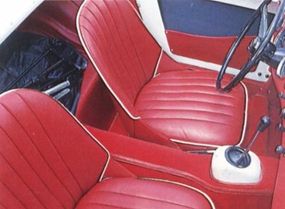
The Big Healey saw one more major revision in the spring of 1964 with the advent of the 3000 Mk III. Boasting even more power -- 148 bhp -- from the same-size engine, it featured a restyled dashboard with wood paneling, and a between-the-seats center console. A “Phase II” version arrived later in the year with modified rear-axle location (now by radius arms) and chassis alterations allowing more suspension travel.
Built at Abingdon from early 1964 to the winter of 1967-68, the Mk III was undoubtedly the best of the breed -- and the fastest: top speed was about 120 mph. Snug and well equipped, it was equally comfortable open and closed.
Of course, not even the most popular cars go on forever, and the Big Healey was beginning to look a bit old-fashioned by the mid-1960s. Even so, no fewer than 5494 Mk IIIs were produced in 1966, the highest one-year tally since 1960, when the original Austin-Healey 3000 was at its sales peak. But by then, BMC faced new U.S. safety and emission regulations and decided that modifying the Big Healey to meet them wasn’t worth the money. Thus, except for a single car assembled in 1968, the Big Healey was consigned to history at the end of 1967.
To learn more about Austin-Healeys and other sports cars, see: