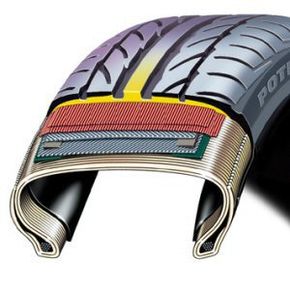
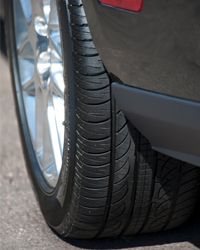
Perhaps the biggest mistake a consumer can make when replacing tires is not using the correct size. On the sidewall of your tire, you'll find a code that tells the tire's size and capabilities. Here's a sample code:
P195/60R16 63H M+S
- P - Type of tire
- 195 - Width of the tire across the tread in millimeters
- 60 - Aspect ratio of the sidewall compared to the width
- R - Radial construction
- 16 - Diameter of the rim in inches
- 63 - Tire's load rating
- H - Tire's speed rating
- M+S - Tire is suitable for all-season driving
If the tire-size code starts with LT instead of P, it means the tire is a light-truck tire. Light-truck tires are designed to have higher-load carrying capacities and are usually found on pickups and SUVs. These vehicles are not required to have LT tires, and in many cases, the original-equipment specification calls for passenger-car tires.
The speed rating translates into the tire's ability to dissipate heat, or prevent heat build-up. Heat is a tire's enemy. The more heat, the faster the tire wears, and the faster a tire might break down. A tire with a higher speed rating can dissipate more heat on long highway trips. If a consumer were to spend little time on the highway, the speed rating might not be an important factor in choosing a replacement tire.
Tires are speed rated from 99 to 186 miles per hour (159.3 to 299.3 kilometers per hour). The most common speed ratings are T (118 miles per hour or 189.9 kilometers per hour) and H (130 miles per hour or 209.2 kilometers per hour). Both of those ratings clearly exceed the nationally posted speed limits and would make excellent long-distance highway tires. If a consumer were to drive only in urban situations at low speeds, a tire with an S (112 miles per hour or 180.2 kilometers per hour) speed rating might be completely acceptable.
Another important factor in choosing a replacement tire is the load rating. The load capacity number on the tire-size code indicates the load-carrying capacity of that single tire. When selecting replacement tires, consumers have to be careful not to select a tire with a lower load-carrying capacity.
Regardless of a tire's speed rating, load-carrying ability, size and construction, traction are the keys to safety. A common mistake is to select a tire without considering its ability to hold the road. Savvy consumers will balance a tire's traction in dry conditions, in wet conditions and in the snow. If you desire a high-performance tire but live in northern climates, consider a "winter" tire for driving in the snowy season. If you live where the weather is warm all year, a touring tire may suit your needs just fine.
Most consumers will make the mistake of waiting until spring to get new tires. As a tire wears out, dry traction generally increases and wet and snow traction decrease. So the best time to buy new tires is not in the spring, but in the fall.
Passenger-car and light-truck tires are very different. Pickup and SUV owners will generally select passenger-car tires because they are less costly and offer a smoother ride. However, if a vehicle will consistently be loaded with cargo or will be asked to pull a heavy trailer, then perhaps the higher load-carrying capacity of a light-truck tire would be the better choice.
Go on to the next page to learn where to buy your new tires.