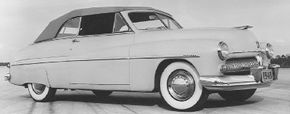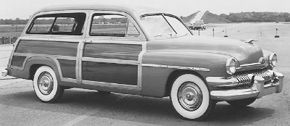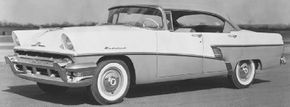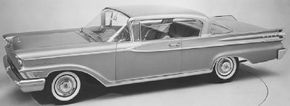
Mercury was conceived largely by Edsel Ford, who saw a place for it in the Ford Motor Company lineup some time before his father Henry did. It arrived for 1939 in the same price league as the Pontiac Eight but somewhat below Oldsmobile -- precisely where Edsel wanted it and Dearborn needed it.
While Mercury would take many years to approach those GM makes in volume, it was successful from the start. Production averaged about 80,000 per year in the early '40s, good for 12th or 13th in the industry, thus winning important new business for Dearborn by filling the huge price gap between Ford and the Lincoln Zephyr.
Advertisement
The original Mercury engine would remain in production through 1948. A 239-cid L-head V-8, it was a slightly larger version of the Ford "V-8/85," having the same stroke but a larger bore. Brake horsepower was 95 through 1941, then 100.
Mercury quickly gained a reputation for performance appropriate to its name (after the winged messenger god in Greek mythology). Well-tuned stock models were quicker than V-8 Fords, and were usually capable of turning close to 100 mph.
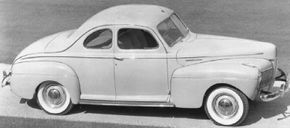
Mercury bowed on a 116-inch wheelbase, four inches longer than the '39 Ford's and sufficient to give its similar styling a "more-important" look. A dashboard with strip-type instruments was also like Ford's, but Mercury's column-mounted gearshift was a talking point at the time. Styling for 1939-40 featured a crisply pointed "prow," beautifully curved fenders, and rounded body lines.
Initial offerings comprised two- and four-door "beetleback" sedans, a notchback sedan coupe, and a convertible coupe spanning a price range of $916-$1018. A $1212 convertible sedan was added for 1940, that year's heaviest and most-expensive Mercury. But four-door ragtops had waned in popularity, so this one was dropped for 1941. Only about 1150 were built.
Models expanded to seven for '41 with a two/four-passenger coupe, business coupe, and wood-bodied station wagon. Styling, again in the Ford mold, was chunkier and less graceful despite a two-inch longer wheelbase; with higher, bulkier fenders; a divider-bar grille; and fender-top parking lights.
Mercury tried harder for 1942 with a serious facelift, the aforementioned 100-bhp engine, and a new extra-cost semiautomatic transmission called "Liquamatic." The last proved very troublesome, though, and was quickly canceled. America's entry into World War II limited model-year production to fewer than 23,000 units. Chrome was "in," at least before the government diverted it to war use.
All '42 Mercs wore a broad, glittery two-section horizontal-bar grille, double chrome bands on each fender, and a bright full-perimeter molding at the beltline. Parking lights shifted inboard to flank a still-pointy hood. The general effect was busier than '41, which had been busier than 1940. Like other '42s, the mostly chromeless, late-production "blackout" Mercurys are now prized by collectors.
Before war's end, Henry Ford II, Edsel's son and old Henry's grandson, returned from the Navy to run Ford Motor Company. Edsel had died in 1943 of complications due to stomach cancer. Old Henry would live until 1947. HF II quickly resumed civilian production, and Mercury placed 10th in the 1946 industry race with about 86,600 units.
As Dearborn delayed its first all-new postwar models to 1949, interim Mercurys were similar to the '42 editions. The inboard parking lights and two-band fender moldings remained, but the hood was blunted above a new vertical-bar grille carrying a large "Mercury Eight" nameplate. Mechanicals were unchanged except the fact that Liquamatic didn't return. Ford's adoption of the 239 V-8 for 1946 was hardly to Mercury's advantage.
Advertisement