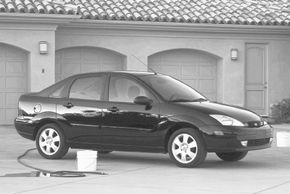
Focus bowed with two-door hatchback, four-door sedan, and four-door wagon body styles, each aimed at a specific audience. The hatchback played both entry-level and sporty roles, offering the widest range of options. The more conventionally styled sedan and wagon emphasized value, practicality, comfort, even luxury with the right options. A hatchback four-door joined the mix for 2002 for even broader market coverage.
To Ford's undoubted delight, the Focus was a critical success most everywhere, winning awards in Europe and the 2000 North American Car of the Year trophy. Consumer Guide® gave its "Best Buy" endorsement to the 2001-04 models. The honor was rather remarkable considering that Focus was fending off new import competition with only evolutionary changes, mainly a confusing parade of model names and equipment shuffles.
A notable exception was the SVT Focus, arriving for 2002 as a two-door hatchback pitched toward the fast-growing "sport compact" market. A companion four-door hatch was added for '03.
Like other SVT efforts, the "factory tuner" Focus delivered numerous upgrades at a surprisingly modest price, initially $17,480. The twincam Zetec engine, for example, was lifted to 170 bhp via new pistons, revised cylinder head, variable intake-valve timing, and new intake and exhaust manifolds. Also on the menu were a mandatory new six-speed manual gearbox, firm suspension with 17-inch wheels, and larger four-wheel disc brakes.
Other Focuses offered ABS, electronic traction control, and front side airbags at extra cost, but these were standard for the SVT. So were unique front and rear fascias, side sills, and a rear spoiler, all de rigueur for a "hot hatch." Inside were special SVT gauge graphics and two extra gauges, leather/cloth seats with heavier front bolstering, aluminum pedal caps and shift knob, and a leather-wrapped steering wheel.
Enthusiasts loved it, but the SVT Focus wouldn't be around long, departing after 2004. One reason was that Ford needed to freshen its small car to maintain buyer interest. The result was a refocused 2005 lineup with more orthodox styling inside and out, plus more competitive "value" pricing.
The sportiest of the lot was a new ZX4 ST sedan, which was no SVT but had significance for its standard engine: a new 2.3-liter twincam four-cylinder that rated Partial Zero Emissions Vehicle status (PZEV) under the ultratight emissions limits of California and four northeastern states.
Available for other Focus models in those five areas, the PZEV four was about as clean as a gasoline engine could be with existing technology -- not far behind the gasoline/electric powertrains earning headlines, goodwill, and profits for Toyota and Honda.
Even better, a PZEV Focus cost far less than a Toyota Prius or Honda Civic Hybrid, was much simpler and easier to maintain, and possessed noticeably more low-end torque that improved acceleration, especially with automatic transmission. It was quite a coup, yet went all but unnoticed amid Dearborn's deteriorating fortunes.
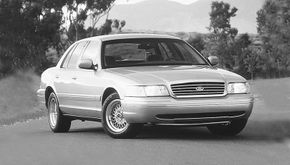
The big Crown Victoria was all but invisible long before the crisis took hold, a relic of much happier times for Ford and all of Detroit. Taxi and law-enforcement fleets were its main buyers as the century turned, sister Mercury Grand Marquis having taken the lead in retail sales.
Still, Ford could afford to keep the "Vicky" around and even splurge for occasional changes: a Grand Marquis-like restyle for 1998, standard horsepower bumped to 220 for 2002, and a few new features along the way.
Calendar-year sales were down to the high 70,000s by '02, when Ford tried adding a little youth tonic with an LX Sport model. This offered a nostalgic buckets-and-console interior with floorshifter, a dual-exhaust V-8 pumped up to 235 bhp, and the firmer-handling suspension available for the mom-and-pop LX.
Extensive revisions occurred for 2003, perhaps because that was Ford's centennial year. A redesigned frame, altered suspension geometry, and a switch from recirculating-ball to rack-and-pinion steering all aimed to improve ride and handling, which they did -- a little. No-cost antilock brakes were laudable, as was first-time availability of front side airbags except on the price-leading Standard.
Though stickers had inevitably risen over time, the Crown Vic still offered a lot of good old-fashioned American metal for the money at around $24,000-$30,000. But old-fashioned it was, and sales continued trailing off toward oblivion, falling below 64,000 for calendar '05.
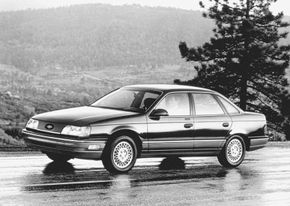
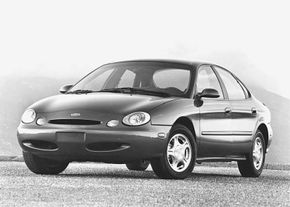
Taurus, too, seemed increasingly passé as the new century progressed, the basic 1995 design being left to soldier on while the Honda Accord and Toyota Camry enticed buyers with three clean-sheet makeovers. Such intense competition and a more knowledgeable public made "new or die" imperative even in the family car field, yet Ford had staked its future more on new trucks than new cars.
Not that Taurus was entirely neglected. A 2000-model restyle, much of it patterned on the less radical Mercury Sable, aimed at wider public acceptance, as did a new, more user-friendly dashboard. Airbags and seatbelt pretensioners were improved in line with growing buyer demand for safety features. (Who could have imagined that back in 1956?) But the interesting SHO was canceled for lack of interest, and other Tauruses changed hardly at all over the next six seasons.
Given that, calendar-year sales were remarkably good, running in the low 100,000s through 2002, then jumping past 200,000 in 2003-04. Still, one suspects most of these cars went to fleets and skinflint consumers, and then only with heavy "cash on the hood."
Taurus was supposed to depart after 2005, when just two varieties of sedan and wagon appeared as a transition to all-new replacements. Yet such was the uncertainty in Dearborn that planners allowed Taurus to hang on through 2006, reduced to just a pair of sedans with the old pushrod V-6.