Hydrogen Power

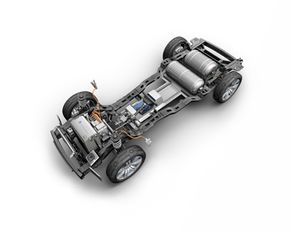
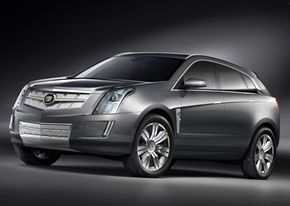
The Cadillac Provoq is powered by a hydrogen fuel cell that sits under the hood, right where you'd find the engine in a typical car. Inside the fuel cell is the stack -- a sandwich of anodes, cathodes and other high-tech materials -- that enables a chemical reaction to give the Provoq its power. At the back end of the vehicle, below the cargo floor, two storage tanks hold 13.2 pounds (5.99 Kg) of hydrogen gas at 10,000 psi. The hydrogen is fed to the fuel cell and mixed with oxygen, which is drawn from the air, pressurized and humidified. The fuel cell can constantly crank out 88 kW of power, which is equal to about
118 horsepower.

The E-flex chassis.
© GM Corp.
The Cadillac Provoq's E-Flex chassis

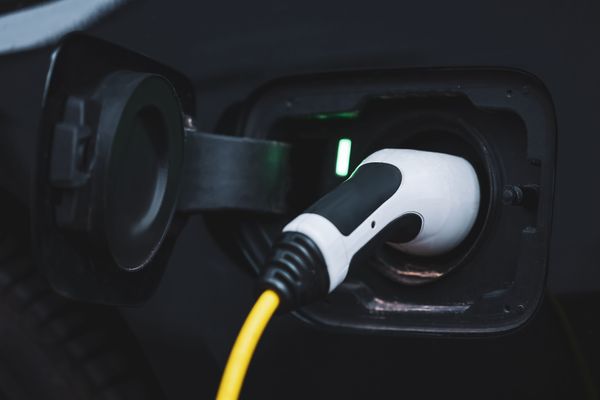
Running along the center of the chassis, beneath the floor of the vehicle, is a series of lithium-ion batteries. These batteries can be charged by plugging the Provoq into an electrical outlet through either of the front fender ports. The battery power can be used to extend the Provoq's range, or it can give the motors a little extra juice if they need to accelerate quickly. The batteries store a maximum of 9 kWh of energy and can generate a peak of 60 kW (80.5 horsepower) for a power boost.

The Provoq is an all-wheel-drive vehicle, giving it stability and traction in a wide range of conditions; however, it doesn't work like most other all-wheel drive vehicles. Instead of a transmission that sends the engine's power to each wheel, the Provoq makes use of three separate drive motors. One motor provides drive for both front wheels at 70 kW (93.9 horsepower). Each rear wheel has its own hub motor, providing 40 kW (53.6 horsepower) of driving force. With that power, the Provoq posts a 0 to 60 mph time of 8.5 seconds and has a top speed of 100 mph. At first, that may seem unimpressive compared to the muscle-bound concept cars of recent years, but they're good numbers for a fuel cell vehicle. Also, electric motors are able to deliver strong, instant torque to the wheels, which makes for very responsive acceleration.

Making Fuel Cells Happen
Hydrogen fuel cell technology has been touted for years as a major automotive breakthrough, but we still don't have fuel cell-driven cars available at the local dealer. A fuel cell mixes hydrogen and oxygen in a chemical reaction that creates an electric current, which drives an electric motor. The exhaust given off by a fuel cell vehicle is water. They're much cleaner than internal combustion engines and they don't rely on gasoline for fuel. What's not to love? For one thing, the total lack of an infrastructure to support a hydrogen economy. A fuel cell is great, unless you have nowhere to fill up your hydrogen tanks. GM is playing wait-and-see when it comes to production cars using fuel cells -- they have tentative plans to sell limited numbers of the fuel cell equipped Equinox in 2010, but only in U.S. cities that build enough hydrogen refueling stations to support it [source: Popular Science].

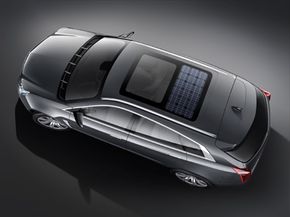
Just how environmentally responsible is the Cadillac Provoq? Does the eco-friendly part of this concept start and stop with the fuel cell? What other green features does the Provoq offer potential owners? Find out on the next page.