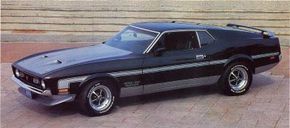
Ford's reign of "Total Performance" was rapidly drawing to a close, but something was still kicking in its muscle car stall: the 1971 Ford Mustang Boss 351.

Muscle Car Image Gallery

Styling on the 1971 Mustang Boss 351 was influenced by Shelby models.
©2007 Publications International, Ltd.
Styling on the 1971 Ford Mustang Boss 351 was influenced by Shelby models. See more muscle car pictures.

Based on the redesigned Mustang SportsRoof, the new Boss was built to qualify a Trans-Am counterpart, a purpose rendered moot by Ford's late-1970 retirement from most forms of organized racing. The upside was that the Boss 351 was probably the only 1971 performance car with a genuine competition-grade engine.

Unfortunately, it had to saddle up the biggest Mustang ever. Wheelbase for the 1971 Ford Mustang Boss 351 was up one inch, and the car gained 2.1 inches in overall length, 2.8 inches in width, and put on about 100 pounds. Its styling was influenced by the last of the Shelby models, which didn't survive into '71. That left the Mach 1 and Boss 351 as Mustang's similarly styled performance flag bearers.
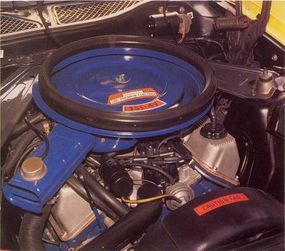
The Boss was the only model to use this 351-cubic-inch V-8, which produced 330 horsepower.
©2007 Publications International, Ltd.
This muscle car had real muscle: The Boss engine
was geared toward competition.

Mach 1's top engine was the 429-cid Super Cobra Jet Ram Air. Its credentials were strong -- 11.3:1 compression, 375 bhp, 450 lb-ft of torque -- but its low-14 second ETs were slower than those of the Boss 351. The Boss had on its side less weight and exclusive use of a thoroughbred 351-cid V-8 that Car and Driver said made the "Z/28 look like a gas mileage motor."

Its rods were shotpeened and Magnafluxed and its heads, drawn from the Boss 302, had staggered valves and huge ports. It had a radical, solid-lifter cam, 11.0:1 compression, a 750-cfm four-barrel, and an honest 330 bhp. Ram-air induction, a Hurst-shifted four-speed, and a 3.91:1 Traction-Lok diff were standard.
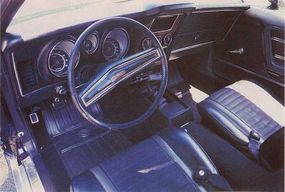
Unfortunately, the cabin was uncomfortable and the gauges difficult to read in the Boss.
©2007 Publications International, Ltd.
With its low seating, unfriendly ergonomics, and vision-imeding
sheetmetal, the 1971 Ford Mustang Boss 351 felt ponderous.

The engine, remarkably tame on the street and a dervish on the track, teamed with a "competition" suspension that used F60Xl5 tires. Ultimate cornering power was high, but the car was ponderous and nowhere near as balanced as a Firebird Trans Am. Moreover, the cave-like cabin was frustratingly difficult to see out of, the ride was harsh, and the gauges and controls were poorly designed.

Mustang had gone from quarter horse to Clydesdale and its best version, Boss 351, lasted just one season. It was a fitting finish to Total Performance.

The 1971 Ford Mustang Boss 351
Specifications
Wheelbase, inches: 109.0
Weight, lbs: 3,281
Number built: 1,806
Base price: $4,124

Top Available Engine
Type: ohv V-8
Displacement, cid: 351
Fuel system: 1 x 4bbl.
Compression ratio: 11.0:1
Horsepower @ rpm: 330 @ 5400
Torque @ rpm: 370 @ 4000

Representative Performance
0-60 mph, sec: 5.8
1/4 mile, sec. @ mph: 13.9 @ 102

Return to Classic Muscle Cars Library.

For more cool information on muscle cars, go to:
  • Some of the best all-around performance machines of the day were Ford muscle cars. See profiles, photos, and specifications of Ford muscle cars.
  • Muscle cars came in many shapes and sizes. Here are features on more than 100 muscle cars, including photos and specifications for each model.
  • Muscle cars created their own culture. To learn about it, read How Muscle Cars Work.

  • Are you thinking of buying a 2007 muscle car, or any other car? See Consumer Guide Automotive's New-Car Reviews, Prices, and Information.

Check out these profiles of muscle cars, which include photos and specifications for each model:

For even more on fantastic Fords and magnificent Mustangs, see:
  • Saddle up for the complete story of America's best-loved sporty car. How the Ford Mustang Works chronicles the legend from its inception in the early 1960s to today's all-new Mustang.
  • The 1971, 1972, 1973 Ford Mustang offered high style and -- with the right options -- great performance.
  • Learn the history of the Ford Explorer, the world's best-selling SUV. Included are profiles of every model year.