
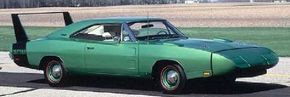
Detroit's 1960s mantra, "Win on Sunday, Sell on Monday," was most relevant in NASCAR racing, but that didn't prevent it from helping create some of the wildest muscle cars ever. The 1969 Dodge Charger 500 and Daytona were examples of superspeedway-inspired special editions that became legendary muscle cars.
Dodge's '68 Charger was an aerodynamic washout on 190-mph high-banked ovals. To reduce drag, Mopar engineers plugged the nose cavity with a flush-mounted Coronet grille. They quelled lift by flush-mounting a rear window over the recessed backlight. The new racer was called the Charger 500, and 392 similarly modified production cars were built to qualify it for NASCAR. They were basically Charger R/Ts with Charger 500 metalwork.
Advertisement
Racing Charger 500s captured 18 NASCAR victories in '69. Trouble was, Ford's droop-nosed aero warriors won 30. Back to the wind tunnel went Mopar engineers. They emerged with the Charger Daytona. Instead of a flush nose, it wore a pointed 18-inch extension that reduced drag and enhanced downforce. It retained the Charger 500's flush back-light, but eliminated rear-end lift by mounting a horizontal tail stabilizer on tall vertical extensions. Again, street-going versions had to be built and approximately 505 were. Except for the wild nose and tail, they were essentially 1969-model Charger R/Ts.
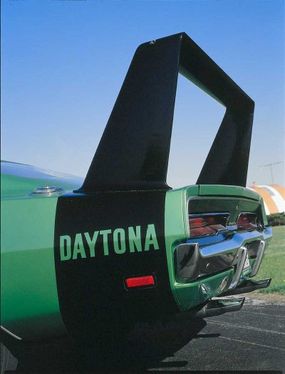
The Daytona debuted during the '69 NASCAR season and was faster than the Charger 500, but it came too late to beat Ford. It returned for the '70 season accompanied by the Superbird, a similar Plymouth design based on the Road Runner. Together they recaptured for Chrysler the NASCAR championship. (Plymouth built around 1920 roadgoing Superbirds as 1970 models.)
Competition editions of all three cars used 426-cid race Hemis. Customer versions had either the 440 or the Hemi. Charger 500s were as quick as like-powered '69 Chargers, but the winged cars weighed as much as 300 pounds more than regular Chargers and Road Runners. Acceleration and handling were correspondingly affected, but their real impact was as the muscle car taken to its magnificent extreme.
Return to Classic Muscle Cars Library.
Advertisement